




01. Edit your form online
Type text, add images, blackout confidential details, add comments, highlights and more.

Type text, add images, blackout confidential details, add comments, highlights and more.

Draw your signature, type it, upload its image, or use your mobile device as a signature pad.

Send it via email, link, or fax. You can also download it, export it or print it out.
In Nebraska, the Advanced Practice Registered Nurse (APRN) credential is regulated by the Department of Health and Human Services. This designation signifies that a nurse has achieved an advanced level of education and clinical competency. As an APRN in Nebraska, professionals are licensed to practice with a degree of autonomy, often taking on responsibilities that include diagnosing and managing patient care, prescribing medications, and providing primary and specialty healthcare services. The recognition of the APRN role underscores the commitment to high standards of nursing practice and patient care.
To qualify for the APRN designation in Nebraska, candidates must satisfy several eligibility requirements. These include maintaining an active Registered Nurse (RN) license in Nebraska or another state that is part of the Nurse Licensure Compact. Applicants must also have completed a graduate-level APRN program, accredited by a national nursing accrediting body recognized by the United States Department of Education. National certification in an APRN role and population focus is mandatory, and candidates should provide evidence of requisite clinical practice hours. Meeting these standards ensures that the applicant possesses the necessary education, skills, and professionalism to perform as an APRN.


The application for the APRN license requires comprehensive documentation. Key documents include proof of age and U.S. citizenship or lawful immigration status. Applicants must submit official academic transcripts from their APRN program. Additional required documentation includes a copy of the RN license, national certification, and a criminal background check clearance. Ensuring that all required documents are current and complete is pivotal in avoiding delays in the application process.
Prepare Documentation: Gather all necessary documents, including proof of education, national certification, and RN licensure.
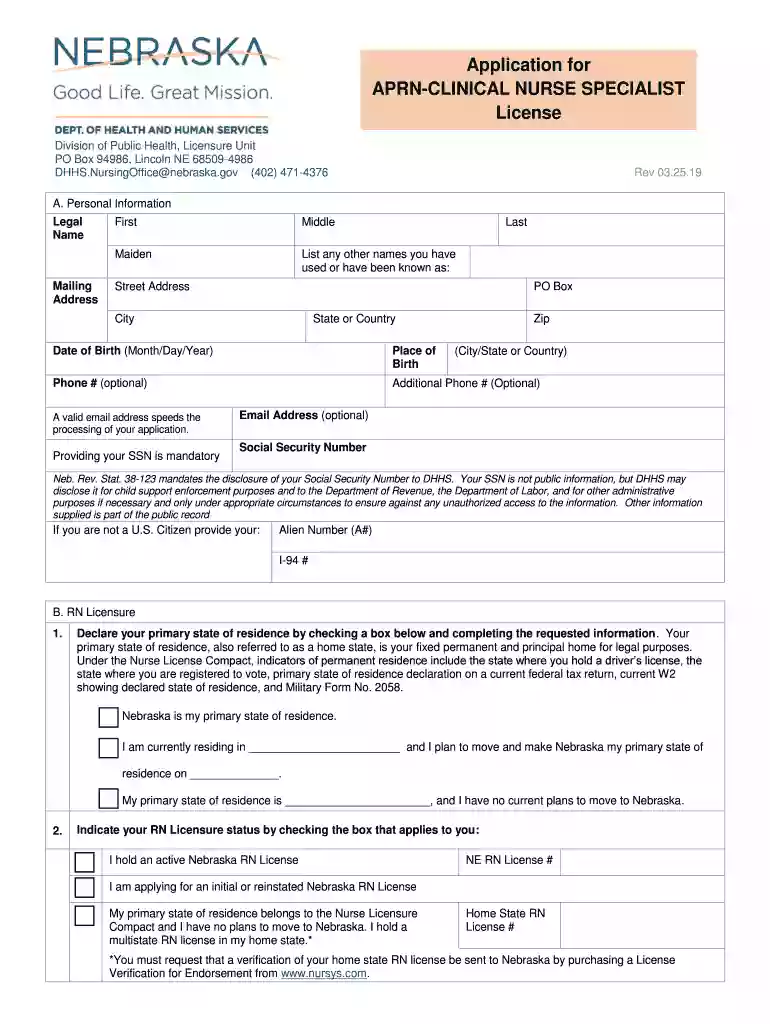
Complete Application: Fill out the APRN application form provided by the Nebraska Department of Health and Human Services. Ensure accuracy and completeness.
Fingerprinting and Background Check: Submit fingerprints for a criminal background check. This step is essential to confirm the candidate's eligibility from a legal standpoint.
Submit Application and Fees: Send the completed application along with the application fee to the Nebraska Department of Health and Human Services. Fees may vary based on the timing of application submission.
Track Application Status: Monitor the application status through the department's online portal or contact the office for updates.
The complete application process spans several weeks, depending on the accuracy of submitted materials and the efficiency of background checks. Typically, after receipt of all required documents and fees, including a successful background check, the approval process for an APRN license may take from a few weeks to several months. Applicants can expedite the process by ensuring that all application elements are thoroughly prepared and submitted on time.
Holding an APRN license in Nebraska allows healthcare professionals to provide advanced care, including conducting assessments, managing therapies, and prescribing medications, within the scope of their training and expertise. Adherence to state and federal regulations governing nursing practice is mandatory. In particular, APRNs must always act within the legal scope defined by the Nebraska Nurse Practice Act, ensuring that patient care is both ethical and compliant with established laws.
Nebraska has unique stipulations that govern the practice of APRNs. These include specific regulations concerning collaborative agreements with physicians for certain services and the maintenance of professional conduct. State law mandates continuing education requirements to ensure APRNs remain current with new healthcare advances. Understanding these state-specific rules is crucial for practicing legally and safely in Nebraska.
In practice, APRNs in Nebraska operate across various settings, including hospitals, clinics, and private practices. For instance, an APRN specializing in pediatrics could manage a child’s healthcare routine, from diagnosis to the development of a treatment plan. In rural or underserved areas, APRNs often play pivotal roles in providing accessible healthcare, empowering communities with better health management, preventive care, and educational outreach.
The Nebraska Department of Health and Human Services offers both digital and paper processes for APRN applications. Digital submissions provide a more streamlined process with faster feedback, leveraging email notifications and online tracking for application status. In contrast, paper versions may demand more time due to traditional mail and manual processing. Regardless of method, accuracy and completeness are pivotal.
Understanding terminologies specific to the APRN role aids in effective communication and practice. These include terms like “scope of practice,” referring to the legal rights and permissions accorded to APRNs. “Collaborative practice agreement” is another pivotal term, representing the written agreement between an APRN and a supervising physician in specific practice areas. Familiarity with these terms is beneficial for clarity and compliance in professional settings.
By comprehensively understanding the various facets of the APRN process within Nebraska, nurses can ensure they navigate the system accurately and effectively, facilitating their journey towards advanced practice and contributing positively to healthcare delivery.
We've got more versions of the APRN - Nebraska Department of Health and Human Services form. Select the right APRN - Nebraska Department of Health and Human Services version from the list and start editing it straight away!
At DocHub, your data security is our priority. We follow HIPAA, SOC2, GDPR, and other standards, so you can work on your documents with confidence.
Georgia and South Carolina residents with a valid Nebraska RN license or an eNLC license can apply for APRN licensure in Nebraska upon graduation, but studentsRead more
An APRN is a registered nurse (RN) with a masters or doctoral degree and national board certification to qualify for licensure. Advanced Practice Registered


