
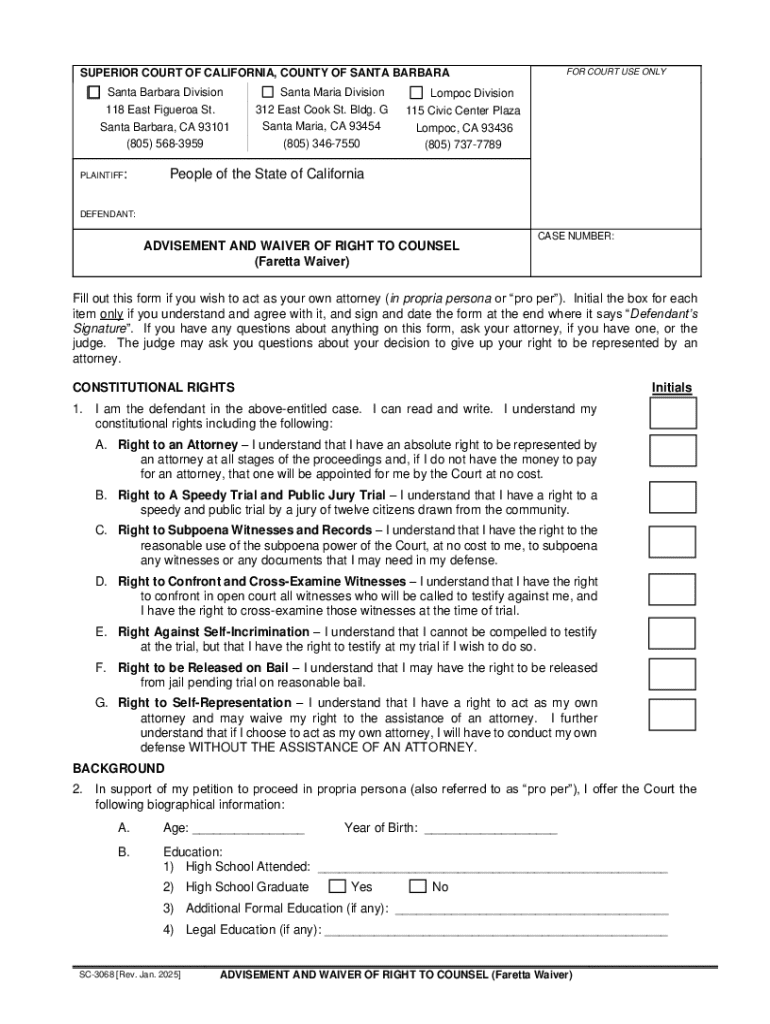







Definition and Meaning of the Advisement and Waiver of Right to Counsel (Faretta Waiver)
The "Advisement and Waiver of Right to Counsel" form, commonly known as the Faretta Waiver, is a legal document used in the United States judicial system. This form allows a defendant to voluntarily waive their right to legal representation and choose to represent themselves in court. The waiver is derived from the Faretta v. California case, where the U.S. Supreme Court ruled that defendants have a constitutional right to self-representation. The form requires defendants to acknowledge that they understand the risks of self-representation, including the complexity of legal proceedings and potential impact on their defense.
Key Elements of the Faretta Waiver
Understanding the components of the Faretta Waiver is crucial for any defendant considering self-representation.
- Acknowledgment of Rights: Defendants must confirm their understanding of the constitutional right to have an attorney.
- Risks of Self-Representation: The form outlines potential disadvantages of not having professional legal help.
- Court Order: A judge's confirmation is needed to validate the waiver, ensuring the defendant is competent and voluntarily waiving the right.
- Interpreter's Statement: If necessary, an interpreter can be involved to ensure the defendant comprehends all aspects of the waiver.
- Personal Information: Defendants must provide their personal information for identification and legal purposes.
Steps to Complete the Faretta Waiver
Filling out the Faretta Waiver involves several important steps to ensure all legal obligations are met.
- Review the Form Thoroughly: Understand each section, especially the implications of self-representation.
- Provide Personal Details: Include accurate personal information, such as name and case number.
- Read the Advisement of Rights: Ensure full comprehension of the rights being waived.
- Acknowledge Risks and Implications: Initial next to sections detailing the disadvantages of self-representation.
- Sign and Date the Form: Provide signature and date, noting that the waiver is voluntary.
- Submit the Form: Submit the completed form to the court for a judge's review and approval.
Important Terms Related to the Faretta Waiver
Understanding certain legal terms can help in navigating the Faretta Waiver more effectively.
- Pro Se: A Latin term meaning "for oneself," it refers to individuals representing themselves in legal proceedings.
- Competency: Refers to a defendant's mental and emotional capability to waive their right to counsel.
- Constitutional Rights: Legal protections provided under the U.S. Constitution, including the right to an attorney.
Legal Use of the Faretta Waiver
The Faretta Waiver holds significant legal implications and is governed by strict requirements.
- Competency Evaluation: Judges must ensure defendants are competent to waive their right, which might involve a psychological evaluation.
- Voluntary Decision: The decision to waive counsel must be made freely and without coercion.
- Informed Choice: Defendants must have a clear understanding of the complexities involved in representing themselves.
Examples of Using the Faretta Waiver
Exploring real-world scenarios helps in grasping the practical application of the Faretta Waiver.
- Criminal Cases: Defendants may choose self-representation in criminal trials if they believe they can mount a suitable defense independently.
- Appeals: Some individuals opt to represent themselves in appeals if dissatisfied with previous legal counsel.
- Minor Legal Issues: For simpler cases, like misdemeanors, some individuals prefer to speak on their own behalf.
State-Specific Rules for the Faretta Waiver
The application of the Faretta Waiver can vary by state, affecting how it is implemented.
- California: Strict guidelines on competency evaluation and advisement of risks.
- New York: Additional requirements for documenting the waiver process on the court record.
- Texas: Emphasis on voluntary and informed waiver, with more frequent use of interpreter services.
Software Compatibility with Document Platforms
For those managing court documents digitally, understanding software compatibility is beneficial.
- DocHub: Allows importing and editing of Faretta Waivers, supporting formats like PDF, DOC, and more on various devices.
- Integration with Google Workspace: Facilitates automatic saving and retrieval of documents from Google Drive.
- Security Features: 256-bit SSL encryption protects sensitive legal documents.
Eligibility Criteria for Using the Faretta Waiver
Not every defendant is eligible to represent themselves. Specific criteria must be met.
- Competency: Only defendants of sound mind qualify to waive their right to legal counsel.
- Clear Understanding: Must demonstrate comprehension of potential consequences of self-representation.
- Voluntary Waiver: The choice should be free and informed, without outside pressure or coercion.


Who Typically Uses the Faretta Waiver
Certain defendants are more likely to consider waiving their right to counsel.
- Experienced Litigants: Those with prior legal knowledge may feel confident without an attorney.
- Defendants with Trust Issues: Some prefer self-representation due to distrust of the legal system or dissatisfaction with attorneys.
- Individuals with Specific Expertise: Defendants with relevant legal experience or knowledge.

State-by-State Differences in Faretta Waiver Use
While fundamentally similar, the Faretta Waiver can vary in its application across states, reflecting differences in process, documentation, and judicial discretion.
- Forms and Documentation: Some states require additional forms for record-keeping and procedural verification.
- Judicial Discretion: Discretion in determining a defendant's competency can vary, affecting who can proceed pro se.
- Resource Availability: The availability of supplemental guides or legal resources for pro se defendants can differ.
By following these detailed instructions, understanding relevant legal terms, and considering state-specific rules, defendants can better evaluate and execute a Faretta Waiver when contemplating self-representation.




