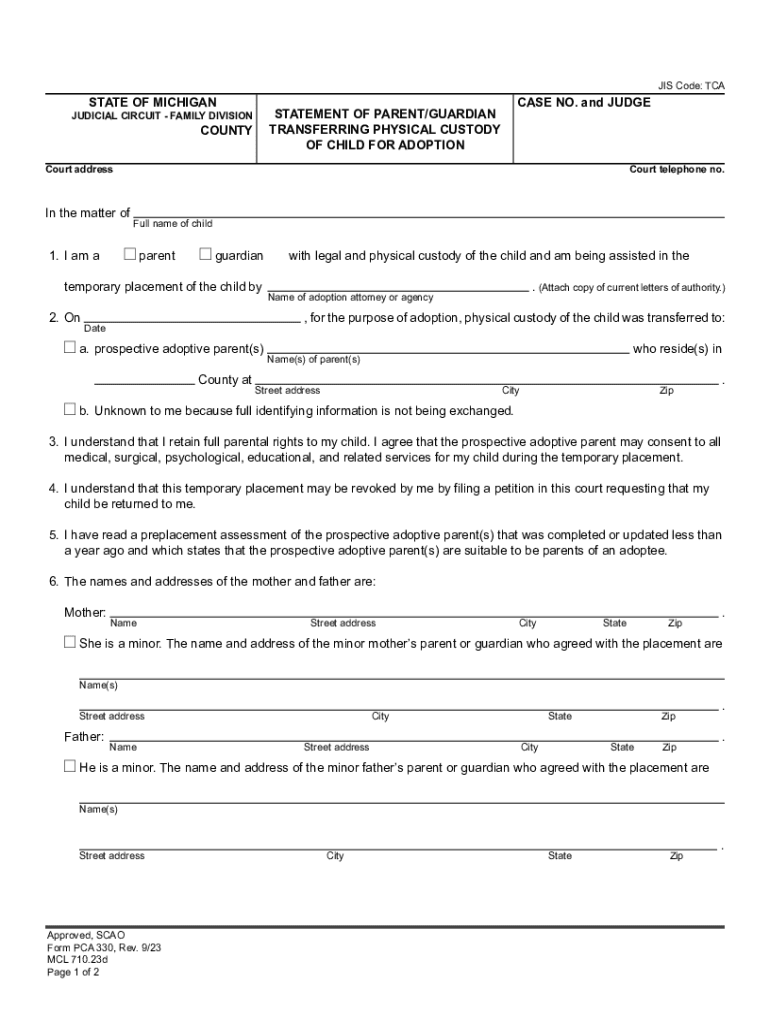







Definition and Meaning of PCA 330
The PCA 330, Statement of Parent Guardian, Transferring Physical Custody of Child for Adoption, is a legal document used in Michigan to temporarily transfer physical custody of a child to prospective adoptive parents while retaining parental rights. This form facilitates the child’s placement for adoption and includes provisions related to medical consent, revocation of placement, and other essential elements necessary for effective legal and practical arrangements. The form requires signatures from the parent or guardian, witnesses, and possibly other involved parties to ensure the custody transfer is legally recognized.
How to Use the PCA 330
To effectively use the PCA 330, one must comprehend its purpose and the necessary steps to ensure all conditions are met for a smooth transfer process. The form outlines specific sections where parental rights and responsibilities are retained even though physical custody is shifted. Individuals should focus on sections such as:
- Identifying details of the child and prospective adoptive parents
- Signatures from all relevant parties, including legal witnesses
- Medical consent provisions allowing decisions on the child’s behalf
This understanding allows for the form’s utility to be maximized in ensuring a legally sound adoption process.
How to Obtain the PCA 330
Acquiring the PCA 330 form typically involves contacting Michigan's relevant legal entities or accessing online resources. Prospective users can do so via:
- Visiting the Michigan Department of Health and Human Services (MDHHS) website.
- Requesting the form through legal representatives, especially lawyers specializing in family law and adoption.
- Inquiring at local courts where family cases, including adoptions, are processed.
Ensuring access to the correct version of the form is crucial for compliance with Michigan legal requirements.
Steps to Complete the PCA 330
Completing the PCA 330 requires meticulous attention to detail due to its legal nature. Follow these steps to ensure accuracy:
- Fill in the child’s and prospective parents’ personal information accurately.
- Specify the terms of custody transfer, including temporary provisions and parental right retention.
- Address details regarding medical consent, outlining who can make medical decisions for the child.
- Ensure all required signatures are obtained, representing parental consent and witness acknowledgment.
- Verify that the completed form aligns with Michigan’s legal stipulations on adoption procedures.
Completing this process carefully verifies that all legal obligations are satisfied.
Key Elements of the PCA 330
Understanding the key components of the PCA 330 form enhances its effective utilization. Essential elements include:
- Child’s Identifiers: Includes the name, date of birth, and other identifying details.
- Prospective Adoptive Parents: Information detailing the adoptive family's credentials.
- Parental Rights: Explicit mention of rights retained by biological parents during the process.
- Medical Consent: Who will be responsible for making health decisions for the child.
- Revocation Terms: Conditions under which the placement can be revoked.
These elements ensure all parties are clear about their rights and responsibilities under the temporary custody arrangement.
Legal Use of the PCA 330
The PCA 330 is legally binding in Michigan and serves to protect the rights of the child, biological parents, and adoptive parents throughout the adoption process. Legal implications include:
- Ensuring that the transfer of custody complies with Michigan's Adoption Code.
- Allowing temporary physical custody while legal parental rights are maintained.
- Providing legal framework for the consented exchange of health-related decision-making rights.
The legal enforceability of this document is crucial in maintaining smooth adoption transitions while protecting all parties involved.
State-Specific Rules for PCA 330
The PCA 330 form is tailored for Michigan, thus subject to the state’s specific legal framework. Some state-specific rules include:
- Adoption procedures that align with Michigan’s Child Adoption Code.
- State-defined terms on revoking the placement, ensuring welfare and protecting rights.
- Compliance with Michigan's legal requirements for witness signatures and authentication.
Familiarity with these specific rules ensures the process remains valid within Michigan’s jurisdiction.
Important Terms Related to PCA 330
Key terminology relevant to the PCA 330 enhances clarity and compliance with legal standards. These terms include:
- Temporary Physical Custody: The interim period where the child lives with the adoptive parents.
- Parental Rights Retention: Clauses ensuring that legal parental status isn’t fully relinquished during the process.
- Medical Consent: Authority granted to make healthcare decisions for the child during this period.
- Revocation: Conditions under which the custody agreement can be terminated.
Understanding these terms helps in accurately interpreting the form's legal and practical implications.