






Definition & Meaning
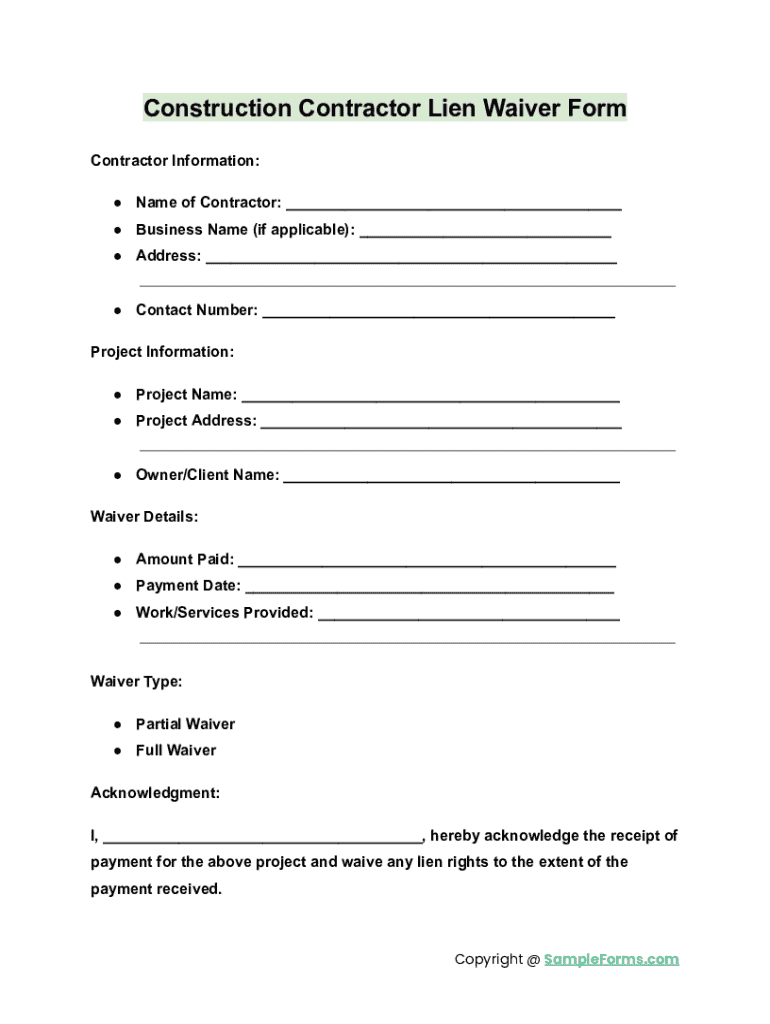
The Construction Contractor Lien Waiver Form is a crucial document in the construction industry, serving as a binding agreement that a contractor will not file a lien for work completed and payment received. These forms are used to release or waive any claim on the property or project upon receiving payment, ensuring that the property owner isn’t burdened with unexpected liens after a financial exchange. The form can apply to partial payments or the entirety of a project, depending on the terms agreed upon by all parties involved.
Key Elements of the Construction Contractor Lien Waiver Form
Understanding the essential components of a Construction Contractor Lien Waiver Form is vital for ensuring its effectiveness. Typically, these forms include:
- Contractor Information: Identifying details such as the contractor's name, company information, and contact details.
- Project Description: A brief overview of the project, including location and specific work performed.
- Payment Details: Information about the amount received, the date of payment, and the payment method.
- Type of Waiver: Indication whether it is a partial or full waiver.
- Signatures: Signatures of both the contractor and, if applicable, the property owner or financial officer, providing legal acknowledgment.
Steps to Complete the Construction Contractor Lien Waiver Form
Filling out a Construction Contractor Lien Waiver Form accurately is essential to safeguard interests and legal rights. Follow these steps:
- Gather Necessary Details: Ensure you have all the required information, including details about the project, payment specifics, and relevant parties involved.
- Fill Out Contractor Information: Start by completing your personal and business details as they must align with records to avoid disputes.
- Describe the Project Accurately: Provide a concise yet detailed description of the work executed, location, and reference project numbers if available.
- Specify Payment Details: Clearly outline the payment terms, amounts, and dates to correlate with finance records.
- Determine Waiver Type: Select whether this waiver is partial or full, based on the terms agreed upon with the project owner.
- Review and Sign: After completing the form, review it to confirm accuracy and legality. Sign the document along with obtaining required countersignatures.
Legal Use of the Construction Contractor Lien Waiver Form
The Construction Contractor Lien Waiver Form's primary legal function is to prevent contractors from imposing a lien after payment has been resolved. It helps:
- Protect Property Owners: By ensuring no undisclosed liens on their property once payments have been made.
- Clarify Payments: Offering documented evidence that payments have been completed for specified work.
- Prevent Legal Complications: Establishing a clear legal foundation that all parties recognize the settlement of debts.
State-Specific Rules for the Construction Contractor Lien Waiver Form
Lien laws vary significantly from state to state, which impacts the Construction Contractor Lien Waiver Form. It is important to:
- Recognize State Laws: Each state in the U.S. has unique lien laws, stipulating different requirements for waiver forms.
- Comply with State Regulations: Ensure that the form adheres to regional legal standards and any specific wording or clauses required by state law.
- Consult Legal Experts: Engage professionals familiar with local laws to draft or review the form compliantly.
Important Terms Related to Construction Contractor Lien Waiver Form
Several terms inherently relate to the functionality and application of the Construction Contractor Lien Waiver Form:
- Lien: A legal claim against assets, often used in construction to ensure payment.
- Waiver: The voluntary relinquishment of a legal right.
- Partial Waiver: A waiver covering only specific payments or project stages.
- Full Waiver: A comprehensive waiver covering the entire project and payment sum.
- Conditional Waiver: Valid once payment has been received and cleared.
- Unconditional Waiver: Effective upon signature, irrespective of payment status.
Examples of Using the Construction Contractor Lien Waiver Form
Utilizing the Construction Contractor Lien Waiver Form can be illustrated through real-world scenarios:
- Residential Construction: A contractor receives a payment for a completed phase of home building and files a partial waiver to show partial fulfillment.
- Commercial Projects: A contractor might sign a full waiver post-project completion when final payment has been made.
- Subcontracting Work: In cases where a subcontractor receives payment, a lien waiver confirms that their part of the project is resolved financially.
Software Compatibility (TurboTax, QuickBooks, etc.)
To streamline financial and documentation processes related to the Construction Contractor Lien Waiver Form, various software integrations prove beneficial:
- QuickBooks: Manage billing and payments, helping track payments associated with lien waivers.
- TurboTax: Ensure that financial transactions reported on these forms align with tax documentation.
- DocHub: For electronic completion and submission, allowing for seamless document management and secure storage of signed waivers.