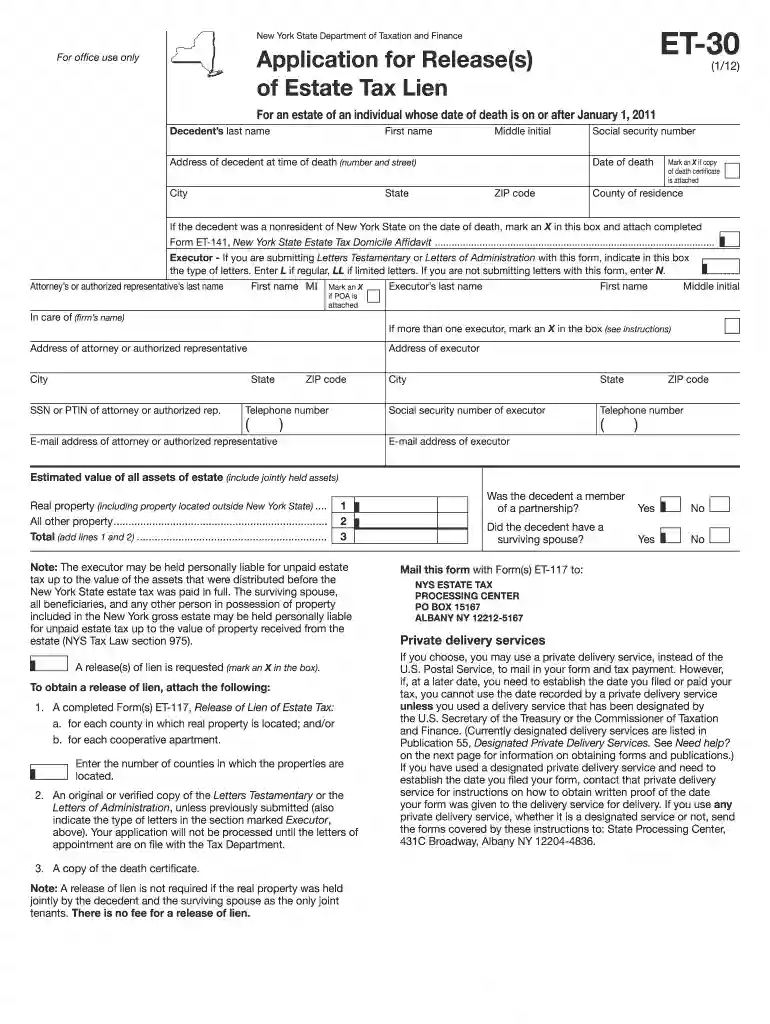
Et 30 2012 form-2026

Get Form
et 30 2012 form Preview on Page 1

Here's how it works

01. Edit your form online
Type text, add images, blackout confidential details, add comments, highlights and more.

02. Sign it in a few clicks
Draw your signature, type it, upload its image, or use your mobile device as a signature pad.

03. Share your form with others
Send it via email, link, or fax. You can also download it, export it or print it out.

Definition and Purpose of the ET-30 2012 Form

The ET-30 2012 form is a specific application used by the New York State Department of Taxation and Finance. Its primary purpose is to facilitate the release of estate tax liens on properties of individuals who passed away on or after January 1, 2011. This form serves as a vital tool for executors or authorized representatives of an estate, providing essential information about the deceased, their assets, and the necessary supplementary documents needed for compliance with estate tax regulations.

Steps to Complete the ET-30 2012 Form

  1. Gather Personal Details: Start with collecting information about the decedent, including their full name, Social Security number, and date of death.
  2. Asset Inventory: Compile a comprehensive list of the decedent’s assets. This includes real estate, bank accounts, investments, and personal property.
  3. Required Documentation: Prepare supplemental documents such as death certificates and letters of appointment from the court.
  4. Form Completion: Fill out the form by entering all required data in the specified fields, making sure each section is thoroughly completed.
  5. Review and Verification: Double-check all entries for accuracy and completeness to prevent delays or rejections.

Who Typically Uses the ET-30 2012 Form

The ET-30 2012 form is primarily used by executors or authorized representatives of an estate. Executors are responsible for managing and settling the decedent’s estate, ensuring compliance with estate tax laws, and relaying necessary information to the tax authorities. Legal professionals, such as estate attorneys, might also utilize this form to ensure proper estate management and taxation compliance.


decoration image ratings of Dochub

Key Elements of the ET-30 2012 Form

  • Decedent Information: Include details such as the name, Social Security number, and date of death of the deceased.
  • Estate Details: A summary of the estate's total value, including real property and personal assets.
  • Attachments: Required supporting documents like death certificates, court-issued letters of appointment, and other relevant paperwork.
  • Signatory Section: Space for signatures of the executor or authorized representative to validate the information provided.

Legal Use of the ET-30 2012 Form

The ET-30 2012 form plays a crucial role in the legal process of estate taxation. It aids in determining the liability for estate taxes under New York State law and ensures that any tax liens on the decedent's properties are addressed, allowing for legal transfers to heirs or beneficiaries. Proper completion of this form helps in the clearance of any governmental claims against the estate, thus assisting in settling the decedent's affairs legally.

Steps to Obtain the ET-30 2012 Form

  • Official Website: Visit the New York State Department of Taxation and Finance website to download the form directly.
  • Local Tax Offices: Request the form from local offices to ensure you have the latest version available.
  • Professional Assistance: Contact an estate attorney or tax professional who can provide the form and assist with its completion.

State-Specific Rules for the ET-30 2012 Form

In New York, estate tax laws stipulate the need for the ET-30 form specifically for estates of a certain size or complexity. Executors must adhere to New York's guidelines, which may differ from federal estate tax regulations. It’s essential to be aware of specific state-level exemptions, tax rates, and deadlines to ensure compliance and avoid any penalties.

Required Documents When Filing the ET-30 2012 Form

  • Death Certificate: This official document verifies the decedent’s death and informs the tax authority of the need to process the estate.
  • Court Appointment Letters: These letters confirm the executor’s authority to act on behalf of the estate.
  • Estate Inventory: A detailed list of the decedent's assets, providing the total value of the estate for tax assessment purposes.

Penalties for Non-Compliance with the ET-30 2012 Form

Failing to file the ET-30 2012 form in a timely manner can result in significant penalties. Potential consequences include fines, increased tax liabilities, and delays in the processing of the estate. Non-compliance may also affect the legal release of estate tax liens, potentially hindering the transfer of estate assets to beneficiaries. Executors must ensure timely and accurate submission to avoid these legal and financial repercussions.

See more et 30 2012 form versions

We've got more versions of the et 30 2012 form form. Select the right et 30 2012 form version from the list and start editing it straight away!
Versions Form popularity Fillable & printable
2020 4.8 Satisfied (27 Votes)
2014 4.4 Satisfied (237 Votes)
2012 4 Satisfied (21 Votes)
2008 4 Satisfied (37 Votes)
be ready to get more

Complete this form in 5 minutes or less

Get form

Got questions?

We have answers to the most popular questions from our customers. If you can't find an answer to your question, please contact us.
Contact us
Residents. The estate of a New York State resident must file a New York State estate tax return if the following exceeds the basic exclusion amount: the amount of the residents federal gross estate, plus. the amount of any includible gifts.
You must file Form ET-706 within nine months after the decedents date of death, unless you receive an extension of time to file the return. An extension of time to file the estate tax return may not exceed six months, unless the executor is out of the country.
The IRS Federal Form 712 reports the value of a life insurance policys proceeds after the insured dies for estate tax purposes. Because its typically the executor who manages the financial affairs of the deceased, its the executors responsibility to file the form - along with an estate tax return if needed.
These 2023 forms and more are available: New York Form IT 201 Personal Income Tax Return for Residents. New York Form IT 201ATT Other Tax Credits and Taxes Pg 1. New York Form IT 203 Personal Income Tax Return for Nonresidents and Part-Year Residents.
An estate tax return (Form 706) must be filed if the gross estate of the decedent (who is a U.S. citizen or resident), increased by the decedents adjusted taxable gifts and specific gift tax exemption, is valued at more than the filing threshold for the year of the decedents death, as shown in the table below.

Security and compliance

At DocHub, your data security is our priority. We follow HIPAA, SOC2, GDPR, and other standards, so you can work on your documents with confidence.

Learn more
ccpa2
pci-dss
gdpr-compliance
hipaa
soc-compliance

People also ask

Use Form ET-14, Estate Tax Power of Attorney, when you want to give one or more individuals the authority to obligate, bind, or appear on your behalf before the New York State Department of Taxation and Finance (the department) with respect to estate tax matters.
Some Executors are surprised to learn that New York State has a statutory estate tax lien on all property located within the state of New York for 15 years from the date of death.

Related links