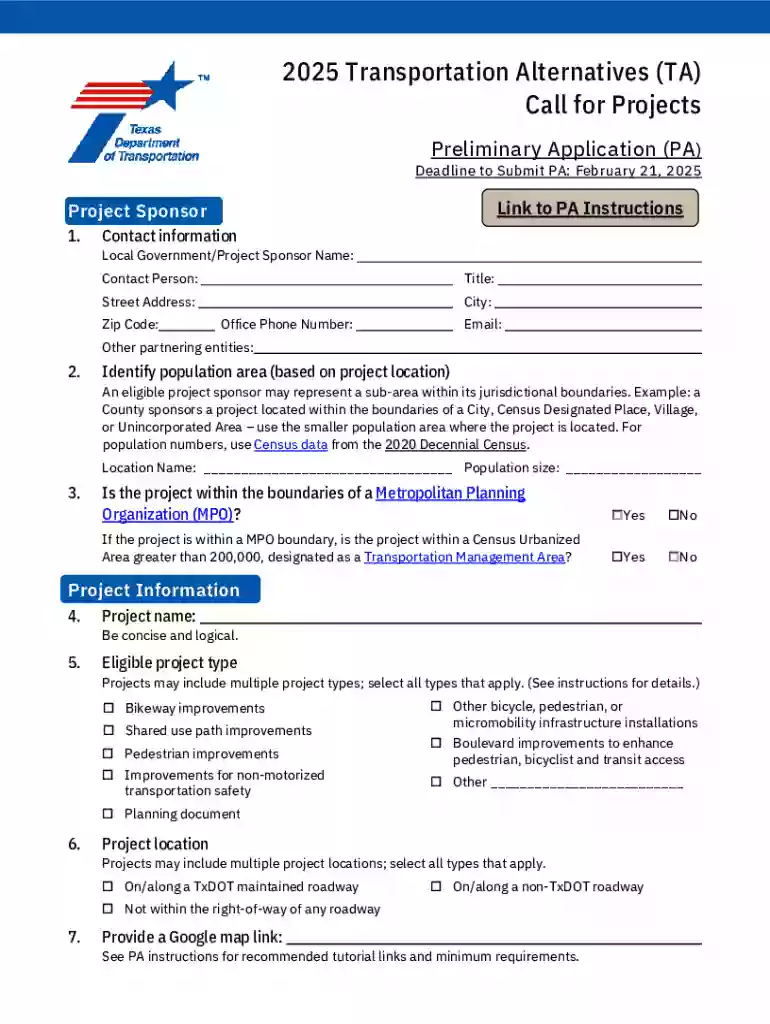
2025 Transportation Alternatives (ta) Call for Projects Preliminary Application-2026

Get Form
2025 Transportation Alternatives (ta) Call for Projects Preliminary Application Preview on Page 1

Here's how it works

01. Edit your form online
Type text, add images, blackout confidential details, add comments, highlights and more.

02. Sign it in a few clicks
Draw your signature, type it, upload its image, or use your mobile device as a signature pad.

03. Share your form with others
Send it via email, link, or fax. You can also download it, export it or print it out.

Definition & Meaning

The 2025 Transportation Alternatives (TA) Call for Projects Preliminary Application is a crucial document for project sponsors looking to secure funding for non-motorized transportation improvements. It serves as the initial step in a competitive process, aiming to enhance pedestrian pathways, bike lanes, and other infrastructure supporting active transportation. This application gathers preliminary information necessary to assess a project's eligibility, potential environmental impacts, and overall alignment with federal and state transportation goals.

Core Objectives

  • Non-motorized Transportation: Focused on promoting walking and cycling, contributing to sustainable urban mobility and reduced carbon emissions.
  • Local Community Benefits: Enhances accessibility and safety, particularly in areas underserved by public transit.
  • Environmental Consideration: Addresses potential ecological impacts, ensuring projects contribute to environmental sustainability.

How to Use the 2025 Transportation Alternatives (TA) Call for Projects Preliminary Application

Completing this application requires careful attention to detail and a comprehensive understanding of the project vision. Here's how to effectively utilize it:

Project Description

  • Narrative Summary: Provide a concise, persuasive overview of your project, highlighting its necessity and anticipated benefits.
  • Location Details: Include geographical information and any pertinent local features that support the project's objectives.

Budget and Funding

  • Estimated Costs: Outline the financial requirements, dividing expenses into categories such as construction, design, and contingency.
  • Local Match Requirement: Demonstrate a local investment of at least 20%, showing commitment and maximizing eligibility for funding.

Environmental Impact

  • Impact Assessment: Identify potential environmental effects and proposed mitigation strategies to minimize ecological disruptions.

Steps to Complete the 2025 Transportation Alternatives (TA) Call for Projects Preliminary Application

Applicants should follow a systematic approach:

  1. Review Guidelines: Thoroughly read the application instructions and backbone criteria to ensure full compliance.
  2. Gather Information: Collect data on your project scope, budget, expected outcomes, and environmental considerations.
  3. Prepare Documents: Compile all necessary documentation, such as site maps, preliminary designs, and community support letters.
  4. Draft and Refine: Complete a draft of the application, seeking feedback from stakeholders or project partners.
  5. Submit Application: Finalize your application and submit it before the stated deadline, confirming receipt with the issuing agency.

Important Terms Related to 2025 Transportation Alternatives (TA) Call for Projects Preliminary Application

Understanding specific terminology is vital:

  • Transportation Alternatives (TA): A program providing funding for projects that expand transportation choices and enhance regional transit networks.
  • Preliminary Application: The initial stage where project concepts are introduced to funding bodies for evaluation.

Key Elements of the 2025 Transportation Alternatives (TA) Call for Projects Preliminary Application

Critical components include:

  • Eligibility Criteria: Confirm your project's alignment with TA program objectives and guidelines.
  • Application Format: Ensure adherence to specified formats, layouts, and section headers.
  • Evaluation Metrics: Understand the scoring process and criteria that will determine project viability and prioritization.

Eligibility Criteria

The eligibility criteria for this application encompass various factors:

decoration image ratings of Dochub

Project Types

  • Infrastructure Improvements: For constructing pedestrian paths and bikeways.
  • Community Engagement Projects: Focused on increasing public participation in transportation planning.

Applicant Types

  • Public Agencies: Municipal, regional, and state transportation departments.
  • Special Districts: School districts or transit agencies with relevant transportation projects.

Steps to Obtain the 2025 Transportation Alternatives (TA) Call for Projects Preliminary Application

Acquiring the application involves a straightforward process:

  1. Access Online Portal: Visit the official transportation department website of your state or region.
  2. Download the Application: Obtain the application form and any associated guidelines.
  3. Contact Officials: For physical copies or further clarification, reach out to designated officials listed on the website.

Filing Deadlines / Important Dates

Keeping track of timelines is crucial:

  • Submission Deadline: Ensure all documents are submitted by the announced cutoff to avoid disqualification.
  • Review Periods: Understand the phases your application will go through, from initial review to final approval.

Application Process & Approval Time

This process involves critical stages:

  • Initial Screening: Assess basic eligibility and compliance with guidelines.
  • Detailed Evaluation: Conduct an in-depth analysis of project specifics and potential impacts.
  • Decision Notification: Receive a formal decision within a defined timeframe post-evaluation.

State-by-State Differences

This application may have regional variations:

Key Differences

  • Application Formats: State-specific templates and submission protocols.
  • Funding Priorities: Some states may prioritize particular project types based on local needs.
be ready to get more

Complete this form in 5 minutes or less

Get form

Got questions?

We have answers to the most popular questions from our customers. If you can't find an answer to your question, please contact us.
Contact us
This program provides funding for programs and projects defined as transportation alternatives, including on- and off-road pedestrian and bicycle facilities, infrastructure projects for improving non-driver access to public transportation and enhanced mobility, community improvement activities, and environmental
The Transportation Alternatives Set-Aside Program (TA Set-Aside; formerly known as Transportation Alternatives Program, or TAP) is administered by the U.S. Federal Highway Administration (FHWA) and helps states fund a variety of activities related to improving transportation assets, including on- and off-road
Transportation Alternatives (TA) provides funding for programs and projects defined as transportation alternatives. These include pedestrian and bicycle facilities, Safe Routes to School projects, safe routes for non-drivers, community improvement activities and environmental mitigation projects.
The TAP replaces the funding from pre-MAP-21 programs including Transportation Enhancements, Recreational Trails, Safe Routes to School, and Scenic Byways, wrapping them into a single funding source.
revenue sourcesprimarily state fuel taxes and vehicle fees. Most of these funds remain at the state level, with a smaller portion provided to local governments on both a formula and competitive basis.

Security and compliance

At DocHub, your data security is our priority. We follow HIPAA, SOC2, GDPR, and other standards, so you can work on your documents with confidence.

Learn more
ccpa2
pci-dss
gdpr-compliance
hipaa
soc-compliance
be ready to get more

Complete this form in 5 minutes or less

Get form

People also ask

Program Funding Safe Routes to School is a 100 percent federally funded cost-reimbursement program managed through the Texas Department of Transportation (TxDOT), Traffic Operations Division (TRF). Projects are funded through a statewide competitive process with funds limited to those authorized in the SRTS program.
The planning phase offers the best opportunity for public health professionals to make an impact.
Assistance programs The Surface Transportation Program - Local (STP-L) allocates federal funds to complete a variety of improvements to off-system roadways functionally classified a a rural minor collector or local road.

Related links