




01. Edit your form online
Type text, add images, blackout confidential details, add comments, highlights and more.

Type text, add images, blackout confidential details, add comments, highlights and more.

Draw your signature, type it, upload its image, or use your mobile device as a signature pad.

Send it via email, link, or fax. You can also download it, export it or print it out.
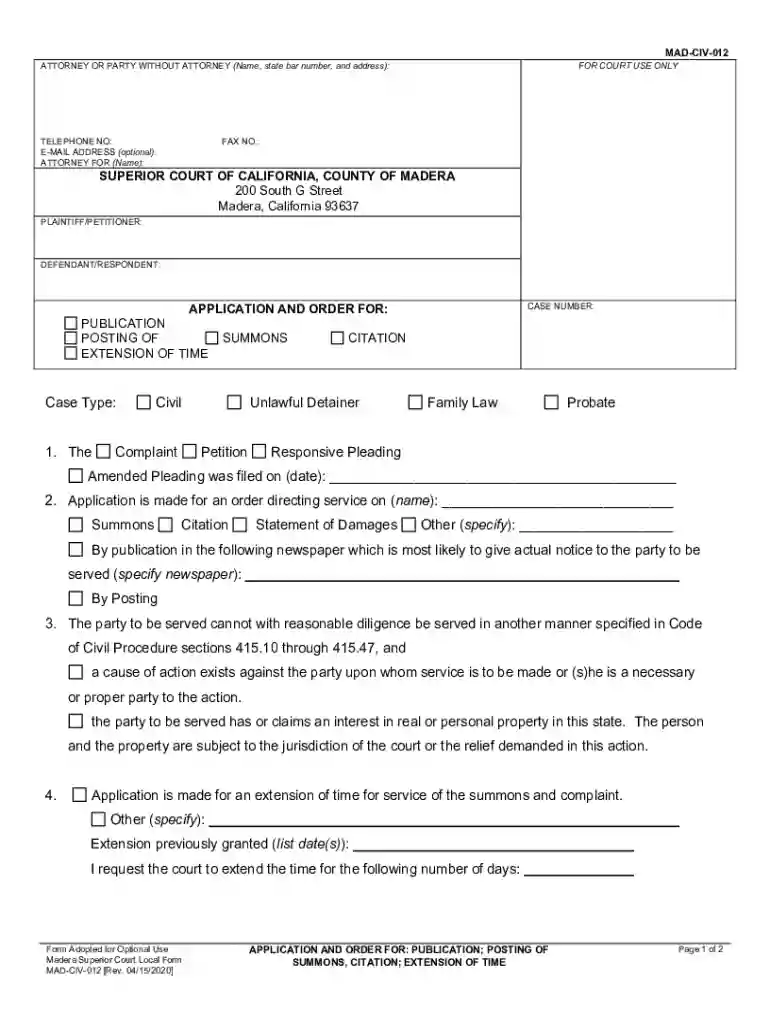
The MAD-CIV-012 is a specialized legal application form used within the Superior Court of California, County of Madera. Its primary purpose is to facilitate requests for serving legal documents via publication or posting, as opposed to more direct methods like personal delivery. Additionally, it serves as a means to apply for an extension of time for such services. This form captures essential details about all parties involved, specifies the case type, and reasons for requesting these alternative methods. It includes an area where the court can approve or deny the submitted application.
Effectively utilizing the MAD-CIV-012 involves understanding each section and the requirements it entails. To properly fill out the form, a petitioner must provide:
Follow these detailed guidelines to ensure all sections are addressed accurately.
This approach ensures coherence and completeness, allowing for effective court processing.
The MAD-CIV-012 can be obtained directly from the Superior Court of California, Madera County's website or by visiting the court in person. Electronic copies are often preferred for ease of access and filing.
Using digital formats reduces time spent and facilitates multiple revisions before submission.
Completing the MAD-CIV-012 requires attention to detail and understanding formational requirements. It is recommended to comply with the following:
This proactive approach minimizes delays often associated with incomplete applications.
The MAD-CIV-012 is crucial because it provides an alternative legal pathway when traditional methods of document service are impractical or impossible. It ensures that the legal process remains accessible, allowing cases to proceed without unnecessary hindrance.
This form is vital in maintaining a fair and efficient legal system within the constraints of practical challenges.
The MAD-CIV-012 includes several essential elements that ensure completeness and legal validity:
Each part plays a critical role in verifying the form's authenticity and applicability.
Proper submission and approval of the MAD-CIV-012 ensure legal compliance with the California legal system while granting necessary flexibility in document service procedures. All applications require full conformity with procedural obligations, and once signed by a judge, become legally binding.
Adhering to these legal mandates prevents potential penalties and procedural delays.
The MAD-CIV-012 is predominantly utilized by legal professionals in California or individuals representing themselves in court who encounter difficulties with standard document serving methods.
This form caters to the diverse needs of the Californian legal landscape, providing a structured yet flexible solution.


Consider scenarios where personal service methods exert strain on parties:
In such scenarios, the MAD-CIV-012 offers a pragmatic legal approach, ensuring justice remains accessible and operations continue smoothly.
We've got more versions of the Mad-civ-012 form. Select the right Mad-civ-012 version from the list and start editing it straight away!
| Versions | Form popularity | Fillable & printable |
|---|---|---|
| 2020 | 4.6 Satisfied (23 Votes) |
At DocHub, your data security is our priority. We follow HIPAA, SOC2, GDPR, and other standards, so you can work on your documents with confidence.


MAD-CIV-012 Form Adopted for Optional Use Madera Superior Court. APPLICATION AND ORDER FOR: PUBLICATION; POSTING OF SUMMONS, CITATION; Case Type: Civil
Jul 30, 1992 Rule 12(b) Some Causes of Dementia. MAD- COW disease, etc. Some causes are reversible low thyroid, B12 deficiency, normal- pressure


