




01. Edit your form online
Type text, add images, blackout confidential details, add comments, highlights and more.

Type text, add images, blackout confidential details, add comments, highlights and more.

Draw your signature, type it, upload its image, or use your mobile device as a signature pad.

Send it via email, link, or fax. You can also download it, export it or print it out.
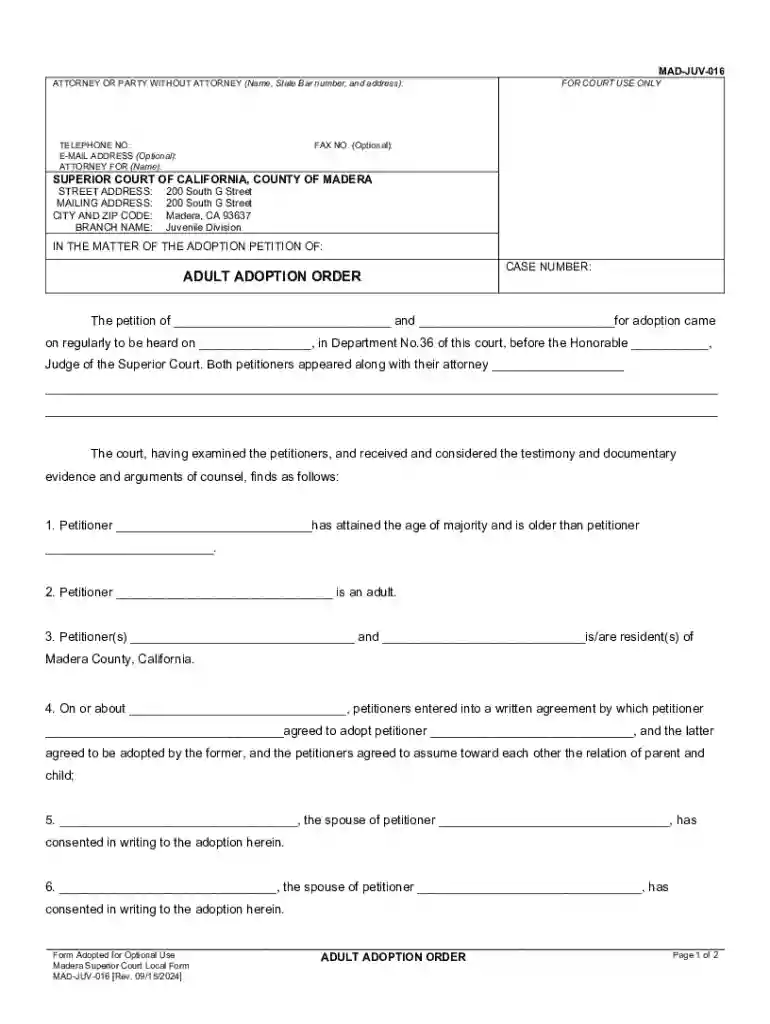
The Mad-juv-016 is a legal form used in adult adoption proceedings within the Superior Court of California, County of Madera. It is specifically designed for two adults seeking to establish a legal parent-child relationship through adoption. This form plays a crucial role in documenting the mutual consent of the parties involved and providing a framework for the court to examine and approve the adoption. The document ultimately serves to formalize the new legal relationship once the court finds that the adoption is in the best interest of the involved parties.
Gather Required Information: Collect personal details of both adopting parties, including full legal names, addresses, and contact information. Obtain any necessary identification documents for accurate data entry.
Fill Out the Form: Carefully enter the gathered information into the form, ensuring all the fields are completed as required. Pay special attention to sections involving consent, as these affirm that both parties fully agree to the adoption.
Review for Accuracy: Double-check all entries for accuracy and completeness. Errors or omissions can delay the court’s processing of the document and the subsequent proceedings.
Sign the Document: Both parties must sign the form in the presence of a notary public or another authorized official to ensure the signatures are legally binding and verified.
Submit to the Court: File the completed form with the Superior Court of California, County of Madera. Ensure that any applicable filing fees are paid during submission.
Attend the Court Hearing: Participate in any required hearings scheduled by the court to discuss the adoption. This is an opportunity for the involved parties to reiterate their consent and for the judge to assess the adoption’s merits.
The Mad-juv-016 form is primarily used by adult individuals within the jurisdiction of the Superior Court of California, County of Madera. These individuals seek to establish a legally recognized parent-child relationship through adoption. Typical users include:


The Mad-juv-016 form operates within the legal framework provided by the Superior Court of California, County of Madera. Key legal uses include:
In California, the Mad-juv-016 form is subject to specific regulatory stipulations:
Real-world scenarios provide practical insights into the form's application:
We've got more versions of the Mad-juv-016 form. Select the right Mad-juv-016 version from the list and start editing it straight away!
| Versions | Form popularity | Fillable & printable |
|---|---|---|
| 2024 | 4.9 Satisfied (29 Votes) |
At DocHub, your data security is our priority. We follow HIPAA, SOC2, GDPR, and other standards, so you can work on your documents with confidence.


