




01. Edit your form online
Type text, add images, blackout confidential details, add comments, highlights and more.

Type text, add images, blackout confidential details, add comments, highlights and more.

Draw your signature, type it, upload its image, or use your mobile device as a signature pad.

Send it via email, link, or fax. You can also download it, export it or print it out.
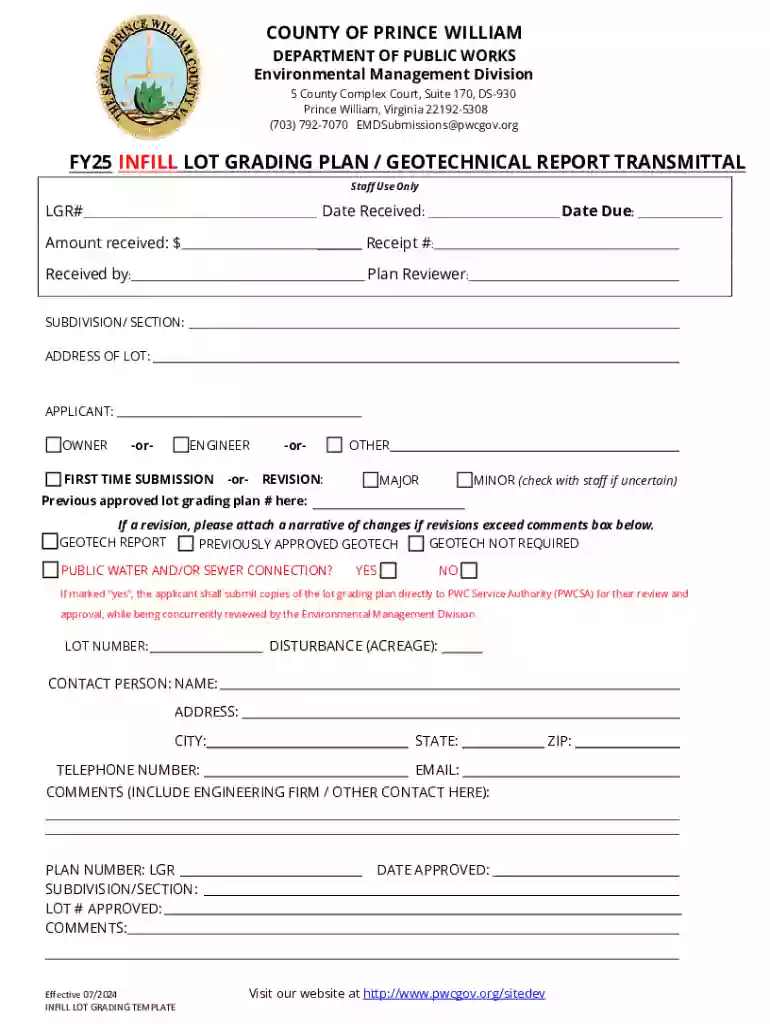
The Fy25 Infill Lot Grading Plan Geotechnical Report Transmittal is a specialized document required for the submission of grading plans and geotechnical reports to the Environmental Management Division of Prince William County. It serves as a formal communication tool between the applicant and the county, ensuring that all necessary information is provided for the review and approval of development projects. The transmittal form includes detailed sections for applicant information, project details, and requirements regarding public utility connections and environmental impact assessments. This ensures compliance with local regulations and facilitates efficient processing by regulatory bodies.
Using the transmittal form involves several important steps to ensure accurate and efficient processing:
Obtain the Form: Access the form through the appropriate county or municipal website, ensuring you have the latest version.
Fill Out Applicant Information: Provide complete details about the applicant, including name, contact information, and any relevant identification numbers or licensing details.
Include Project Details: Clearly describe the scope of the project, the infill lot location, and the purpose of the grading plan and geotechnical report. This section should also include any relevant site measurements and environmental considerations.
Attach Required Reports: Ensure that the infill lot grading plan and geotechnical report are comprehensive and up-to-date. These documents should be prepared and certified by qualified professionals, such as civil engineers or geotechnical experts.
Review and Submit: Double-check all entries for accuracy and completeness before submission. Forms can usually be submitted online, by mail, or in-person at designated county offices, depending on specific county guidelines.
Properly completing the transmittal requires attention to detail:
Gather Necessary Information: Compile details about the infill lot, such as location, size, and current zoning classification.
Consult Professionals: Work with licensed civil engineers and geotechnical experts to prepare the required reports. These professionals should be familiar with local codes and regulations.
Complete the Applicant Section: Enter all personal or organizational information, ensuring it matches any official records or previous submissions to the county.
Detail Project Specifications: Use the project details section to outline the purpose and objectives of the grading plan and any anticipated environmental impacts.
Ensure Compliance with Utility Requirements: If applicable, outline how the project will connect to public water and sewer systems, and include any correspondence related to these arrangements.
Submit for Review: Follow submission guidelines specific to Prince William County, ensuring that all documents are legible and properly categorized.
The transmittal form contains several critical elements:
The transmittal form is a legally binding document that confirms compliance with local construction and environmental laws. It provides oversight authorities with all necessary documentation to evaluate the project's viability and adherence to zoning laws. Misrepresentation or incomplete submissions can lead to project delays or legal penalties, emphasizing the importance of accuracy and thoroughness in completing the form.
Consider a property developer planning a residential subdivision on an undeveloped urban infill lot. They would use the transmittal to submit their grading plan and geotechnical report to demonstrate how the development meets county regulations. This example underscores the transmittal's role in securing necessary project approvals.
Similarly, a local business aiming to expand its facilities might need to submit a revised grading plan via this transmittal to comply with updated environmental assessments or infrastructural changes. These scenarios highlight the transmittal's application in both private and commercial projects.
Prince William County has specific regulations regarding land use and development that influence the transmittal's requirements. While the form itself is specific to this county, understanding broader Virginian environmental and construction laws is essential. Requirements may vary slightly for different types of developments, such as residential versus commercial projects, further emphasizing the importance of local legislative awareness when completing this form.
Submitting the transmittal requires several key documents:
We've got more versions of the Fy25 Infill Lot Grading Plan Geotechnical Report Transmittal form. Select the right Fy25 Infill Lot Grading Plan Geotechnical Report Transmittal version from the list and start editing it straight away!
| Versions | Form popularity | Fillable & printable |
|---|---|---|
| 2024 | 4.7 Satisfied (24 Votes) |
At DocHub, your data security is our priority. We follow HIPAA, SOC2, GDPR, and other standards, so you can work on your documents with confidence.




Lot Line Adjustment (four or fewer lots). $671.00. Resolution 2025-20 Crime Reports Per report up to 10 pages. $10.00. Charter, Section 708 Gen. RevRead more
This report makes the case for integrated land use and water management planning. FY 21FY 25. clearing, grading and landscaping, beaches and shores, and


