(PATERNITY ACTION) 2026

Get Form
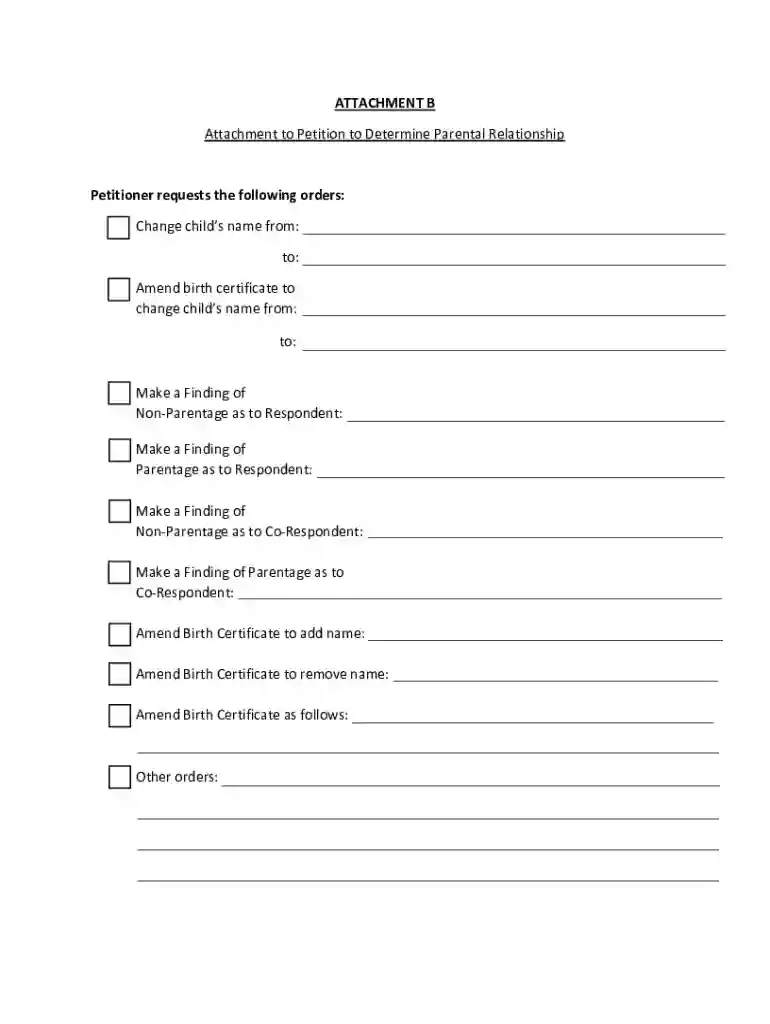
(PATERNITY ACTION) Preview on Page 1

Here's how it works

01. Edit your form online
Type text, add images, blackout confidential details, add comments, highlights and more.

02. Sign it in a few clicks
Draw your signature, type it, upload its image, or use your mobile device as a signature pad.

03. Share your form with others
Send it via email, link, or fax. You can also download it, export it or print it out.

How to use or fill out (PATERNITY ACTION) with our platform

Form edit decoration
9.5
Ease of Setup
DocHub User Ratings on G2
9.0
Ease of Use
DocHub User Ratings on G2
  1. Click ‘Get Form’ to open the PATERNITY ACTION document in the editor.
  2. Begin by filling out the petitioner and respondent information. Include names, addresses, and contact details as required in the designated fields.
  3. In section 1, specify your relationship to the children listed. Indicate whether you gave birth, wish to be recognized as a parent, or assert non-parentage.
  4. For section 2, provide details about each child including their names and birthdates. Ensure accuracy for legal purposes.
  5. Complete section 3 by explaining the court's jurisdiction over the respondent. Check applicable boxes based on residency or conception circumstances.
  6. In section 5, outline any claims regarding parentage and support obligations. Attach supporting documents if necessary.
  7. Review all entries for completeness and accuracy before saving your form as a PDF.

Start using our platform today to easily complete your PATERNITY ACTION form online for free!

See more (PATERNITY ACTION) versions

We've got more versions of the (PATERNITY ACTION) form. Select the right (PATERNITY ACTION) version from the list and start editing it straight away!
Versions Form popularity Fillable & printable
2023 4.2 Satisfied (39 Votes)
2021 4.8 Satisfied (127 Votes)
2021 4.4 Satisfied (80 Votes)
2021 4.3 Satisfied (60 Votes)
2020 4.3 Satisfied (83 Votes)
2018 4.3 Satisfied (76 Votes)
2016 4.3 Satisfied (64 Votes)
2014 4.7 Satisfied (50 Votes)
be ready to get more

Complete this form in 5 minutes or less

Get form

Got questions?

We have answers to the most popular questions from our customers. If you can't find an answer to your question, please contact us.
Contact us
A DNA paternity test can help accurately determine a childs biological father. You can conduct tests during pregnancy or after your baby is born. Most tests use cheek swabs to collect genetic material. You must complete a DNA paternity test at an approved testing facility if you need results for legal reasons.
The causes of paternity discrepancy include: premarital pregnancy, womens desperation for child-birth, infidelity, multiple sex partnership, and poverty.
Paternity is the establishment of the identity of a childs legal father. Paternity ensures the fathers rights and responsibilities towards his child. He can petition the court for custody, child support or challenge an adoption.
In summary, lying about paternity can be considered perjury if it occurs in a legal context where the individual is under oath or has signed a sworn statement. Otherwise, it may lead to other legal repercussions but not necessarily perjury charges.
Paternity disputes occur when the father claims that he is not the biological father of that child and refuse to take the responsibility of the child, however the mother claims that the man is the biological father of her child.

Security and compliance

At DocHub, your data security is our priority. We follow HIPAA, SOC2, GDPR, and other standards, so you can work on your documents with confidence.

Learn more
ccpa2
pci-dss
gdpr-compliance
hipaa
soc-compliance
be ready to get more

Complete this form in 5 minutes or less

Get form

People also ask

Disputed paternity is when a man claims that he is not the biological father of the child and does not take the responsibility of the child. Biological father is the one who donates his sperms to the child. Legal father is the one who is recognized as the father of the child by the law.
If the respondent admits paternity, an order of filiation is entered. If the parties cannot agree on paternity, the matter is then scheduled for a hearing. Both parties may testify and present witnesses and the blood or DNA test results may be offered in evidence.

Related links