






Understanding the CC Form 139-R Cadet Enrollment Record
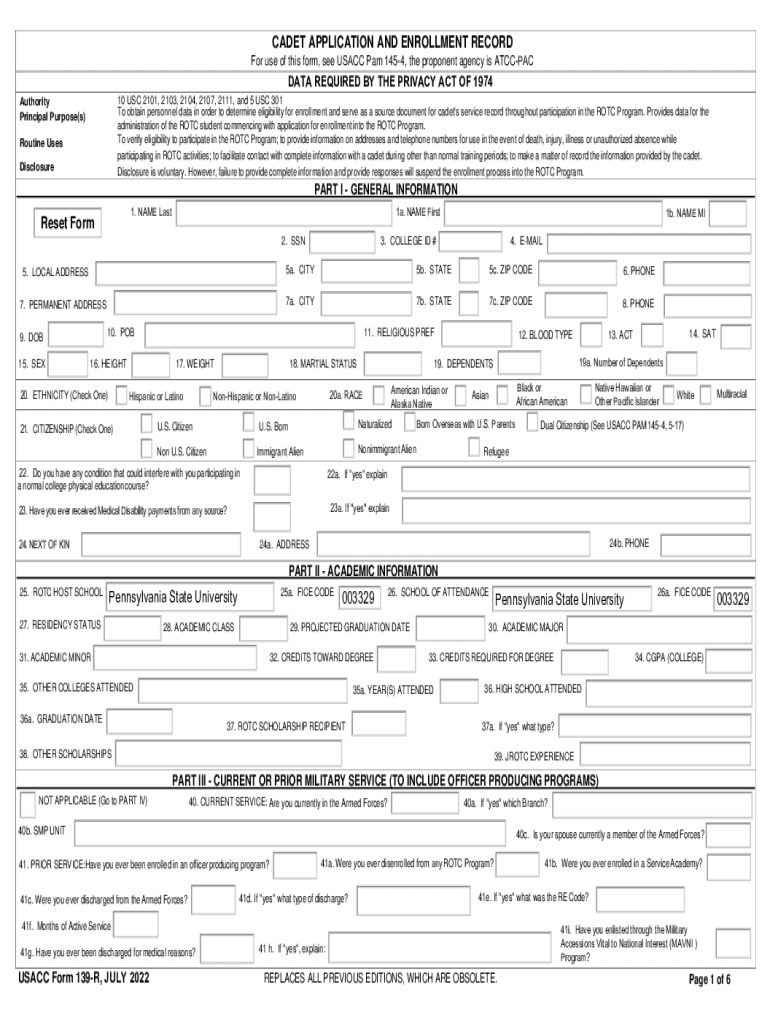
The CC Form 139-R Cadet Enrollment Record is a crucial document for individuals looking to enroll in the Reserve Officers' Training Corps (ROTC) Program. Its primary purpose is to gather comprehensive information concerning personal, academic, and military service history to establish eligibility for the program. Given the significance of this form in securing a spot in ROTC, it's vital to ensure accuracy and completeness in its completion.
Key Sections and Elements of the Form
Understanding the various sections and important elements of the CC Form 139-R is essential for accurate completion:
-
Personal Information: This section captures essential details about the applicant, such as full name, contact information, date of birth, and social security number. Accuracy in this section is imperative to ensure proper identification and processing.
-
Academic History: Applicants must provide detailed educational background, including the names of schools attended, degrees earned, GPA, and current academic status. This information helps assess the applicant's educational qualifications and readiness for the ROTC program.
-
Military Service Details: For those with prior military service, this part requires details about service branch, service dates, rank, and military occupational specialties (MOS). Accurately filling out this section aids in evaluating the applicant's military experience and potential placement within the ROTC.
-
Eligibility Checklists: These checklists ensure applicants meet the necessary criteria. This includes declarations of U.S. citizenship, age requirements, and moral and physical standards compliance. The checklist serves as a quick reference to ascertain if the candidate meets the program's fundamental eligibility criteria.
Steps to Complete the CC Form 139-R
Filling out the CC Form 139-R efficiently requires following these outlined steps:
-
Gather Necessary Information: Before starting the form, collect all required personal, academic, and military documents. This preparation avoids delays and omissions during the form-filling process.
-
Complete Personal Information: Start by entering all personal details with precision. Double-check for any typographical errors, especially in numerical data like the social security number, to minimize processing errors later.
-
Fill in Academic and Military Details: Accurately detail your academic records and any military service information. Continuously verify all entries with supporting documents to ensure consistency.
-
Review Eligibility Checklists Thoroughly: Carefully go through the eligibility checklists. Make sure to address each item, ensuring compliance with ROTC requirements. This step is crucial as any discrepancies might delay your application.
-
Validate Form Alterations (if needed): If any changes are made to the form, indicate them clearly and provide justifications if required, ensuring transparency and maintaining the integrity of the provided information.
-
Submit the Form: Once completed, follow the prescribed submission guidelines, whether it be through mail or as a digital submission. Ensure all additional required documents accompany the form.
Digital vs. Paper Version
In today's digital age, completing the CC Form 139-R can be done electronically. This method provides several benefits over the traditional paper version:
-
Efficiency and Speed: Applicants can fill out and submit the form faster online, with the added advantage of digital correction tools to minimize errors.
-
Environmental Considerations: Digital submissions reduce paper usage and the environmental impact associated with printing and mailing physical documents.
-
Trackability: Digital submissions can often be tracked more easily, providing confirmation of receipt and reducing uncertainties associated with mail delays.
Legal Use and Compliance
The information gathered with the CC Form 139-R falls under the Privacy Act of 1974. As such, it is crucial that applicants understand the legal implications of providing false information. Deliberate misrepresentation in the form can lead to disqualification from the ROTC Program or other legal consequences. Therefore, applicants are encouraged to be truthful and thorough in their responses to safeguard their military careers and avoid ramifications.
Real-World Scenarios and Case Studies
Consider a scenario where an applicant with prior military service is applying for the ROTC program. By accurately reflecting their MOS and rank, they could potentially receive advanced standing in the program, whereas omitting such critical information might lead to their earlier military achievements not being recognized.
Additionally, students currently enrolled in higher education institutions can leverage their academic records to fulfill specific prerequisites, making documentation essential in validating their current standing and opening doors for potential scholarships within the ROTC framework.
These scenarios underscore the importance of carefully compiling and verifying the information provided in the CC Form 139-R to ensure it supports the applicant's objectives effectively.