






Definition & Purpose of the Application Form
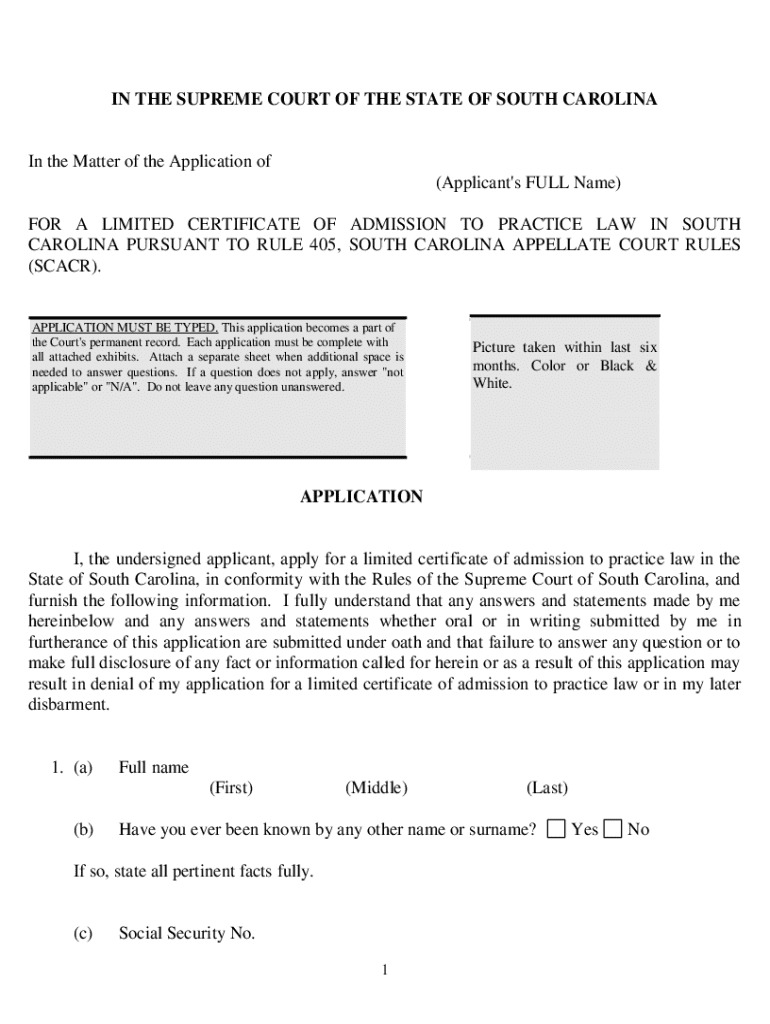
The "IN THE SUPREME COURT OF THE STATE OF SOUTH CAROLINA" application form serves as a fundamental document for legal professionals seeking to obtain a limited certificate of admission to practice law in South Carolina. Governed by Rule 405 of the South Carolina Appellate Court Rules, this form requires comprehensive personal and professional information. It is designed to assess the applicant's eligibility and fitness to practice law in the state, ensuring all conditions for legal practice are met. This form is an official record and should be filled out with accuracy and care, as it becomes a permanent part of the court's documents.
Steps to Complete the Application Form
-
Gather Required Information: Before beginning, collect all necessary documents and information, including educational history, employment details, and personal identification.
-
Complete Personal Information: Provide details such as your full name, contact information, and identification number. Ensure that all information matches legal documents.
-
Educational and Employment History: List educational qualifications and work experience relevant to the legal practice. Include institution names, degrees earned, and employment durations.
-
Disclosures and Authorizations: Address all questions related to character and fitness truthfully. You may also be required to submit fingerprints and authorize background checks.
-
Review and Sign: Carefully review the completed form for any errors or missing information. Sign and date the application as a declaration of the information's truthfulness.
-
Submit the Form: Follow the specified method for submission, whether online, via mail, or in-person. Ensure all additional documents are attached if required.
Key Elements of the Application
-
Personal Information: Accurate personal identification, including name, date of birth, and contact details.
-
Educational Credentials: Verified educational qualifications necessary for practice in South Carolina.
-
Previous Legal Experience: Employment history, particularly relating to legal work or positions of responsibility.
-
Character and Fitness Disclosures: Honest answers to questions regarding any past ethical or legal issues, providing context where necessary.
-
Fingerprint and Background Check: Consent to and provision of fingerprints for a comprehensive background check as a requirement of the application process.
Eligibility Criteria
To be eligible for the limited certificate of admission in South Carolina, applicants must fulfill the following criteria:
- Hold a valid law degree from an accredited institution.
- Demonstrate proof of good moral character and fitness to practice law, assessed through detailed disclosures.
- Have passed a bar exam or equivalent legal assessment approved by the South Carolina Supreme Court.
- Fulfill residency or work-related conditions as specified by the state's legal requirements.


Importance of Compliance with Application Requirements
Ensuring compliance with the application requirements is crucial for several reasons:
-
Legal Obligations: As an aspiring legal practitioner, meeting these requirements upholds the integrity and standards of the legal profession.
-
Consequences of Non-Compliance: Failure to accurately complete the form or provide truthful information may result in penalties, including denial of admission or disciplinary actions.
-
Long-Term Professional Impact: A thorough and honest application can facilitate a successful legal career in South Carolina, fostering trust and credibility within the legal community.
State-Specific Rules and Variations
South Carolina's legal admission procedures vary from other states, emphasizing the need for applicants to:
- Understand the nuances of Rule 405 under the South Carolina Appellate Court Rules.
- Observe any unique residency or practice requirements specific to South Carolina.
- Familiarize themselves with statewide standards on ethical practice and professional conduct.
Examples of Application Use
-
Recent Law Graduates: Those who have recently completed their law degree and are seeking to begin their practice within South Carolina.
-
Interstate Lawyers: Attorneys from other states wishing to extend their practice to South Carolina need to meet the jurisdiction’s specific legal admission guidelines.
-
Foreign-Trained Lawyers: Individuals with legal qualifications from outside the United States, following any additional procedures or qualifications needed for state recognition.
Important Legal Terms
Understanding certain key terms is vital for completing the application accurately:
-
Certificate of Admission: A legal document authorizing an individual to practice law within the state's jurisdiction.
-
Character and Fitness: A set of criteria evaluating an applicant’s suitability to practice law, focusing on ethical standards.
-
Background Check Authorization: Consent provided by an applicant to undergo a criminal and character investigation to verify eligibility.
Conclusion & Final Steps
Once the application is submitted, the waiting period for approval may vary. Applicants should ensure they have completed all sections accurately and provided all required documentation to avoid delays. Staying informed about the application's status and responding promptly to any additional requests from the Supreme Court of South Carolina aids in a smooth admission process.