







Understanding the Fifth Grade Mathematics Unit 2 Framework
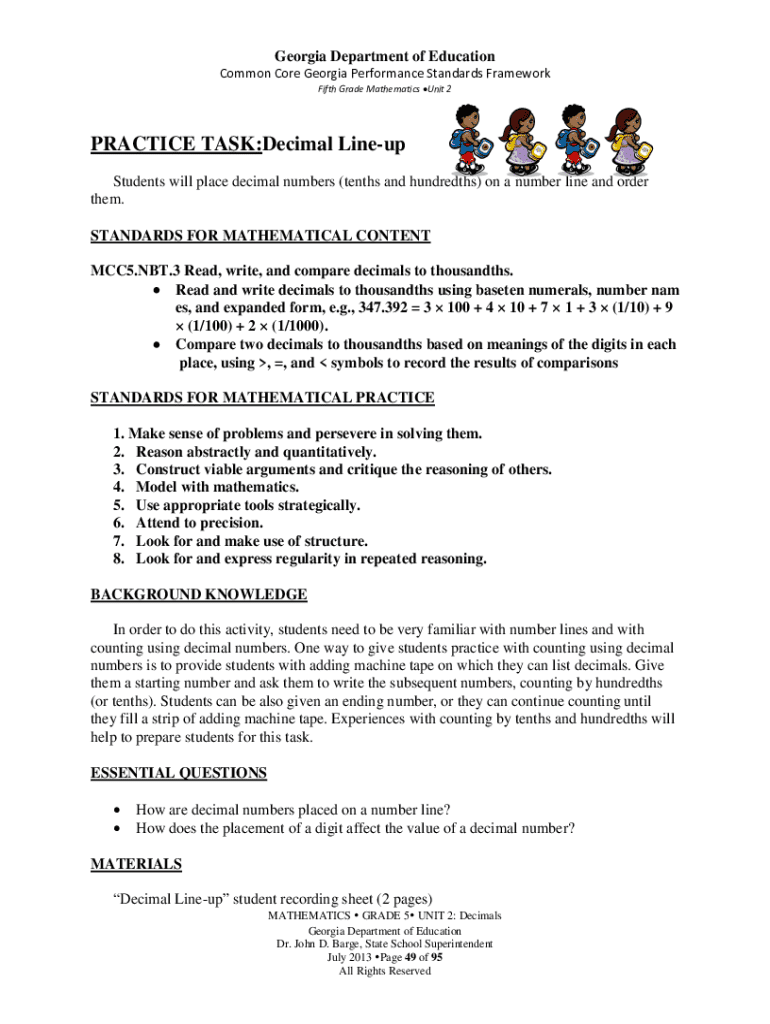
The Common Core Georgia Performance Standards Framework for Fifth Grade Mathematics Unit 2 focuses on enhancing students’ understanding of decimals and their placement on a number line. This unit encourages activities such as the 'Decimal Line-up' task, which aids students in accurately positioning and ordering decimal numbers, particularly tenths and hundredths.
How to Use the Framework
The framework should be used as a guide for classroom instruction, providing a structured approach to teaching decimals. Educators can utilize the included standards and tasks to develop lesson plans. It features:
- Practice Tasks: Activities like 'Decimal Line-up' that engage students in practical application of their math skills.
- Standards Alignment: Ensures lessons meet state educational requirements.
- Materials and Resources: Suggestions for materials that support teaching activities.
Steps to Complete the Mathematical Tasks
To complete tasks in Unit 2, educators should:
- Review the standards and objectives outlined in the framework.
- Gather necessary materials as listed in the document, such as number lines and decimal cards.
- Guide students through initial explorations of decimals using real-world examples.
- Implement the 'Decimal Line-up' task, facilitating student collaboration and discussion.
- Assess understanding and provide feedback to enhance learning outcomes.
Key Elements of the Framework
- Background Knowledge: Essential pre-requisites that students should meet before starting this unit, ensuring foundational understanding.
- Essential Questions: Prompts that encourage critical thinking and deepen comprehension, like how decimals relate to fractions.
- Task Descriptions: Detailed instructions on implementing activities within the classroom setting.
Important Terms Within the Framework
Several terms are critical for understanding and teaching this unit, including:
- Decimals: Representation of fractions using base ten.
- Tenths and Hundredths: Subdivisions of whole numbers, crucial for understanding decimal placement.
- Number Line: A visual tool that helps in placing and comparing decimals.
Examples of Using the Framework
Practical examples include:
- Decimal Exploration: Students convert fractions to decimals and plot them on a number line, fostering an understanding of decimal sizes.
- Classroom Discussions: Engaging students in conversations about real-life uses of decimals, like money and measurements.
Benefits of Implementing the Framework
Implementing this framework helps students develop a solid grasp of decimal concepts, crucial for advanced mathematics. Teachers benefit from:
- Structured Curriculum: Aligns teaching with state standards, ensuring cohesive learning.
- Improved Student Outcomes: Encourages active engagement and practical applications, enhancing retention.
Legal and State-Specific Considerations
Using the framework ensures compliance with state educational mandates. It aligns with legal requirements of the Common Core, which are standardized across various states, promoting consistency ineducation.
Digital vs. Paper Versions
The framework is available in both digital and paper formats, making it accessible. Educators can choose:
- Digital Solutions: Utilize platforms like DocHub to edit and distribute materials electronically.
- Paper Formats: Traditional methods for hands-on activities and task implementation in the classroom.
Software Compatibility
Educators can enhance their use of this framework by integrating software that supports interactive learning, such as:
- Google Classroom: For managing assignments and sharing resources.
- Mathematics Applications: Tools that provide digital number lines and interactive decimal exercises.
By following these guidelines, educators can leverage the Common Core Georgia Performance Standards Framework effectively to support students through Fifth Grade Mathematics Unit 2. It ensures a comprehensive understanding of decimal notation and application, fundamental for progressing in mathematics education.




