




01. Edit your form online
Type text, add images, blackout confidential details, add comments, highlights and more.

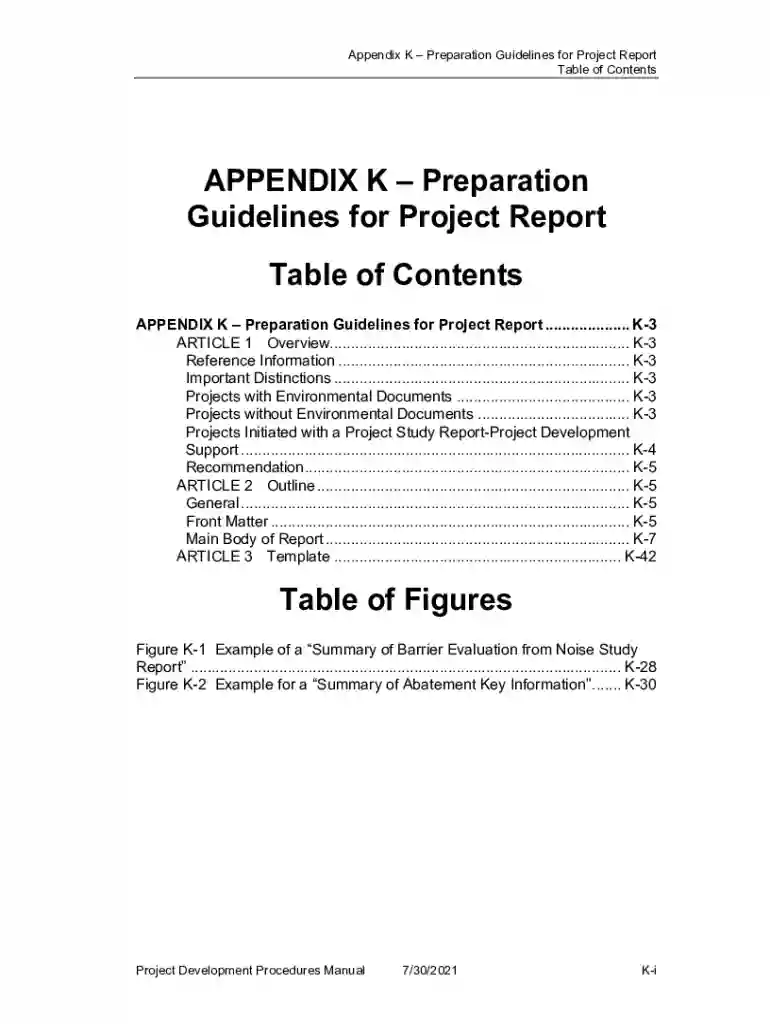
Type text, add images, blackout confidential details, add comments, highlights and more.

Draw your signature, type it, upload its image, or use your mobile device as a signature pad.

Send it via email, link, or fax. You can also download it, export it or print it out.
The Appendix K Preparation Guidelines for Project Reports serve as a comprehensive manual for structuring project reports effectively. This document is designed to provide clarity and specific instructions on how to assemble both Draft Project Reports (DPR) and final Project Reports (PR). Its primary aim is to standardize the process, making it easier for teams and individuals to communicate project details in a clear and structured manner that satisfies regulatory requirements and enhances project presentation.
The guidelines ensure consistency and coherence across project reports, making it easier for reviewers and stakeholders to understand the project’s goals, methodologies, and results. By adhering to these guidelines, project managers can effectively communicate essential information, enhancing transparency and facilitating better decision-making.
These guidelines are typically used by project managers, planners, and coordinators within organizations that require formal project reporting. They are invaluable for professionals involved in government projects, non-profit operations, and private sector initiatives, particularly where regulatory compliance is a concern.


Incorporating legal standards and compliance within project reports is critical. The guidelines ensure that all legal obligations, particularly those related to environmental compliance and stakeholder interactions, are thoroughly addressed. This not only aids in meeting regulatory requirements but also protects against potential legal challenges.
Utilizing the Appendix K Preparation Guidelines for Project Reports helps to present data in an organized fashion, ensuring all project aspects are transparently conveyed to relevant parties.
We've got more versions of the APPENDIX KPreparati on Guidelines for Project Repor t form. Select the right APPENDIX KPreparati on Guidelines for Project Repor t version from the list and start editing it straight away!
At DocHub, your data security is our priority. We follow HIPAA, SOC2, GDPR, and other standards, so you can work on your documents with confidence.






Jul 22, 2021 Appendices in the proposal should be clearly labeled and provide supportive information that relates directly to the proposed project. InRead more
The report could be structured as follows: Cover sheet; Table of contents; Change history; Contact person; Project overview (scope, classification, time period)Read more
Appendices A through Z contain guidelines for various project development reports. Appendices BB through QQ contain project development forms andRead more


