01. Edit your form online
Type text, add images, blackout confidential details, add comments, highlights and more.

Type text, add images, blackout confidential details, add comments, highlights and more.

Draw your signature, type it, upload its image, or use your mobile device as a signature pad.

Send it via email, link, or fax. You can also download it, export it or print it out.
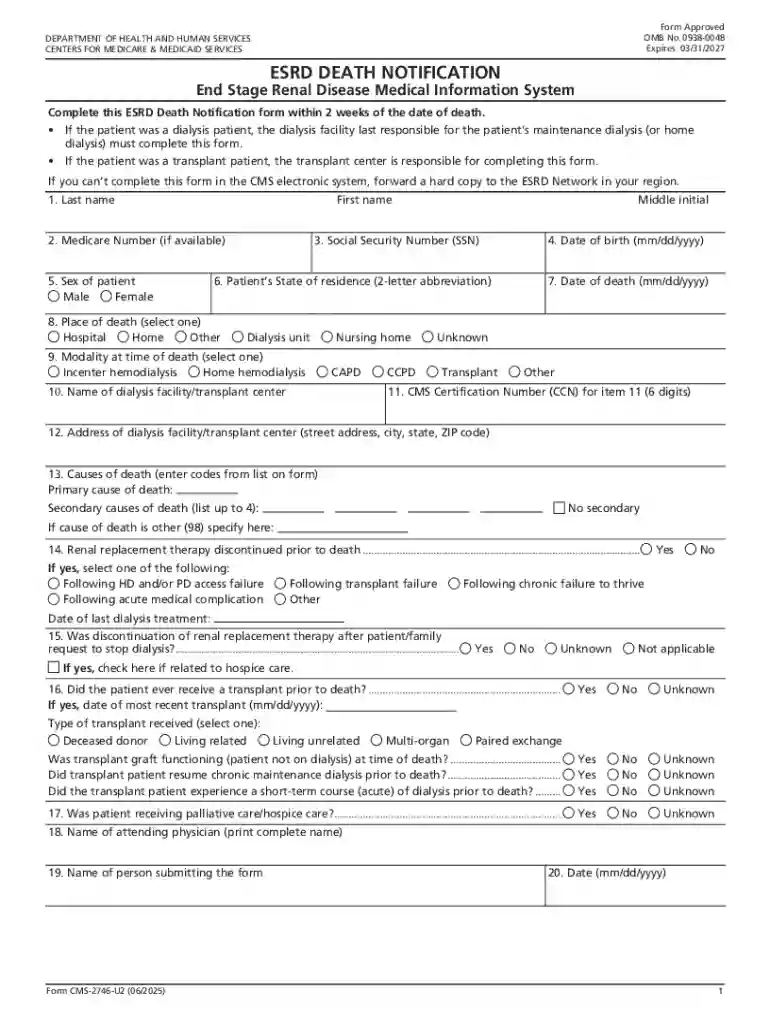
The ESRD Death Notification form, officially known as CMS-2746-U2, is a mandatory document required by the Centers for Medicare & Medicaid Services (CMS). It serves the crucial function of recording and reporting the deaths of patients with End Stage Renal Disease (ESRD). The form provides a structured means of supplying key details about the patient's medical history, the cause of death, and any renal replacement therapy involved. This standardized form ensures that all necessary data is captured comprehensively, aiding in the maintenance of accurate records for healthcare statistics and policy development.
Completing the ESRD Death Notification form involves several detailed steps to ensure accuracy and compliance.
Gather Patient Information: Start by collecting the patient's personal details, including full name, Medicare number, and date of birth.
Document the Cause of Death: Clearly identify and document the medical conditions leading to death, including primary and secondary causes.
Renal Therapy Details: Include information about any renal replacement therapy the patient was receiving, such as dialysis type, frequency, and duration.
Review and Verify Information: Before submission, review all entries for completeness and accuracy to prevent any delays in processing.
The form must be completed and submitted within two weeks following the patient's death to comply with CMS regulations.
The ESRD Death Notification form carries specific legal obligations that must be adhered to by dialysis facilities and transplant centers. Failure to submit the form timely can result in non-compliance penalties. The document ensures privacy and confidentiality protections under HIPAA regulations, safeguarding the patient's personal and medical information during the reporting process. It's vital that staff responsible for completing the form understand these legal requirements to protect the patient's rights and the facility's compliance status.
Primarily, dialysis facilities and transplant centers are tasked with using and submitting the ESRD Death Notification form. Healthcare professionals within these organizations, such as nephrologists, social workers, and administrative staff, play key roles in ensuring the form is accurately completed and submitted. By meticulously recording the requisite details, they help maintain compliance with CMS and contribute to critical data collection that impacts healthcare policies and advancements.
When submitting the ESRD Death Notification form, several documents are often necessary to ensure a comprehensive record:
Ensuring these documents are complete and attached appropriately is crucial for form validation and compliance.
The ESRD Death Notification form can be submitted through various methods, which include:
Each method has its benefits, with online submission being favored for its speed and security.
Understanding key terms associated with the ESRD Death Notification form is essential for accurate completion:
Familiarity with these terms enables healthcare professionals to provide precise information and ensures the form's effectiveness in patient record-keeping.
While the ESRD Death Notification form is standardized at the federal level, certain states may have additional rules or requirements influencing its completion. Some states might impose stricter timelines or specific documentation guidelines. Healthcare providers should remain informed about any updates or changes to state-specific regulations to maintain compliance and ensure timely submissions. Regular consultations with legal and compliance teams can provide the necessary guidance to navigate these variations effectively.
The ESRD Death Notification form must be filed within a specific timeframe to comply with CMS guidelines. Typically, the form should be submitted within two weeks following the death of a patient. Keeping track of these deadlines is crucial to avoid penalties and ensure the timely and accurate recording of patient data. Facilities often implement reminder systems or checklists to assist healthcare professionals in meeting these deadlines without fail.
We've got more versions of the Esrd Death Notification form. Select the right Esrd Death Notification version from the list and start editing it straight away!
At DocHub, your data security is our priority. We follow HIPAA, SOC2, GDPR, and other standards, so you can work on your documents with confidence.