Definition & Meaning of Salvage Vehicle Statement
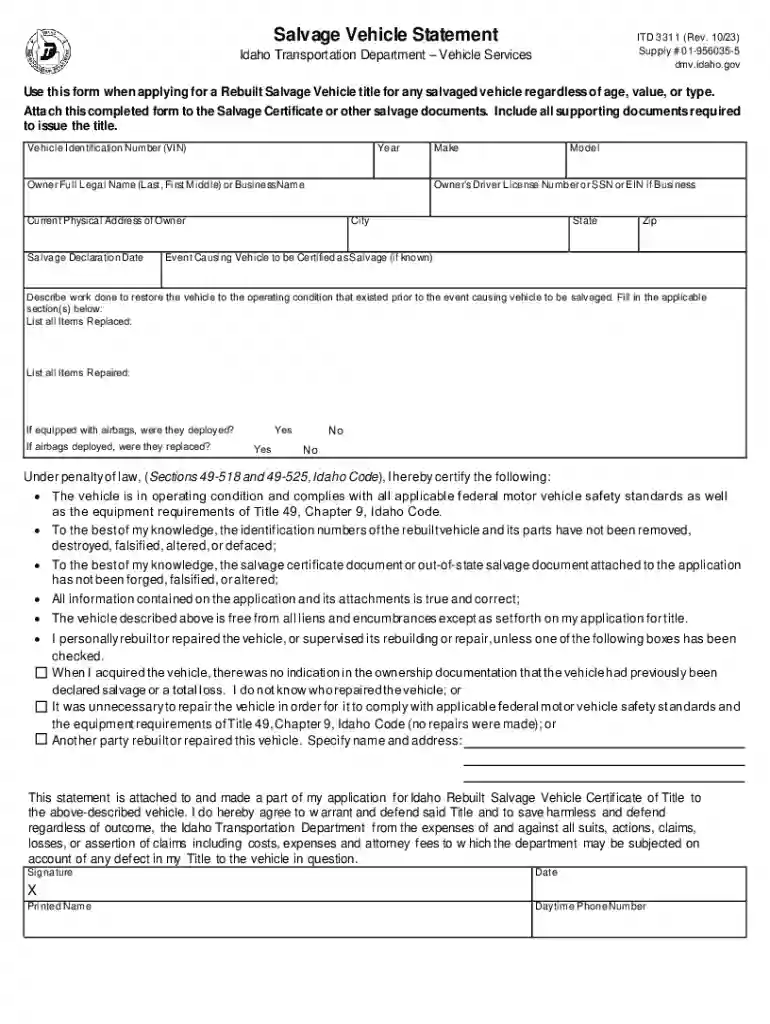
The Salvage Vehicle Statement is a formal document used primarily by the Idaho Transportation Department for individuals applying for a Rebuilt Salvage Vehicle title. This statement is crucial for vehicles that have been declared salvage but have been reconstructed to meet safety and operational standards. It includes detailed information about the vehicle, its owner, and the restoration work performed, ensuring all modifications comply with safety regulations. Additionally, the form incorporates declarations regarding the vehicle's condition, identification numbers, and any liens. An affirmation of the information's accuracy by the applicant is a requirement, underscoring the form's legal importance.
Key Elements of the Salvage Vehicle Statement
The Salvage Vehicle Statement comprises several critical components that ensure the document serves its intended purpose.
- Vehicle Information: This section requires specifics about the vehicle, such as the make, model, year, and Vehicle Identification Number (VIN). It's essential for cross-verifying the vehicle's identity and ensuring its history is accurately documented.
- Owner Details: This part captures the personal information of the vehicle owner, including name, address, and contact information, to establish clear ownership and responsibility.
- Restoration Work Description: A detailed account of the restoration work done on the vehicle must be provided. This involves listing modifications, repairs, and parts replaced, ensuring the vehicle's roadworthiness post-salvage.
- Expense Declaration: Owners must disclose costs incurred during the restoration, which can be used to assess whether the repairs align with value assessments for insurance and resale purposes.
Steps to Complete the Salvage Vehicle Statement
Completing the Salvage Vehicle Statement involves a methodical process to ensure accuracy and compliance with state regulations.
- Gather Necessary Information: Collect all relevant documents and details required, such as vehicle specifications, restoration receipts, and ownership proofs.
- Fill Out Vehicle and Owner Details: Accurately input the vehicle's make, model, year, and VIN, along with the owner's personal and contact information.
- Detail Restoration Work: Provide a comprehensive list of all repair work and modifications performed on the vehicle. Include all parts replaced and their sources.
- Sign and Certify: The applicant must certify that the information provided is true, acknowledging that this serves as a legal declaration.
- Submit the Form: File the form with the Idaho Transportation Department, adhering to submission guidelines to avoid processing delays.
Legal Use of the Salvage Vehicle Statement
The Salvage Vehicle Statement holds significant legal implications. Submitting this form is a critical step in re-registering a salvage vehicle as roadworthy and legally operational.
- Certification of Accuracy: The applicant's certification ensures the document’s truthfulness, holding the individual legally accountable for any false information.
- Lien Disclosure: The form requires the disclosure of any liens on the vehicle, protecting buyers and insurers from unforeseen financial claims.
- Title Issuance: Approval of this form is mandatory for obtaining a Rebuilt Salvage title, certifying the vehicle’s safety compliance post-restoration.
State-Specific Rules for the Salvage Vehicle Statement
In Idaho, specific rules govern the use and submission of the Salvage Vehicle Statement to ensure standardization and safety compliance.
- Idaho Compliance: The vehicle must comply with Idaho's emission and safety standards, necessitating thorough inspections regardless of restoration work location.
- Documentation Protocol: Additional documentation, such as proof of prior title and restoration receipts, may be required to validate the information provided in Idaho.
- Timeframe for Submission: There are specified timeframes within which the completed form must be submitted post-restoration, ensuring timely processing of the vehicle's new title.
Examples of Using the Salvage Vehicle Statement
The Salvage Vehicle Statement is utilized in multiple scenarios to achieve compliance with legal and safety standards.
- Post-Accident Restoration: After a vehicle has been declared a total loss, the owner may choose to restore it. The form documents these changes, verifying the vehicle’s resurgence to safe operational status.
- Insurance Claims: Insurers may require this form when a vehicle previously claimed as salvage is insured post-restoration. The documented repairs aid in assessing the vehicle’s insured value.
- Resale Transactions: Buyers interested in purchasing a rebuilt salvage vehicle can request this form to verify the vehicle's history and confirm its current legal standing and safety compliance.
Electronic and Paper Submission Options
The Salvage Vehicle Statement accommodates both digital and paper submission options, offering flexibility for applicants.
- Digital Submission: Applicants can submit the form electronically via the Idaho Transportation Department's online portal, benefiting from streamlined processing and immediate confirmation of receipt.
- Paper Submission: Alternatively, the form can be printed and mailed to the department. Paper submissions might suit individuals less comfortable with online forms or who prefer physical documentation confirmation.
- Form Accessibility: Offering digital and paper options ensures the form remains accessible to a diverse range of users, accommodating varying preferences and technological capabilities.