01. Edit your form online
Type text, add images, blackout confidential details, add comments, highlights and more.

Type text, add images, blackout confidential details, add comments, highlights and more.

Draw your signature, type it, upload its image, or use your mobile device as a signature pad.

Send it via email, link, or fax. You can also download it, export it or print it out.
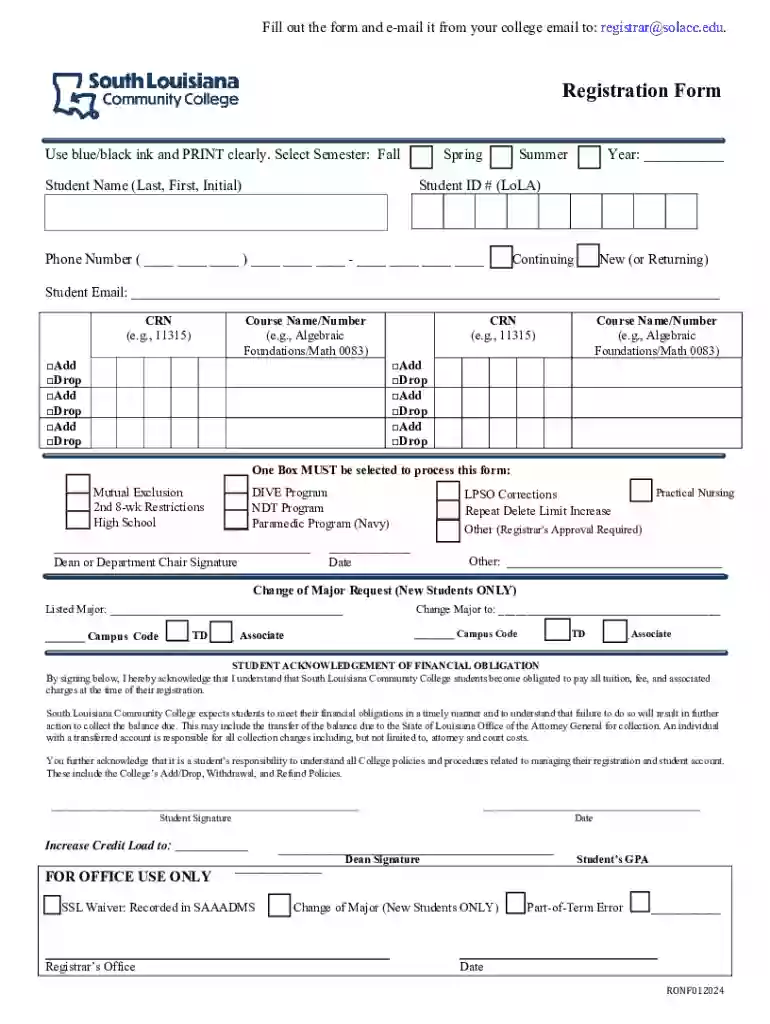
A registration form is a structured document used to collect essential information from individuals or organizations for the purpose of enrolling them in a particular program, event, or service. In the context of South Louisiana Community College, this form gathers student details, course selections, and necessary signatures to ensure accurate enrollment records. Registration forms play an integral role in administrative functions, ensuring that data is collected systematically for processing and record-keeping.
Understanding the key elements of a registration form is crucial. Typically, these forms include sections for personal details such as name, address, and contact information. In educational settings, course registration options are provided, where students can select or drop classes as needed. Each form may require additional fields based on its specific purpose, such as a major change request or acknowledgment of financial obligations. Understanding these elements enables individuals to provide complete and accurate information, ensuring seamless processing.
Completing a registration form involves a series of straightforward steps. First, gather all necessary personal and academic information, such as student ID, current course details, and personal identification details. Next, carefully fill out each section of the form, paying close attention to required fields marked with an asterisk or bold text. Ensure that any additional requests, such as course changes or major alterations, are clearly indicated. Finally, review the completed form for accuracy before submitting it for processing, ensuring that any required signatures, whether digital or handwritten, are obtained.
Several documents are typically required when submitting a registration form. These may include identification documents, proof of residency, previous academic records, and any relevant financial information. Specific institutions or organizations may also request documents relating to eligibility criteria or program-specific prerequisites. It is crucial to prepare these documents in advance to streamline the registration process and prevent any delays in submission or approval.
Obtaining a registration form can be done through multiple channels. Institutions often make these forms available on their official websites for easy access. Additionally, physical copies may be obtained directly from administrative offices or mailed upon request. In modern systems, digital versions can be completed and submitted online, allowing for a streamlined, paperless process. Ensure that the form obtained is the most current version, as outdated forms may not be accepted.
The submission of registration forms can generally be done through online, mail, or in-person channels. Online submission is widely favored for its convenience and speed. Mail submissions may require additional processing time, so it's essential to account for postal delays. In-person submissions enable immediate confirmation but might require a visit to campus or administrative offices. Selecting the appropriate method depends on personal preference and the urgency of the registration process.
Registration forms are legally binding documents that often require signatures attesting to the accuracy and truthfulness of the information provided. In educational contexts, signing this form may legally bind students to financial responsibilities associated with enrolled courses. Ensuring all information is truthful and complete is a legal obligation, with potential consequences for misstated or omitted information, including fines or enrollment holds.
Understanding terms commonly associated with registration forms enhances comprehension and completion accuracy. Terms such as "enrollment," "credit hours," and "prerequisites" frequently appear on academic registration forms. Additionally, terminology specific to an institution, like "student ID" or "program code," should be clearly understood to avoid errors in form completion. Familiarity with these terms aids in a seamless registration experience.
Registration forms are used by various individuals in educational and organizational settings. Students are the primary users in academic environments, required to register for courses and acknowledge program requirements. Educational administrators and faculty members utilize these forms to process and manage course enrollments and student records efficiently. Understanding the role and utility of registration forms for each user group underpins their successful implementation and functional purpose.


Real-world examples provide practical insight into the utility and implementation of registration forms. For instance, a student enrolled at South Louisiana Community College uses the registration form to select courses for the upcoming semester, request a major change, or acknowledge tuition-related obligations. Additionally, institutions employ these forms to maintain comprehensive student records, create schedules, and track enrollment metrics. These scenarios illustrate the form's role as an indispensable tool in educational settings.
Non-compliance with registration form requirements can result in several consequences. Failure to submit required information or meet specified deadlines may lead to enrollment cancellations, late fees, or holds on student accounts. It is critical to adhere to submission guidelines and deadlines to avoid such penalties. Institutions outline these consequences clearly to ensure students understand the implications of non-compliance.
Varying state regulations may influence the structure and required contents of registration forms, particularly in educational contexts. States may impose specific guidelines regarding residency verification, tuition classification, or eligibility criteria for certain programs. Understanding these state-specific regulations is essential when completing registration forms to ensure compliance and avoid any potential issues during the admissions or registration process.
We've got more versions of the Registration Form form. Select the right Registration Form version from the list and start editing it straight away!
At DocHub, your data security is our priority. We follow HIPAA, SOC2, GDPR, and other standards, so you can work on your documents with confidence.