Directive physicians 2026

Get Form
directive physicians Preview on Page 1

Here's how it works

01. Edit your form online
Type text, add images, blackout confidential details, add comments, highlights and more.

02. Sign it in a few clicks
Draw your signature, type it, upload its image, or use your mobile device as a signature pad.

03. Share your form with others
Send it via email, link, or fax. You can also download it, export it or print it out.

How to use or fill out directive physicians with our platform

Form edit decoration
9.5
Ease of Setup
DocHub User Ratings on G2
9.0
Ease of Use
DocHub User Ratings on G2
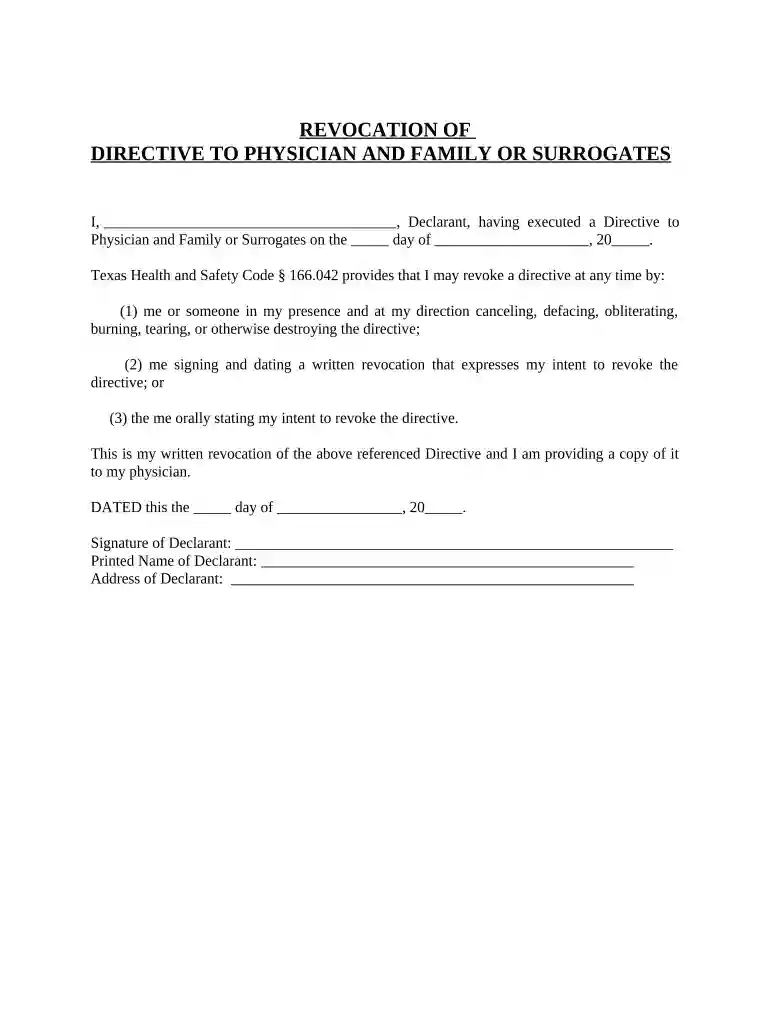
  1. Click ‘Get Form’ to open the directive physicians document in the editor.
  2. Begin by entering your name as the Declarant in the designated field at the top of the form.
  3. Fill in the date on which you executed the original Directive, ensuring accuracy for legal purposes.
  4. In the section regarding revocation methods, familiarize yourself with Texas Health and Safety Code § 166.042, which outlines how you can revoke your directive.
  5. Sign and date the revocation statement at the bottom of the form, confirming your intent to revoke. Ensure that your signature is clear and legible.
  6. Provide your printed name and address in the respective fields to complete your revocation documentation.

Start using our platform today to easily manage your directive physicians forms online for free!

be ready to get more

Complete this form in 5 minutes or less

Get form

Got questions?

We have answers to the most popular questions from our customers. If you can't find an answer to your question, please contact us.
Contact us
Living Wills are a statement of preferences for treatment (or, as may be the case, lack of treatment); Advance Directives include that information as well as legally appointing and empowering a person (called a Healthcare Agent) to speak on our behalf if we cant.
Advance directives refer to any legal form guiding your future medical care, and living wills refer to specific documents that shape end-of-life treatment.
People often choose to have a DNR when theyre facing a terminal illness, or they might decline in order to avoid aggressive life-saving measures. But if you want to plan ahead just in case there is ever a time when you are unable to make healthcare decisions on your own, youll need an advance directive.
Advance directives are legal documents that provide instructions for medical care and only go into effect if you cannot communicate your own wishes. The two most common advance directives for health care are the living will and the durable power of attorney for health care.
An advance health care directive lets your physician, family, and friends know your health care preferences, including the types of special treatment you want or dont want at the end of life, your desire for diagnostic testing, surgical procedures, cardiopulmonary resuscitation and organ donation.

Security and compliance

At DocHub, your data security is our priority. We follow HIPAA, SOC2, GDPR, and other standards, so you can work on your documents with confidence.
Learn more
ccpa2
pci-dss
gdpr-compliance
hipaa
soc-compliance
be ready to get more

Complete this form in 5 minutes or less

Get form

People also ask

A directive to physicians and family (also called living wills, health care directives, and advance directives) are legal mechanisms where an individual can choose to prevent medical personnel from using life sustaining treatments for life-threatening health situations.

Related links