01. Edit your form online
Type text, add images, blackout confidential details, add comments, highlights and more.

Type text, add images, blackout confidential details, add comments, highlights and more.

Draw your signature, type it, upload its image, or use your mobile device as a signature pad.

Send it via email, link, or fax. You can also download it, export it or print it out.
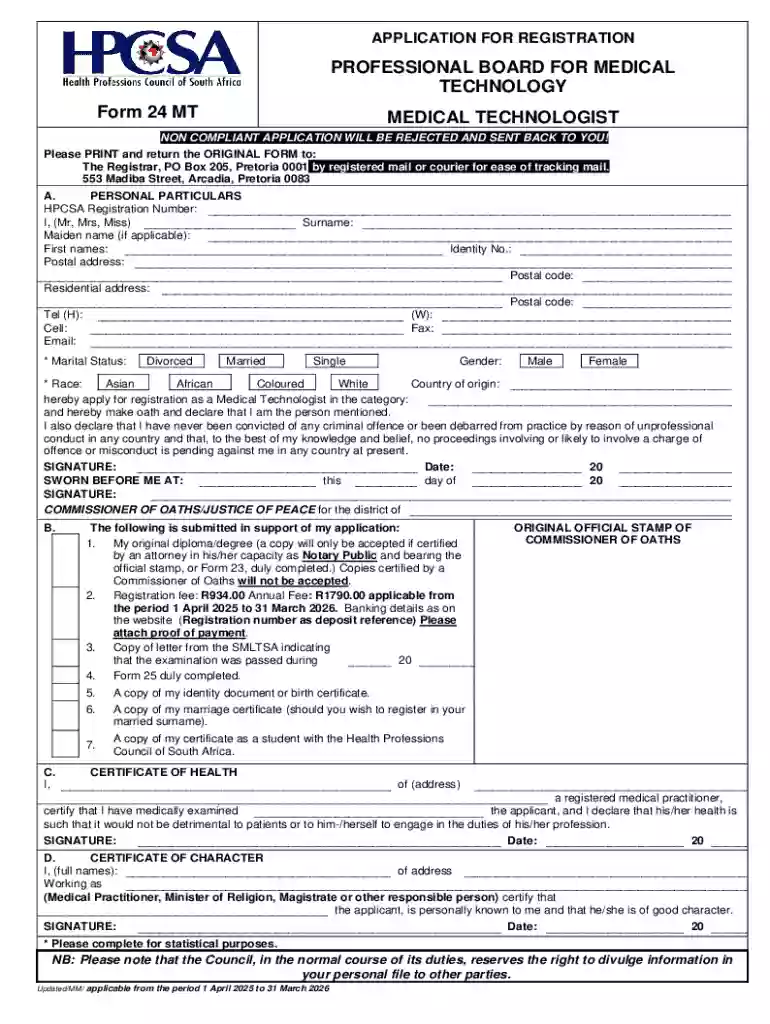
An "Application for Registration" is a form used to document and formalize the enrollment of individuals or entities within a specific organization, profession, or governmental body. This type of form acts as a formal request for entry into a registry and may require pertinent personal, professional, or organizational information. In the context of becoming a Medical Technologist, the form certifies that the applicant meets predetermined qualifications and standards set by the Professional Board for Medical Technology.
Completing an "Application for Registration" necessitates attention to detail. Below is a typical sequence that applicants should follow to ensure all components are accurately filled out.
Gather Necessary Personal Information
Provide Proof of Qualifications
Payment of Fees
Applicants must submit a comprehensive package of documents; incomplete submissions can delay processing.
The approval process for registration varies based on the organization or board handling the applications. Understanding the expected timeline can help applicants manage their expectations.
Submission Review
Verification of Credentials
Approval Notification
Various individuals and entities may need to complete this form based on specific circumstances and professional environments.


Following legal guidelines is crucial to ensure the "Application for Registration" is properly recognized.
Adherence to Regulatory Standards
Data Privacy Considerations
Non-compliance in the application process can lead to various consequences.
In today's digital era, many registration applications can also be submitted online, which provides ease and efficiency.
By emphasizing these crucial aspects of an "Application for Registration," applicants can significantly enhance their understanding and navigate the process more effectively, ensuring successful and timely submissions.
We've got more versions of the Application for Registration form. Select the right Application for Registration version from the list and start editing it straight away!
At DocHub, your data security is our priority. We follow HIPAA, SOC2, GDPR, and other standards, so you can work on your documents with confidence.