






Definition & Meaning
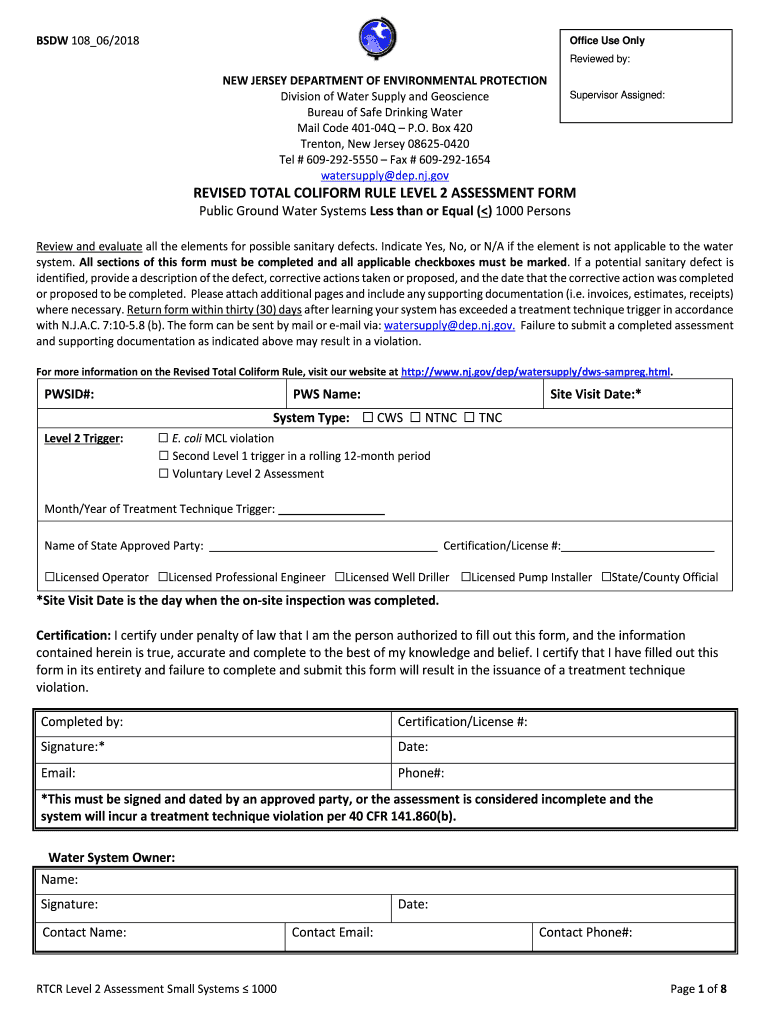
The Revised Total Coliform Rule Level 2 Assessment Form, specifically for public groundwater systems in New Jersey, is designed to help monitor water safety. It focuses on evaluating potential sanitary defects. These defects could lead to contamination, and the form requires a detailed investigation into the system's components and operational practices. By detecting and addressing issues early, the form aims to ensure safe and clean drinking water for communities relying on smaller systems.
Key Elements of the Revised Total Coliform Rule Level 2 Assessment Form
This assessment form contains multiple critical components that help identify and rectify water system defects:
- System Overview: Includes the system's basic details, such as location, capacity, and operator information.
- Sanitary Defect Analysis: Requires a thorough review of possible defects, such as breaches in sanitary conditions, equipment failure, or contamination risks.
- Corrective Actions: Outlines necessary steps taken to correct identified problems, including timelines and responsible personnel.
- Documentation: All actions and observations must be documented meticulously, ensuring compliance with legal standards and providing a clear record of system integrity.
How to Use the Revised Total Coliform Rule Level 2 Assessment Form
To effectively use this form, follow these structured guidelines:
-
Gather Preliminary Data: Collect all relevant system data before beginning the assessment. This includes system schematics, operational records, and recent water quality test results.
-
Conduct the Assessment: Using the form, systematically review each section. Evaluate the physical conditions, operational practices, and historical performance metrics of the water system.
-
Identify Defects: Carefully list any sanitary defects or risks detected through the assessment. Include specific details about the nature and potential impact of each defect.
-
Record Corrective Measures: Document the corrective actions implemented to address each defect noted on the form. Ensure timelines and responsible parties are clearly assigned.
-
Submit the Form: Once all sections are completed, submit the completed form within the stipulated thirty-day period to the appropriate authorities to maintain regulatory compliance.
Steps to Complete the Revised Total Coliform Rule Level 2 Assessment Form
Completing the form requires careful attention to detail and adherence to the following steps:
-
Review System Documentation: Start by examining existing documentation and records to familiarize yourself with the system's current state.
-
Onsite Inspection: Perform a physical inspection of the site to observe real-time operational conditions and identify any visible issues.
-
Fill Out the Form: Accurately complete each section of the form. Ensure all fields are filled, with clear, concise, and factual information noted.
-
Implement and Record Solutions: As issues are identified, promptly execute any necessary corrective measures and record these actions on the form.
-
Final Check and Submission: Double-check for thoroughness and accuracy before submitting the form, maintaining a copy for your records.
Important Terms Related to Revised Total Coliform Rule Level 2 Assessment Form
Understanding the terminology within the form is crucial:
- Coliforms: Bacteria commonly found in the environment; their presence in water indicates potential contamination.
- Sanitary Defects: Conditions that may lead to contamination in the water supply system.
- Corrective Action: Measures taken to rectify identified defects within a water system.
- Trigger Event: An incident or test result indicating potential contamination, prompting the need for this assessment.
State-Specific Rules for the Revised Total Coliform Rule Level 2 Assessment Form
New Jersey’s specific regulations impact how this form is used:
- Applicability: This form applies to public groundwater systems serving 1,000 or fewer persons.
- Submission Timeline: The form must be completed and submitted within thirty days of a treatment technique trigger event.
- Authority Oversight: Coordination with local environmental authorities is required for submission and compliance verification.
Penalties for Non-Compliance
Failure to comply with these assessment requirements may result in serious penalties:
- Fines and Sanctions: Public water systems may be subject to fines if they fail to submit the form on time.
- Increased Scrutiny: Systems may undergo more frequent inspections and potentially incur higher scrutiny from state environmental agencies.
Examples of Using the Revised Total Coliform Rule Level 2 Assessment Form
The form is routinely used in scenarios such as:
- Routine Compliance Checks: Water systems use the form as part of regular inspections to maintain sanitation standards.
- Incident Responses: If high levels of coliforms are detected, the form is used to assess and rectify the issue.
- Regulatory Reporting: It serves as a documented compliance tool for state regulators to evaluate public water systems' adherence to safety standards.
Each block of information here serves to enhance understanding and provide practical insight into using the Revised Total Coliform Rule Level 2 Assessment Form effectively, ensuring compliance and safeguarding public health.