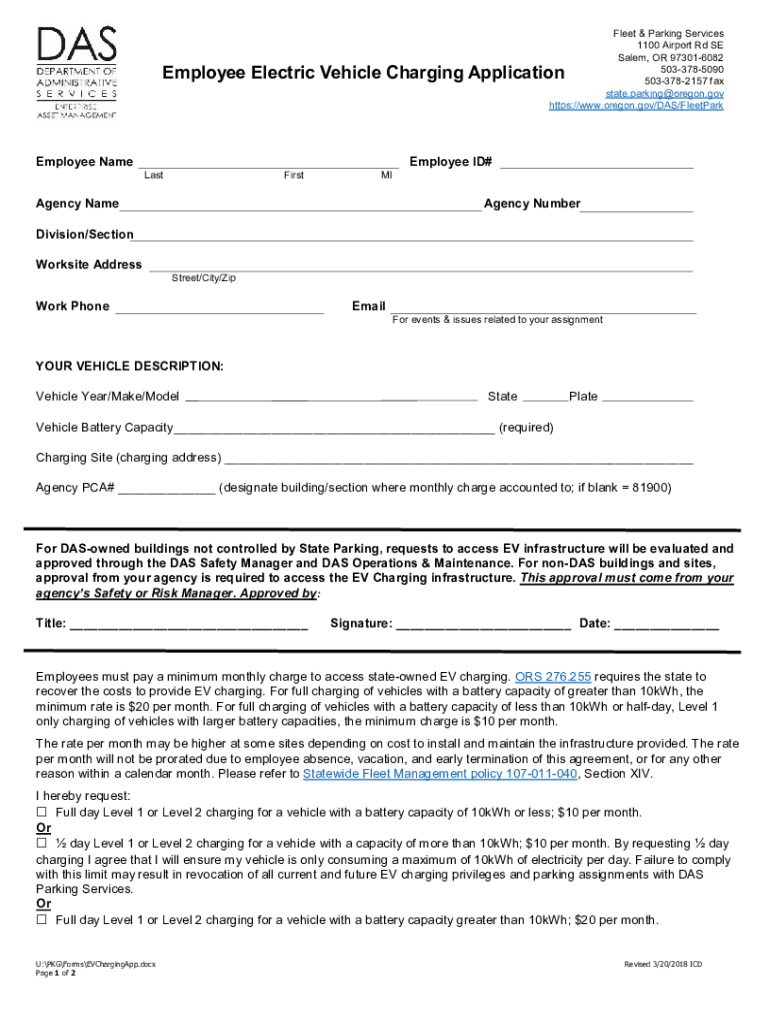







Definition and Purpose of the Employee Electric Vehicle Charging Application
The Employee Electric Vehicle Charging Application is designed for state employees in Oregon who wish to utilize state-owned electric vehicle (EV) charging infrastructure. The application serves as the formal document required to gain approval for using these charging stations and details the necessary requirements and steps involved. By providing a standardized process, the application ensures that employees meet all criteria for charging site approval and agree to the associated costs and regulations.
- Battery Capacity Charges: Employees are informed about monthly fees based on their vehicle’s battery capacity. These charges are designed to cover the costs associated with providing and maintaining the charging infrastructure.
- Safety Regulations: Safety guidelines are an essential feature, ensuring that both the users and the infrastructure are compliant with safety standards.
Application Process and Approval Time
To streamline the application process, employees must complete several steps to ensure timely approval. Understanding this process helps manage expectations regarding timeframes and the required documentation.
- Fill Out the Application Form: Employees must provide detailed vehicle information and specify the desired charging site.
- Submit for Approval: Once completed, the application is submitted to the designated authority for review.
- Approval Notification: After the review, employees are notified about the approval status. The typical approval time may vary depending on the volume of applications and the completeness of the submitted information.
- Authorize Payroll Deductions: As part of the approval, employees need to authorize payroll deductions for the monthly costs associated with EV charging.
Steps to Complete the Application
Completing the application accurately and thoroughly is crucial for a successful and timely approval.
- Gather Required Documents: Before beginning, employees should assemble all necessary vehicle information and any other supporting documents.
- Detail Vehicle Information: Include make, model, and battery capacity, as this helps determine applicable charges.
- Select Charging Site: Select a preferred site for charging, ensuring it aligns with work or residential requirements.
Required Documents for Submission
Certain documents are mandatory for the successful submission of the Employee Electric Vehicle Charging Application. Proper documentation ensures that applications are processed without unnecessary delays.
- Vehicle Registration: Proof of registration must be provided to validate the vehicle’s eligibility for state charging subsidies.
- Proof of Employment: A valid state employee ID or equivalent documentation is required as proof of employment status, confirming the employee’s eligibility.
- Authorization of Payroll Deduction Form: This can be a part of the application form or a separate document, specifying agreement to the automatic deduction of charges.
Legal Use and Compliance
Understanding the legal implications of using the Employee Electric Vehicle Charging Application is critical. This section outlines the binding agreements and compliance aspects.
- Legally Binding Agreement: By signing the application, employees consent to a legally binding agreement that holds them accountable to comply with all rules and costs.
- Adherence to Policies: Employees must adhere to all organizational policies and guidelines regarding the use of EV charging stations, ensuring responsible and fair usage.
State-Specific Rules and Differences
The application process and regulations can differ based on state guidelines. In Oregon, specific rules apply that may not be present in other states, emphasizing the importance of regional compliance.
- Oregon’s EV Infrastructure: Oregon has invested significantly in EV infrastructure, making it an exemplary state for electric vehicle integration.
- State Incentives: As a progressive move, Oregon may offer incentives for employees who switch to electric vehicles, promoting an eco-friendly initiative.
Eligibility Criteria for Applicants
Before applying, it’s important for state employees to ensure they meet eligibility requirements. This section offers detailed insight into who can apply.
- Employment Status: Applicants must be current state employees, as verified by appropriate documentation.
- Vehicle Eligibility: Only electric vehicles are eligible for charging under this application, excluding hybrids or gas-powered cars.

Form Submission Methods
The Employee Electric Vehicle Charging Application can be submitted through various methods to accommodate different preferences and facilitate accessibility.
- Online Submission: This is typically the preferred method due to its convenience and efficiency, offering a streamlined process for both submission and approval tracking.
- Mailing Option: For those who prefer traditional methods, submissions by mail are accepted, though they may result in longer processing times.
- In-Person Submission: Occasionally available, this method allows for direct support during submission, helping to ensure that all required information is accurately provided.
Key Elements of the Application Form
Understanding what sections require particular attention can ensure an accurately completed application.
- Personal Information: Applicants must provide current contact information and work details, ensuring timely communication from the approving body.
- Vehicle Details: A comprehensive section dedicated to vehicle specifics such as battery type and capacity. Accurate information here is essential for determining cost and eligibility.
- Site Preference and Usage: Identifying preferred charging sites, with clear guidelines about their operation and availability.
This comprehensive view into the Employee Electric Vehicle Charging Application highlights the importance of thorough preparation and understanding for successful completion and submission. By addressing all relevant aspects, employees can achieve a seamless transition to using the state's electric vehicle infrastructure.