






Definition & Meaning
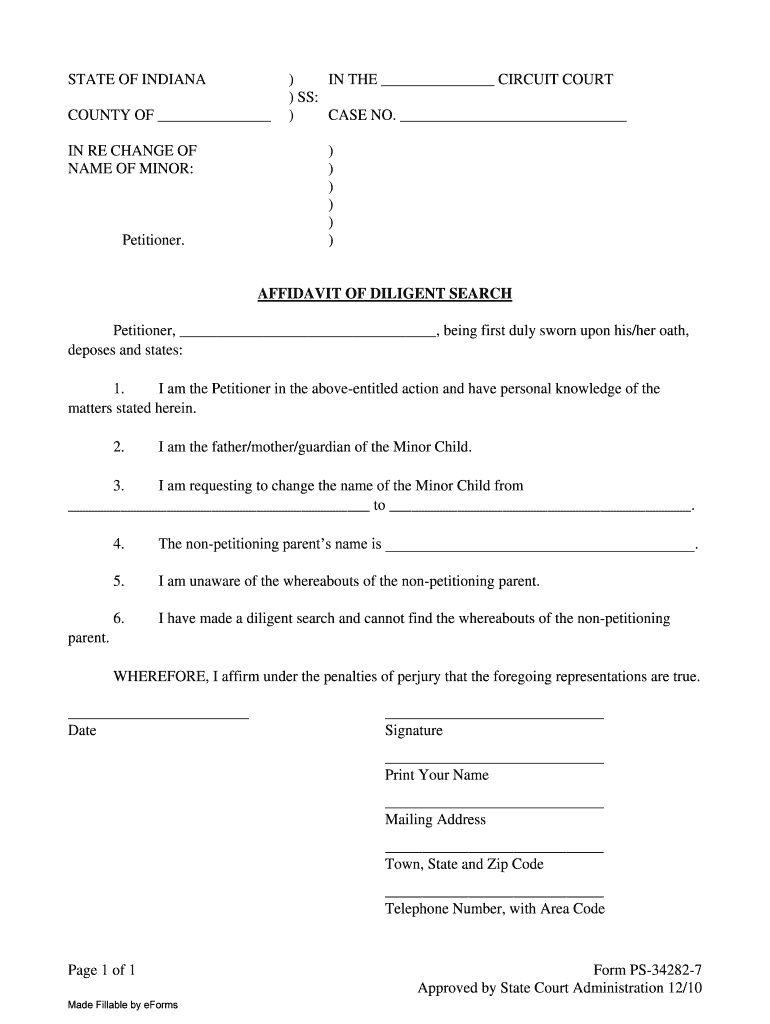
The "Indiana - Affidavit of Diligent Search (No Consent)" is a legal document used in Indiana courts, specifically within the context of family law matters such as name change requests for a minor. The affidavit serves to demonstrate to the court that a petitioner has made diligent efforts to locate a non-consenting parent, acknowledging that despite such efforts, their whereabouts remain unknown. This document is critical when one parent seeks to move forward with legal proceedings without the other parent's consent, necessitating a formal declaration of exhaustive search attempts.
How to Use the Indiana - Affidavit of Diligent Search (No Consent)
-
Initiate a Name Change Petition: When seeking a minor name change, the parent or guardian must typically submit a petition to the Indiana Circuit Court. The affidavit of diligent search becomes a part of this filing process if the other parent's location is unknown.
-
Document Search Efforts: The petitioner must clearly outline the specific steps taken to locate the absent parent. This includes attempts such as contacting relatives, checking social media profiles, and querying public records.
-
Submit the Affidavit: File the completed affidavit with the court as part of the petition packet. Ensure all sections are filled accurately to avoid delays.
-
Await Court Decision: After submission, the court will review the affidavit and other accompanying documents to decide on granting the petition without the non-consenting parent's involvement.
Steps to Complete the Indiana - Affidavit of Diligent Search (No Consent)
-
Gather Information: Before completing the affidavit, compile details of the absent parent, such as their last known address, previous employment, and any known connections that might aid the search.
-
Detail Search Efforts: Clearly and methodically document every attempt made to locate the missing parent. Include specifics like dates, methods used, and any responses received.
-
Provide Supporting Evidence: Attach copies of relevant communications or public records that substantiate the search claims. This might include emails, letters, or search reports.
-
Affirm Oath: Sign the affidavit in the presence of a notary public to validate the claims under oath.
-
Submit to Court: Once completed and notarized, file the affidavit with the relevant court office handling the family law case.
Key Elements of the Indiana - Affidavit of Diligent Search (No Consent)
- Petitioner Information: Includes full name, relation to the minor, and contact information.
- Child's Details: Name and age of the child for whom the name change is sought.
- Non-Consenting Parent Information: Known details about the parent whose consent is not provided.
- Efforts Made: A comprehensive list of attempts to locate the non-consenting parent.
- Signature and Notarization: The document must be signed under oath and notarized to ensure its legal validity.
Legal Use of the Indiana - Affidavit of Diligent Search (No Consent)
In the state of Indiana, this affidavit is utilized primarily in legal procedures where the court's decision is contingent on the petitioner proving that they have made all possible efforts to involve the other parent. Such proceedings often pertain to family law matters, where modifications to a child's legal documentation require both parental inputs, or, in this case, a documented absence of input from one parent.
State-Specific Rules for the Indiana - Affidavit of Diligent Search (No Consent)
Indiana has specific guidelines regarding the search process and the affidavit's credibility. The court may require detailed documentation to validate each search attempt. Failure to meet these state-prescribed standards could result in delays or denial of the petition. Legal professionals often recommend consulting state-specific resources or seeking legal advice to ensure compliance with Indiana laws.
Required Documents
To effectively file the affidavit, gather the following:
- Birth certificate of the minor
- Petition for name change
- Previous court orders involving custody, if applicable
- Copies of any communication made during the search
- Any publicly available records or search results that support the diligence of the efforts
Form Submission Methods
- In-Person: Submitting at the local court clerk's office ensures immediate attention.
- Mail: Sending the documents via certified mail offers a reliable method with proof of submission.
- Online: Some jurisdictions may provide online submission for affidavits within their e-filing systems.
Fulfilling these sections with the appropriate content will help ensure a comprehensive understanding and correct filing of the Indiana - Affidavit of Diligent Search (No Consent).