







Definition & Meaning
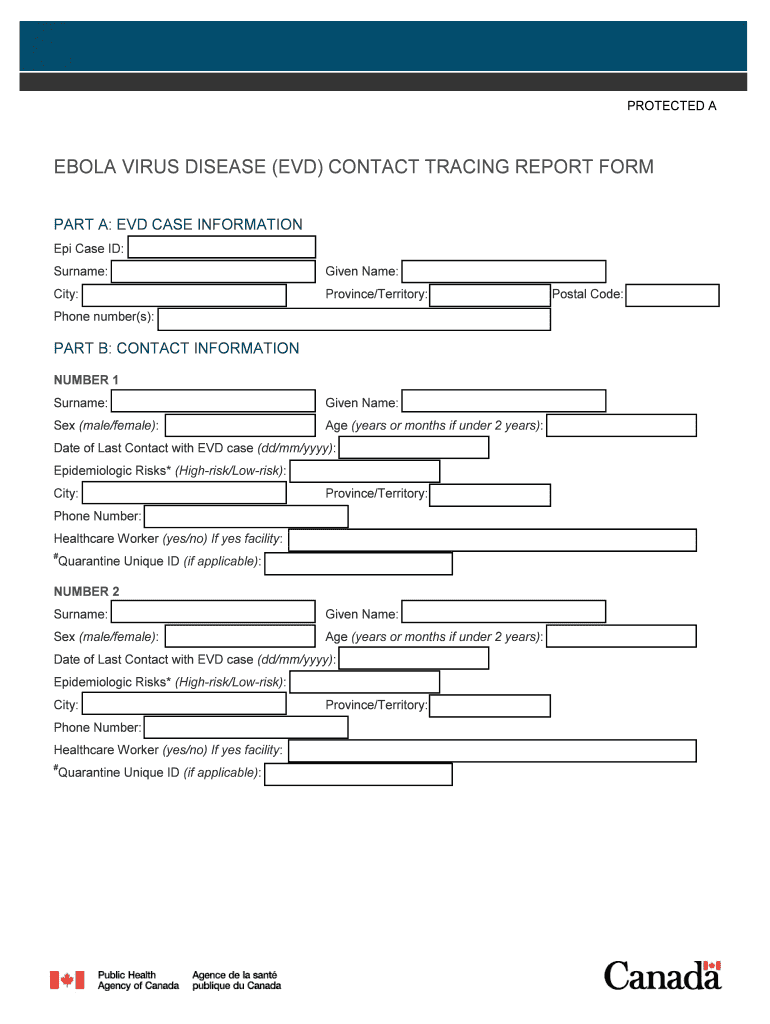
The Ebola Virus Disease (EVD) Contact Tracing Report Form is a specialized document used to collect crucial data about individuals exposed to or infected with EVD. The primary goal is to identify and monitor individuals who have come into contact with confirmed EVD cases, to mitigate the spread of this highly infectious disease. The form contains fields for collecting detailed information on both the infected individual and their contacts, providing insight into demographics, potential risk levels, and healthcare engagement.
Key Features
- Personal Details: Captures information about both EVD cases and their contacts, including names, contact information, and personal identification numbers.
- Exposure Categories: Defines high and low-risk exposure levels to streamline prioritization in follow-ups and interventions.
- Healthcare Interaction: Determines if contacts are healthcare workers, offering a clearer picture of potential transmission vectors within healthcare settings.
How to Use the Evola Virus Disease (EVD) Contact Tracing Report Form
Efficiently using the EVD Contact Tracing Report Form involves understanding its structure and completing it with precision to ensure accurate data collection for effective contact tracing.
Completion Steps
- Identify Participants: Begin by accurately identifying the EVD case and their contacts. Ensure that personal data is accurate and up-to-date.
- Document Exposure: Record the last contact date with the EVD case and classify the level of exposure risk.
- Assess Risk Level: Use predefined criteria to establish whether each contact is at high or low risk, guiding subsequent monitoring actions.
Practical Tips
- Ensure Legibility: Whether digital or paper, ensure that entries are clear and legible to facilitate efficient processing and follow-up.
- Verify Information: Double-check all entered data for accuracy, as errors can lead to flawed tracing outcomes and missed containment opportunities.
Steps to Complete the Evola Virus Disease (EVD) Contact Tracing Report Form
Completing the EVD Contact Tracing Report Form requires careful attention to detail and an understanding of each section’s purpose.
Step-by-Step Guide
- Fill Personal Information: Start with personal details of the EVD case and contacts such as full name, age, and address.
- Record Contact Dates: Notate the dates of last contact with the EVD case to establish timelines for potential virus incubation.
- Risk Assessment: Determine the epidemiologic risk level for each contact based on their exposure and healthcare status.
Examples
- High-Risk Contact: A family member living with an EVD case.
- Low-Risk Contact: A colleague who shared an office with an ample distancing protocol in place.
Who Typically Uses the Evola Virus Disease (EVD) Contact Tracing Report Form
The target users of the EVD Contact Tracing Report Form are varied but generally include public health officials, medical professionals, and epidemiological researchers. These users play a crucial role in identifying and managing disease spread within communities.


Key Users
- Public Health Agencies: Utilize the form for population-wide screening and intervention strategies.
- Healthcare Providers: Complete and review forms to safeguard their workplace and manage patient care efficiently.
- Researchers: Analyze form data to assess transmission trends and disease management efficacy.
Important Terms Related to the Evola Virus Disease (EVD) Contact Tracing Report Form
Understanding the terminology associated with EVD contact tracing is essential for effective communication and data interpretation.
Common Terms
- Incubation Period: Time between exposure to the virus and the onset of symptoms.
- Epidemiologic Risk Level: Classification determining potential contagiousness, guiding isolation measures.
- Demographics: Detailed statistical data relating to the population involved in contact tracing.
Key Elements of the Evola Virus Disease (EVD) Contact Tracing Report Form
The completeness and accuracy of the form hinge on several key elements that gather comprehensive data for each contact identified.
Core Components
- Demographic Information: Helps in analyzing which segments of the population are most at risk.
- Exposure and Interaction Details: Provides insights into how the virus may spread within communities and healthcare settings.
- Health Monitoring Parameters: Assists in planning for health interventions and care logistics.
Legal Use of the Evola Virus Disease (EVD) Contact Tracing Report Form
The EVD Contact Tracing Report Form must be used in compliance with legal standards to protect the privacy and rights of individuals while facilitating disease management.
Legal Considerations
- Data Protection: Ensure all collected data adheres to privacy laws, such as the Health Insurance Portability and Accountability Act (HIPAA).
- Informed Consent: Obtain consent from all participants before gathering their information.
- Confidentiality: Maintain strict confidentiality of all contact traces to uphold ethical and legal responsibilities.
State-Specific Rules for the Evola Virus Disease (EVD) Contact Tracing Report Form
While the core structure of the EVD Contact Tracing Report Form remains consistent, certain states may have additional requirements or variations in form usage.
Variations and Adaptations
- State Health Regulations: States may impose additional health data collection parameters to align with local disease control policies.
- Reporting Procedures: Submission timelines and methods might vary, necessitating adaptation to state-specific protocols for processing contact tracing data effectively.
Examples of Using the Evola Virus Disease (EVD) Contact Tracing Report Form
Real-world application of the EVD Contact Tracing Report Form demonstrates its significance in managing public health crises.
Case Study
- Community Outbreak Management: In a small rural community, a confirmed EVD case led to swift contact tracing using the form. The completion of forms enabled timely intervention, significantly reducing further transmission.
By understanding and correctly utilizing the EVD Contact Tracing Report Form, relevant professionals can play a key role in controlling and containing Ebola outbreaks, thereby promoting safer and healthier communities.




