




01. Edit your form online
Type text, add images, blackout confidential details, add comments, highlights and more.

Type text, add images, blackout confidential details, add comments, highlights and more.

Draw your signature, type it, upload its image, or use your mobile device as a signature pad.

Send it via email, link, or fax. You can also download it, export it or print it out.
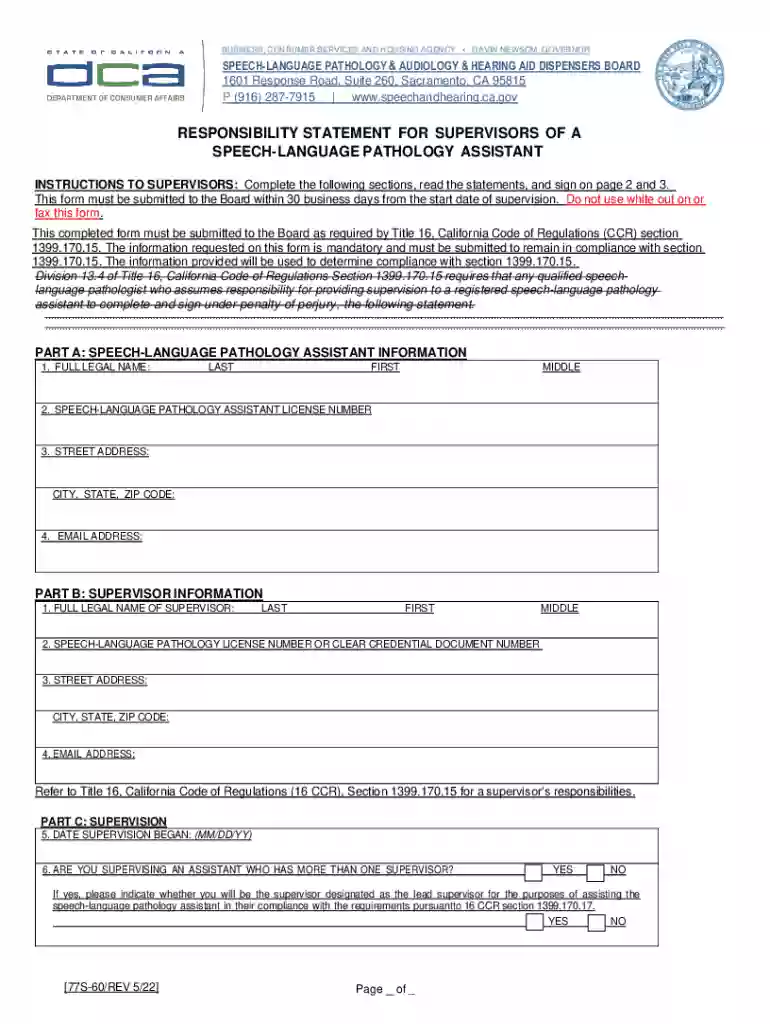
The "Responsibility Statement for Supervision of a Speech-Language Pathology Assistant (77S-60, Rev 5 22)" is an official document that outlines the obligations of supervisors overseeing speech-language pathology assistants (SLPAs) in California. This form ensures that SLPAs operate under appropriate supervision while fulfilling professional and legal standards. It includes specific details about qualifications, mandates under Title 16 of the California Code of Regulations, and requires that both supervisors and assistants provide personal and professional information.
To effectively use the Responsibility Statement, supervisors must ensure that they meet all stated qualifications and understand the obligations described in the form. The completed statement certifies that they will adhere to legal and professional requirements while supervising an SLPA. Both the supervisor and the assistant must complete their respective sections accurately to ensure compliance. Regular reviews of the statement may be necessary to ensure ongoing adherence to the outlined responsibilities.
Personal Information: Start by filling out the personal details section for both the supervisor and the SLPA, including names, addresses, and contact details.
Qualifications: The supervisor must provide proof of qualifications, detailing their ability to oversee an SLPA according to the specified regulations.
Compliance Agreement: Both parties should read the compliance requirements carefully. The supervisor must confirm understanding and adherence to the professional standards and Title 16 regulations.
Signature Section: The form must include signatures from both the SLPA and the supervisor, confirming the accuracy of the provided information and their commitment to the outlined responsibilities.
Submission: Submit the completed form within 30 business days of the commencement of supervision. Check for any specific submission guidelines, such as online or mail options, to ensure timely processing.
California’s specific legal standards govern the responsibilities outlined in this document. Supervisors must familiarize themselves with Title 16, which emphasizes proper credentialing, legal compliance, and professional conduct requirements relevant to the state's guidelines for supervising SLPAs. Understanding these rules is essential for avoiding legal pitfalls and ensuring the legitimacy of the SLPA's work under the supervision.
The statement serves as a legally binding agreement between the supervisor and the SLPA. It acts as proof of compliance with state regulations and validates the working relationship under legal scrutiny. Supervisors and SLPAs must ensure the document is completed correctly to avoid penalties or legal repercussions due to non-compliance or misrepresentation.
Case Scenario: A licensed speech-language pathologist in California uses the statement to legally supervise a newly hired SLPA. They review and submit the statement to comply with state regulations, ensuring both parties understand their roles and responsibilities.
Training Situations: In training programs, this document serves as a foundational tool to outline the expectations and responsibilities of supervisors towards their assistants, providing a framework for evaluating the competence and development of the SLPA.
Non-compliance with the completion or submission of the Responsibility Statement can lead to substantial penalties. These may include fines, revocation of licenses, or the inability to legally employ SLPAs. Supervisors must ensure the form is accurately completed, submitted on time, and regularly reviewed for compliance to avoid such outcomes.
We've got more versions of the Responsibility Statement for Supervision of a Speech-Language Pathology Assistant (77S-60, Rev 5 22) form. Select the right Responsibility Statement for Supervision of a Speech-Language Pathology Assistant (77S-60, Rev 5 22) version from the list and start editing it straight away!
At DocHub, your data security is our priority. We follow HIPAA, SOC2, GDPR, and other standards, so you can work on your documents with confidence.
A Supervisory Responsibility Statement Form shall be submitted in a manner prescribed by the department by both the applicant and the proposed supervisor.
[77S-60/REV 5/22]. Page of . RESPONSIBILITY STATEMENT FOR SUPERVISORS OF A. SPEECH-LANGUAGE PATHOLOGY ASSISTANT. INSTRUCTIONS TO SUPERVISORS: Complete theRead more


