






Definition and Meaning
A "Motion for Partial Summary - GSBCA GSA" is a legal document filed in cases reviewed by the Board of Contract Appeals, particularly those involving the General Services Administration (GSA). This motion seeks a summary judgment on specific parts of a larger dispute, allowing the court to resolve these issues without a full trial if there are no material facts in dispute. Such motions often occur in contractual disputes where a party, such as a contractor, believes that certain claims or defenses have clear answers based on the evidence presented, along with the legal standards applicable to the case.
Contextual Importance
A motion for partial summary judgment is crucial in legal proceedings as it can expedite the resolution of straightforward issues, thereby narrowing the scope of the matters that need to be addressed in a full trial. This efficiency can save time and resources for both the courts and the parties involved in the dispute.
How to Use a Motion for Partial Summary - GSBCA GSA
Filing a motion for partial summary judgment involves submitting a detailed written argument to the court. This document must outline the undisputed facts, cite relevant legal standards, and argue why those facts, when applied to the relevant law, justify a judgment in favor of the party filing the motion on specific claims or defenses.
Preparing the Motion
- Gather Evidence: Compile all relevant documentation that supports the claims for which you seek partial summary judgment.
- Drafting: Write a clear and concise motion, specifying the facts that are not in dispute and supporting them with legal precedents and evidence.
- Legal Support: Reference statutory provisions, case law, and contractual terms that bolster your argument.
Steps to Complete the Motion for Partial Summary - GSBCA GSA
- Identify the Claims: Pinpoint the claims or defenses for which you seek summary judgment.
- Collect Documentation: Gather all necessary documents, such as contracts, correspondence, and affidavits, that support your motion.
- Writing the Motion: Draft the motion with a detailed account of undisputed facts, applicable laws, and relevant arguments.
- File the Motion: Submit the motion to the appropriate court and serve a copy to the opposing party.
- Court Hearing: Attend any hearings scheduled by the court pertaining to the motion.
Important Considerations
- Proof of No Dispute: A critical part of the motion is demonstrating that there are no material facts in dispute regarding the claims addressed.
- Legal Rationale: Clearly articulate why the law favors your position based on the undeniable facts.
Who Typically Uses the Motion for Partial Summary - GSBCA GSA
This type of motion is commonly used by legal representatives of parties involved in contractual disputes with the GSA. This includes general contractors, subcontractors, and suppliers engaged in governmental projects where contractual terms or execution are under scrutiny.


Commonly Involved Parties
- Contractors: Businesses involved in construction or service delivery under government contracts.
- Legal Practitioners: Attorneys representing parties in disputes before the Board of Contract Appeals.
Key Elements of the Motion for Partial Summary - GSBCA GSA
- Undisputed Facts: A clear list of facts considered not open to debate.
- Legal Basis: The statutory or case law supporting the motion.
- Written Argument: A persuasive narrative tying the evidence to the legal framework.
- Request for Relief: A clear statement of the judgment sought by the filing party.
Legal Use of the Motion for Partial Summary - GSBCA GSA
The motion serves as a strategic legal tool to achieve a resolution on specific issues within a case, reducing the issues for trial and providing clarity on the enforceability of certain contractual clauses or obligations.
Illustrative Use-Cases
- Construction Disputes: When a contractor seeks resolution on specific clauses of a construction contract with the GSA.
- Labor Issues: Cases where labor inefficiencies and their causes are sufficiently documented to merit summary judgment.
State-Specific Rules for the Motion for Partial Summary - GSBCA GSA
Although federal guidelines often dictate the use of motions in federal tribunals, state-specific nuances may influence procedural aspects. It is essential for filing parties to consult local rules that might affect deadlines and filing procedures.
Examples of Nuances
- Filing Deadlines: States may have specific deadlines for filing, dictating the timing of when such motions must be submitted.
- Procedural Variations: Differences in how evidence is presented, such as affidavits versus depositions, might be state-dependent.
Examples of Using the Motion for Partial Summary - GSBCA GSA
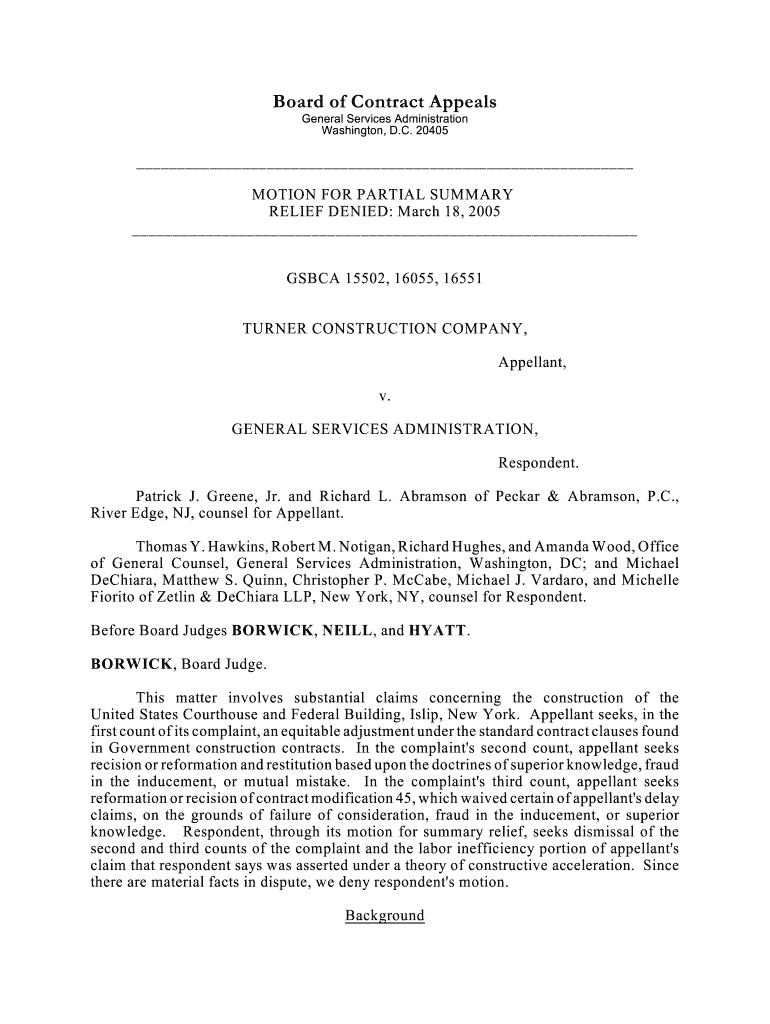
Real-life applications include contractual disputes such as those in the United States Courthouse in Islip, New York, where issues like the adequacy of construction drawings and contract modifications are decided.
Case Study
- Turner Construction Company vs. GSA: In this dispute, Turner sought equitable adjustments for construction delays, wherein a motion for partial summary judgment was filed to expedite resolution over specific claims related to design deficiencies.
Through thorough preparation and strategic legal thinking, parties can effectively use motions for partial summary judgment to gain favorable outcomes in dispute resolution proceedings with the GSA.