






Definition & Purpose of Triangle Unit Parts 1 3 Worksheet
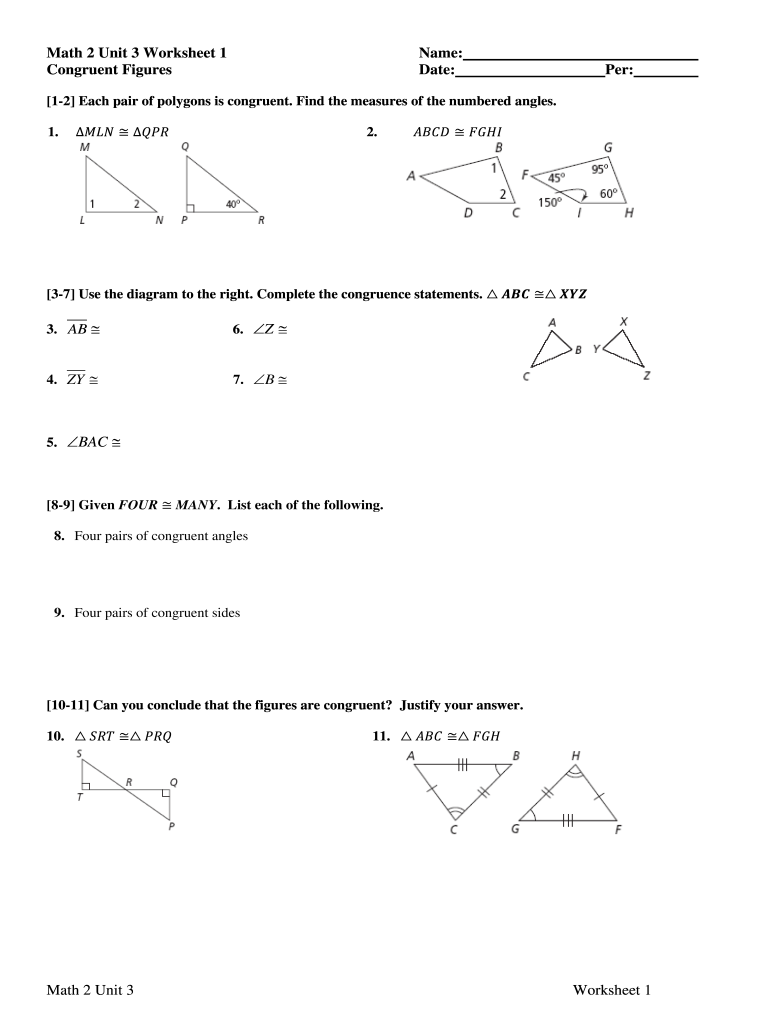
The "Triangle Unit Parts 1 3 Worksheet" is a structured educational tool focusing on the mathematical study of triangles, crucial for Middle and High School curricula in the United States. This worksheet is designed to help students understand concepts related to congruent triangles, transformations, and proofs. By engaging with this resource, students improve their skills in identifying congruent figures, proving triangle congruence using postulates such as SSS (Side-Side-Side) and ASA (Angle-Side-Angle), and understanding properties of geometric transformations like rotations and reflections.
How to Use the Triangle Unit Parts 1 3 Worksheet
Using the "Triangle Unit Parts 1 3 Worksheet" involves several steps to ensure a comprehensive engagement with the material:
- Review Instructions: Begin by reading the instructions provided at the top of the worksheet to understand the expectations and outcomes.
- Identify Congruent Angles and Sides: The worksheet tasks students with labeling congruent angles and sides using the given figures.
- Complete Congruence Statements: Practice writing and completing statements that show congruence between triangles.
- Utilize Postulates for Proofs: Employ SSS, SAS (Side-Angle-Side), ASA, and AAS (Angle-Angle-Side) postulates to prove triangle congruence.
- Apply Transformations: Follow exercises involving geometric transformations such as reflections and rotations of triangles.
- Self-Check and Review: Use any provided answer keys to verify solutions and understand mistakes or misapprehensions.
Key Elements of the Triangle Unit Parts 1 3 Worksheet
The worksheet typically includes several key components that aid in learning:
- Congruence Proof Exercises: Tasks that involve proving triangles are congruent using different mathematical postulates.
- Transformation Problems: Exercises focusing on applying transformations, such as reflections and rotations on triangles.
- Congruence Statement Completion: Activities where students must complete statements depicting congruence relationships.
- Geometric Diagrams: Visual aids that depict triangles, requiring students to identify congruent segments and angles.
- Properties of Perpendicular Lines and Angle Bisectors: Concepts covered include how perpendicular lines and angle bisectors relate to triangle geometry.
Steps to Complete the Triangle Unit Parts 1 3 Worksheet
To effectively complete the worksheet, students should:
- Familiarize with Postulates: Review and understand postulates such as SSS, SAS, ASA, and AAS before starting.
- Analyze Given Diagrams: Carefully examine any diagrams or geometric figures provided.
- Work Through Problems Sequentially: Tackle problems in order, as many build on prior concepts.
- Document Solutions Neatly: Write down each step of your solution, ensuring clarity in reasoning.
- Review and Revise: Go through solutions again to check for errors, especially in proof logic and calculations.
Important Terms Related to Triangle Study
Understanding the key terms associated with the triangle worksheet facilitates better comprehension:
- Congruent Figures: Two shapes that are identical in shape and size.
- Transformation: Movements of figures in a plane, including translations, rotations, reflections, and dilations.
- Perpendicular Lines: Lines that intersect to form right angles.
- Angle Bisector: A line that splits an angle into two equal angles.
Examples of Using the Triangle Unit Parts 1 3 Worksheet
Several practical examples demonstrate the utility of this worksheet:
- Classroom Setting: Teachers may distribute the worksheet for practice during geometry lessons on triangle congruence and transformations.
- Homework Assignment: Students might complete the worksheet at home to reinforce learning outcomes and prepare for exams.
- Peer Study Groups: Learners can collaborate in small groups, using the worksheet to discuss and solve triangle-related problems together.
Who Typically Uses the Triangle Unit Parts 1 3 Worksheet
This worksheet is primarily used by:
- Students in Geometry Courses: Particularly those focusing on middle and high school levels.
- Teachers and Educators: As a resource for classroom instruction and assessment.
- Tutors: Providing additional support to students needing extra practice or clarification.


Software Compatibility with Educational Tools
Integrating educational technology can enhance the use of the worksheet:
- Document Editing Software: Apps like those provided by DocHub facilitate the digital editing and annotation of worksheets.
- Online Learning Platforms: Teachers may upload worksheets to platforms like Google Classroom, allowing for easy access and submission.
- Digital Math Tools: Software such as GeoGebra supports interactive exploration of geometric concepts.