




01. Edit your form online
Type text, add images, blackout confidential details, add comments, highlights and more.

Type text, add images, blackout confidential details, add comments, highlights and more.

Draw your signature, type it, upload its image, or use your mobile device as a signature pad.

Send it via email, link, or fax. You can also download it, export it or print it out.
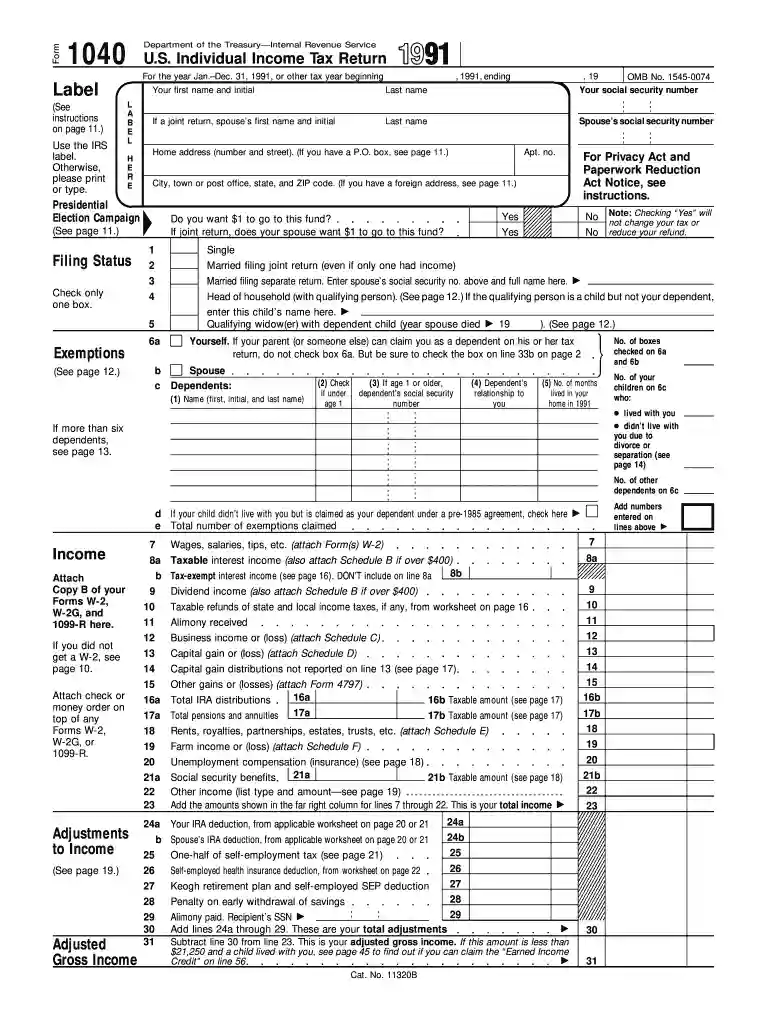
The 1991 U.S. Individual Income Tax Return Form, commonly referred to as Form 1040, is a critical document used by taxpayers to report their income to the Internal Revenue Service (IRS). The form allows individuals to detail their income, claim deductions and credits, and calculate their overall tax liability for the year 1991. It included several sections that cover personal information, filing status, exemptions, income sources, adjustments to income, and more. This document plays a vital role in ensuring compliance with federal tax obligations and helps determine whether a taxpayer owes additional taxes or is eligible for a refund.
Completing Form 1040 for the 1991 tax year involves several detailed steps designed to ensure accuracy in reporting.
Gather Required Documents: Collect all necessary financial documents, including W-2s, 1099s, and records of other income.
Fill Out Personal Information: Begin by entering your name, address, and Social Security number at the top of the form.
Determine Filing Status: Choose the appropriate filing status—such as single, married filing jointly, or head of household—based on your circumstances for that tax year.
Exemptions and Dependents: Input the number of exemptions you’re claiming, including yourself, your spouse, and any dependents.
Report Income: Accurately report all sources of income, including wages, interest, dividends, and other earnings.
Calculate Adjustments: Identify any applicable adjustments to your income to reduce your overall taxable income.
Credits and Deductions: Apply eligible tax credits and deductions to lower the amount of taxes owed.
Tax Liability and Payments: Calculate your total tax liability and compare it against your tax payments to determine if you owe additional tax or are due a refund.
Being familiar with key terminology related to Form 1040 is crucial for accurate completion:
Form 1040 serves as the official document for legally reporting individual federal income taxes for the year 1991. Compliance with the form's completion and submission requirements ensures adherence to federal law. The IRS uses the information provided to verify income, deductions, and credits, making the form an essential tool in maintaining tax transparency and integrity. Misreporting or underreporting income on this form can lead to penalties or audits by the IRS.
For the 1991 tax year, the deadline for filing Form 1040 was April 15, 1992. Taxpayers who failed to meet this deadline could request an extension, typically granted until August 15 of the same year. Filing by this date helps avoid late fees and penalties. It is crucial for taxpayers to be aware of these deadlines each tax year to maintain compliance and avoid unnecessary complications.
Form 1040 is used by U.S. individuals who meet certain income thresholds. This includes:
The form accommodates various income types, making it adaptable for a wide range of taxpayers.


The IRS provides comprehensive instructions for completing Form 1040, ensuring taxpayers understand each section. These guidelines help clarify how to report different types of income, claim applicable deductions, and apply proper tax credits. The instructions also cover frequently encountered scenarios and exceptions, giving taxpayers the necessary tools to accurately complete the form.
Accurate completion of Form 1040 requires several documents to substantiate reported figures:
Ensuring all documents are organized and accessible helps streamline the tax filing process.
While the original 1991 Form 1040 was predominantly submitted in paper form, taxpayers now have the option to submit their tax documents electronically. Electronic filing enhances accuracy, speeds up processing times, and reduces the risk of error. Documentation must be digitized and verified to ensure compliance with digital filing standards. Electronic filing systems often provide built-in checks and validations, further ensuring the correct information is submitted.
By using these sections to provide depth and value, users will better understand the 1991 Form 1040, ensuring they complete their tax obligations accurately and effectively.
We've got more versions of the 1991 form form. Select the right 1991 form version from the list and start editing it straight away!
| Versions | Form popularity | Fillable & printable |
|---|---|---|
| 2025 | 4.9 Satisfied (56 Votes) | |
| 2024 | 4.5 Satisfied (50 Votes) | |
| 2023 | 4.9 Satisfied (56 Votes) | |
| 2022 | 4.3 Satisfied (60 Votes) | |
| 2021 | 4.8 Satisfied (50 Votes) | |
| 2020 | 4.4 Satisfied (257 Votes) | |
| 2019 | 4.2 Satisfied (85 Votes) | |
| 2018 | 4.4 Satisfied (346 Votes) | |
| 2017 | 4 Satisfied (21 Votes) | |
| 2017 | 4.4 Satisfied (458 Votes) | |
| 2016 | 4.4 Satisfied (657 Votes) | |
| 2015 | 4.3 Satisfied (174 Votes) | |
| 2014 | 4 Satisfied (48 Votes) | |
| 2013 | 4 Satisfied (70 Votes) | |
| 2012 | 4 Satisfied (28 Votes) |
At DocHub, your data security is our priority. We follow HIPAA, SOC2, GDPR, and other standards, so you can work on your documents with confidence.


