






Definition & Meaning
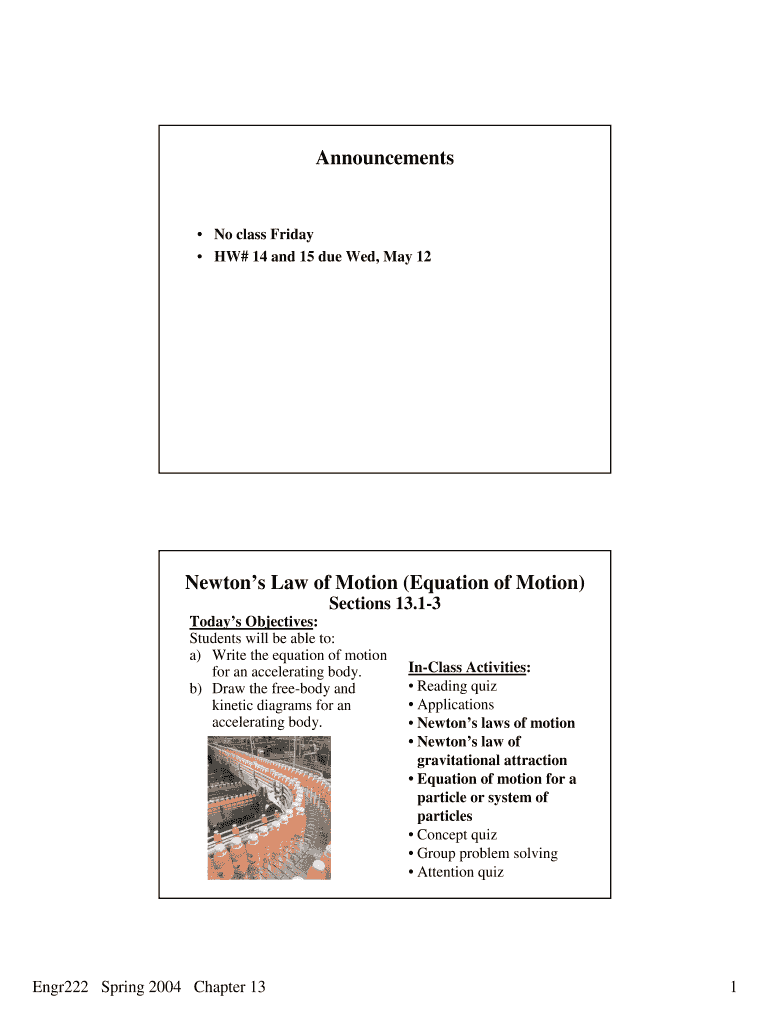
Understanding the concept of "Announcements Newton's Law of Motion (Equation of Motion) - people wallawalla" involves delving into both physics and community communications within an educational setting. Newton's laws of motion describe the relationship between a body and the forces acting upon it, alongside its motion in response to those forces. This specific document appears to relate to course announcements or educational materials that incorporate these scientific principles.
Breaking Down the Elements
- Newton's Laws: These include the law of inertia, the equation F=ma (force equals mass times acceleration), and the principle of action and reaction.
- Equation of Motion: This refers to equations that describe the motion of a body under the influence of forces.
- People Walla Walla: Likely a reference to a community or demographic focus, such as students or faculty at a location identified as Walla Walla. This part could relate to local educational institutions or student groups.
How to Use the Document
This document serves as a comprehensive guide or educational resource, particularly within an academic or instructional setting focused on physics and motion.
Practical Steps for Utilization
- Incorporate in Curriculum: Use it as a resource for teaching Newton's laws of motion, integrating practical examples and problem-solving sessions into classroom activities.
- Educational Announcements: Form a basis for regular updates about coursework, such as deadlines, class activities, and objectives.
- Community Engagement: Engage specific demographics, like the Walla Walla community, in educational initiatives or physics forums.
How to Obtain the Document
Accessing this document requires steps tailored to educational or community-based sourcing.
Acquisition Process
- Institutional Request: Obtain through educational institution libraries or course administrators.
- Online Resources: Access might be provided through platforms like DocHub for document management and distribution.
- Community Centers: For demographic-specific documents, contact local community centers in Walla Walla.
Steps to Complete the Document
Completing any sections within this document involves a systematic approach to ensure all educational activities are covered.
Step-by-Step Process
- Read Thoroughly: Carefully read through all announcements and instructions.
- Schedule Alignment: Sync document contents with existing course schedules and deadlines.
- Participate in Activities: Engage with quizzes, assignments, and interactive sessions outlined.
Key Elements of the Document
Several core components make this type of document invaluable for educational purposes.
Critical Components
- Study Guides: Detailed summaries of each law of motion and their applications.
- Interactive Sessions: In-class activities like quizzes or problem-solving exercises.
- Announcements Section: Updates on schedule changes, deadlines, or important academic dates.
Important Terms
Understanding technical terms within the document can aid in effective usage.
Glossary Highlights
- Inertia: Resistance of an object to change its state of motion.
- Force and Mass Relation: Central to the second law, defining how force is proportional to mass and acceleration.
- Reaction Forces: Fundamental to understanding the third law of motion.
Legal Use and Compliance
Ensuring that the document is used legally and ethically within educational environments is crucial.
Compliance Guidelines
- Adhere to Educational Standards: Align with educational guidelines for teaching scientific principles.
- Data Protection: Ensure all shared educational data is protected according to FERPA or other applicable laws.
Examples of Using the Document
Applications in real-world scenarios can enhance understanding and retention of material.
Educational Implementation
- Physics Demonstrations: Use as a reference during physics experiments or demonstrations.
- Public Lectures: Serve as a basis for community science talks or open educational events in Walla Walla.
Who Typically Uses the Document
This document is beneficial for a range of audiences within educational or community contexts.


Typical Users
- Educators and Instructors: For teaching physics and dynamics.
- Students: As a study aid for preparing for evaluations or exams.
- Community Educators: Engaging public audiences in educational outreach.