01. Edit your form online
Type text, add images, blackout confidential details, add comments, highlights and more.

Type text, add images, blackout confidential details, add comments, highlights and more.

Draw your signature, type it, upload its image, or use your mobile device as a signature pad.

Send it via email, link, or fax. You can also download it, export it or print it out.
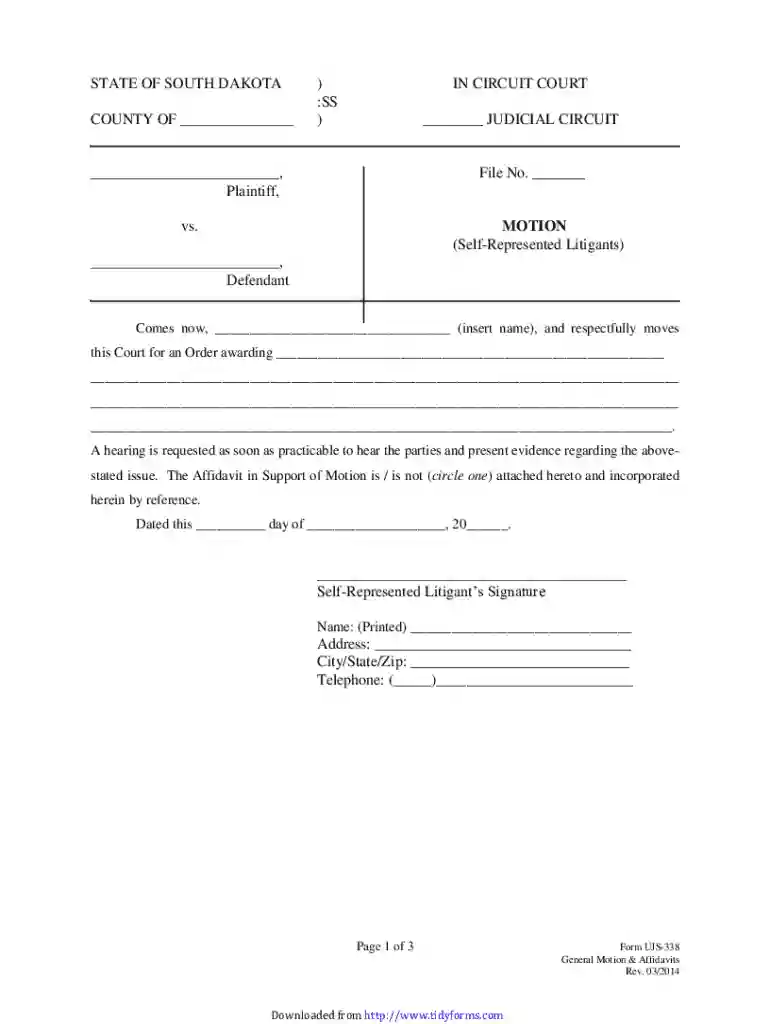
The "docslib doc9174077State of South Dakota ) in the Circuit Court ) Ss County of" is a legal form used in the Circuit Court of South Dakota. This document is specifically designed for self-represented litigants, guiding them through the court process. The form encompasses various sections necessary for filing motions, presenting affidavits in support of these motions, and providing sworn statements regarding their cases. The primary goal of this form is to ensure that individuals without legal representation can submit comprehensive and compliant documents as part of their legal proceedings.
Completing the "docslib doc9174077State of South Dakota ) in the Circuit Court ) Ss County of" form requires careful attention to detail to ensure all necessary legal information is provided:
Filling Personal Information: Begin by accurately entering your full name, address, and contact details. This information is crucial because it identifies the litigant in all court records.
Case Details: Enter specific information about your case, including the case number and the party names involved. These details help the court identify the legal context in which you are filing the motion.
Motion Section: Clearly outline the motion you are filing. State the nature of your request and the specific court order you are seeking. It is essential to articulate your request in a precise manner to avoid misunderstandings.
Affidavit in Support: Provide a detailed affidavit supporting your motion. This section involves stating facts and the basis of your request, which must be factual and sworn under oath.
Affidavit of Mailing: Complete the affidavit of mailing section to confirm that you have mailed copies of your motion and supporting documentation to all involved parties.
Signatures: Conclude by signing the form where necessary. Ensure that all sections requiring a signature are completed to verify the form's legitimacy.
Review and Submit: Before submitting, thoroughly review the entire document for accuracy and completeness. Errors or omissions can delay the process or result in the form being rejected by the court.
This form includes several critical components that must be accurately completed:
These elements ensure the document meets the requirements for legal processing in the South Dakota Circuit Court.
Understanding the terminology within this legal form is crucial for effective completion:
Each term has precise legal implications, fundamental for correct form completion and submission.
The form is legally binding, serving a critical function in the court process for those who are self-representing. By submitting this form, litigants affirm the truthfulness of the information, supporting documents for motions, and compliance with court procedures. In addition, it acts as a formal record within the court system, ensuring that the legal process is observed and upheld according to state laws.
In South Dakota, specific rules govern the submission and use of legal forms within the Circuit Court system:
Familiarity with these state-specific rules is essential to ensure that the form is valid and enforceable within the jurisdiction of South Dakota.
This form is primarily used by self-represented litigants participating in legal proceedings within the South Dakota Circuit Court. It is often utilized by individuals seeking to file motions or request specific court actions without the assistance of an attorney. Typical users include:
Understanding who typically uses this form can aid resources and guidance for individuals planning to navigate the legal system independently.
We've got more versions of the docslib doc9174077State of South Dakota ) in the Circuit Court ) Ss County of form. Select the right docslib doc9174077State of South Dakota ) in the Circuit Court ) Ss County of version from the list and start editing it straight away!
At DocHub, your data security is our priority. We follow HIPAA, SOC2, GDPR, and other standards, so you can work on your documents with confidence.