






Definition & Purpose of the Clinical Medical Assistant Performance Record
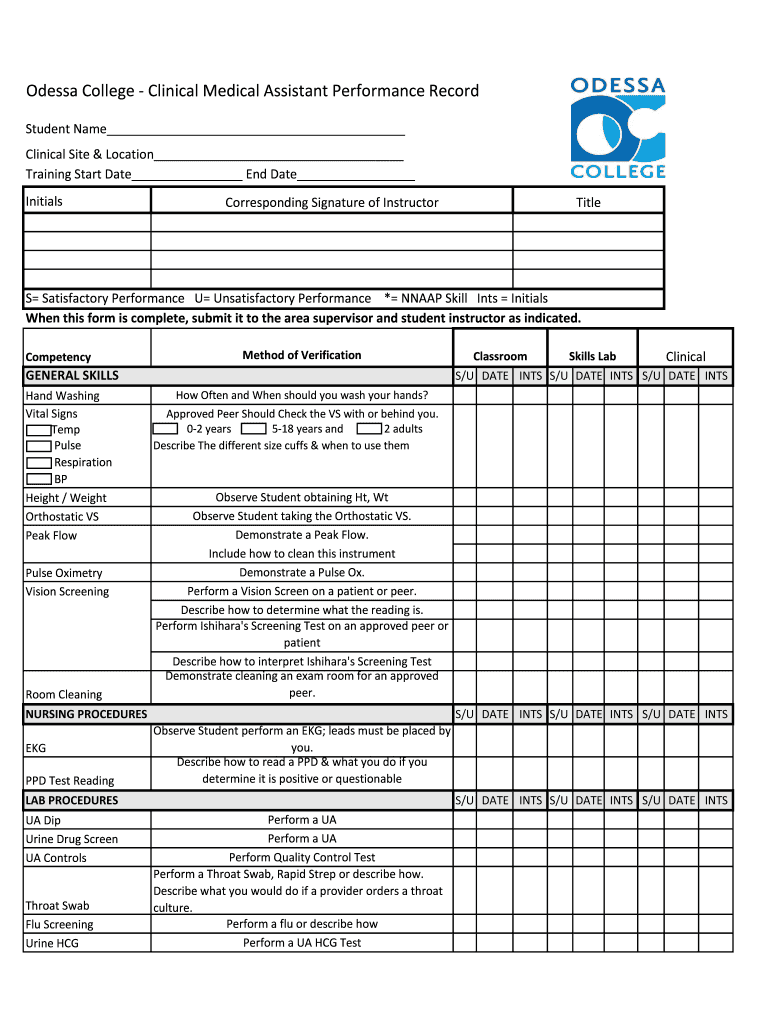
The Odessa College - Clinical Medical Assistant Performance Record serves as a critical assessment tool for tracking the skills and competencies of students in their clinical training as medical assistants. Its primary function is to provide a structured format for evaluating a student's ability to perform essential tasks in a healthcare setting. The performance record includes areas such as general skills, lab procedures, nursing procedures, patient care, computer skills, and interpersonal communication.
Each of these categories is assessed using indicators of satisfactory or unsatisfactory performance. The form not only serves as a measurement of current abilities but also guides students in identifying areas that require further development.
Steps to Complete the Clinical Medical Assistant Performance Record
Completing the Clinical Medical Assistant Performance Record involves several steps that ensure thorough evaluation of a student's readiness for practical roles:
-
General Skills Assessment:
- Begin by evaluating basic professional skills.
- Assess punctuality, professionalism, and the ability to follow healthcare protocols.
-
Lab Procedures Evaluation:
- Test competencies in conducting common laboratory procedures.
- Include proficiency in using lab equipment and conducting tests accurately.
-
Nursing Procedures Assessment:
- Evaluate skills in basic nursing tasks.
- Tasks include vital signs monitoring and administrating medications under supervision.
-
Patient Care Competencies:
- Assess ability to provide compassionate and comprehensive patient care.
- Incorporate communication with patients and handling patient records.
-
Computer Skills Analysis:
- Test capacities in using healthcare management software.
- Evaluate for data entry, appointment scheduling, and patient record management.
-
Interpersonal Communication Review:
- Review ability to communicate effectively with patients and colleagues.
- Assess conflict resolution, empathy, and teamwork skills.
Each section must be validated by an instructor with signatures and comments, providing feedback for continuous improvement.
Key Elements of the Performance Record
The Clinical Medical Assistant Performance Record consists of specific elements that together create a comprehensive evaluation framework:
-
Competency Sections: Each category in the record is tailored to address a core area of medical assistant responsibilities.
-
Performance Indicators: Performance is gauged using standardized criteria that determine whether tasks are completed satisfactorily.
-
Instructor Signatures: Instructor reviews are mandatory to ensure accuracy and authenticity in assessment.
-
Comments Section: Provides space for targeted feedback and recommendations for improvement.
How to Use the Clinical Medical Assistant Performance Record
To effectively utilize the Clinical Medical Assistant Performance Record, instructors and students should adhere to the following practices:
-
Regular Updates: Update the performance record consistently throughout the clinical training period to accurately reflect growth and skill acquisition.
-
Feedback Integration: Use instructor feedback to focus on improvement areas, setting actionable goals for skill development.
-
Goal Setting: Students should use the record to set personal development goals aligned with career objectives.
-
Collaborative Review: Engage in periodic reviews with instructors to discuss progress and adapt learning strategies as needed.
Who Typically Uses the Clinical Medical Assistant Performance Record
The primary users of the Clinical Medical Assistant Performance Record are:
-
Students: Utilize the form to track skill development and identify areas for improvement during clinical training.
-
Instructors and Preceptors: Employ the record as a tool for providing structured feedback and ensuring standard competencies are met.
-
Clinical Education Coordinators: Use these records to ensure that training programs meet accreditation standards and student learning outcomes.


Examples of Using the Clinical Medical Assistant Performance Record
Practical scenarios showcasing the use of the performance record include:
-
Monitoring Student Progress: Tracking a student's transition from basic medical procedures to more complex clinical tasks.
-
Identifying Training Needs: Highlighting skills that require additional focus, such as patient communication or lab proficiency, guiding curriculum adjustments.
-
Ensuring Readiness for Certification: Utilizing the record to verify that students meet the necessary competencies for certification exams or employment.
Versions or Alternatives to the Clinical Medical Assistant Performance Record
While the Clinical Medical Assistant Performance Record at Odessa College is a tailored document, alternative versions may exist to suit specific program requirements or standardized assessments:
-
Adapted Performance Records: These may incorporate additional competencies specific to specialized medical fields or technology use.
-
Digital Versions: Some institutions might offer electronic forms integrated with training management software for ease of access and analysis.
-
Alternative Evaluation Tools: Programs might also use comprehensive exams or simulation assessments as a complement to the performance record.
By understanding and effectively utilizing the Clinical Medical Assistant Performance Record, Odessa College enhances the quality of medical assistant training, ensuring students are well-prepared for their professional roles.