




01. Edit your md tax return online
Type text, add images, blackout confidential details, add comments, highlights and more.

Type text, add images, blackout confidential details, add comments, highlights and more.

Draw your signature, type it, upload its image, or use your mobile device as a signature pad.

Send maryland state income tax form via email, link, or fax. You can also download it, export it or print it out.
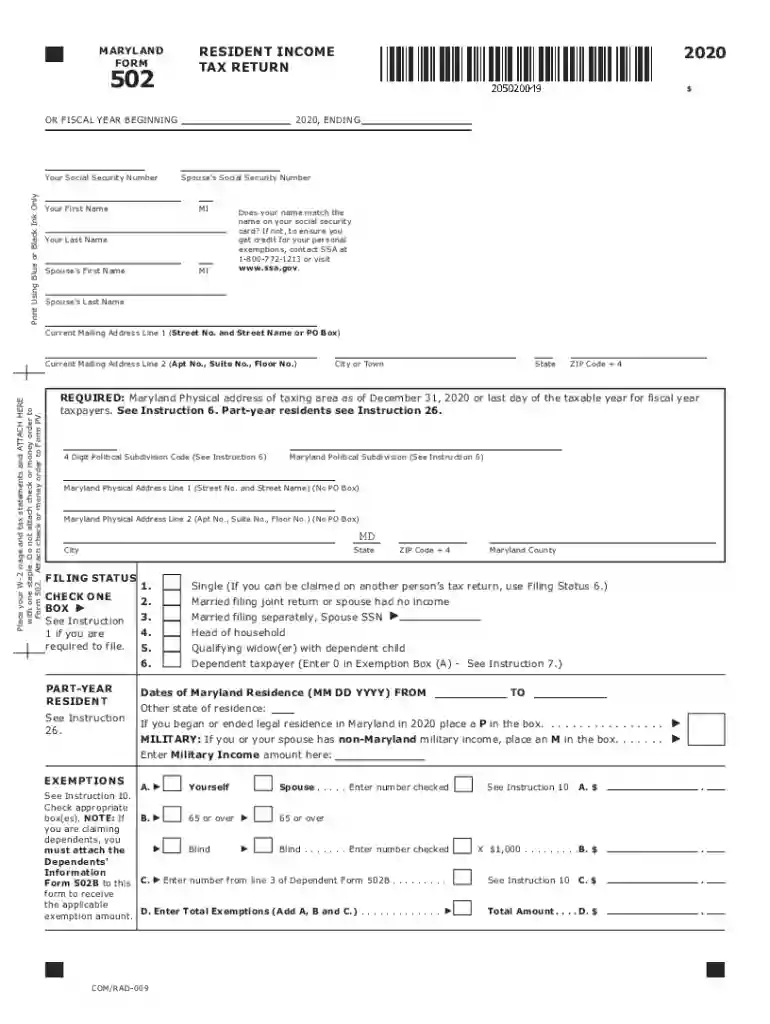
Maryland state tax forms are critical documents used by residents and businesses in the state of Maryland to report their income, claim deductions, and calculate their tax obligations. These forms ensure that taxpayers comply with Maryland's tax code and help the state government assess the appropriate amount of taxes owed. The most commonly used form is the Maryland Form 502, which is specifically for resident income tax returns.
Maryland state tax forms serve multiple purposes, including ensuring accurate reporting of personal or business income, itemizing allowable deductions, facilitating tax computations, and ultimately directing payments or refunds. Each form has a set structure and format to maintain consistency in how tax information is provided, resulting in efficient processing by tax authorities.
Using Maryland state tax forms involves several organized steps to ensure thorough and accurate completion. Taxpayers should first gather financial documents, such as W-2s or 1099s, to accurately report their taxable income. Next, it's crucial to understand exemptions and deductions available for the fiscal year, as these can impact the overall tax liability significantly.
Once these prerequisites are in place, taxpayers should carefully follow the instructions provided with the specific form. Maryland Form 502, for instance, contains sections for personal details, income reporting, deductions, and calculations. Users should meticulously enter each piece of information, ensuring adherence to guidelines to avoid errors.
Ensuring accuracy in each step mitigates the risk of audits or penalties. Reviewing entries before submission ensures compliance with Maryland's tax regulations.
Understanding specific terminology related to Maryland tax forms is vital for accurate completion. Some critical terms include:
Knowledge of these terms ensures that taxpayers properly apply form instructions and optimize available tax benefits.
Maryland state tax forms typically need to be filed by April 15, aligning with federal tax deadlines. If this date falls on a weekend or holiday, the deadline may be extended to the next business day.
It is crucial to adhere to these deadlines to avoid penalties. Taxpayers needing additional time should file for an extension before the deadline; however, it's essential to note that an extension does not prolong the time to pay taxes owed.
Failing to file or pay taxes by the deadline results in penalties and interest, which accrue over time. Timely filing can mitigate unnecessary financial burdens.
Completion of Maryland state tax forms necessitates several key documents:
Gathering these documents in advance facilitates a smoother filing process, helping taxpayers ensure they claim all allowable deductions and accurately report income.
Maryland offers several methods for submitting state tax forms, including:
Electronic filing is encouraged due to its efficiency and reduced processing times. Electronic submissions often include additional safeguards, such as automated error checking.
Using Maryland's online tax filing system provides taxpayers with a secure platform featuring immediate confirmation of receipt and error-reduction measures, streamlining the entire tax filing experience.
Maryland tax forms must comply with both state and federal tax laws. Ensuring accurate completion, maintaining truthful statements, and adhering to the provided guidelines are mandatory to avoid legal issues.
Tax forms often include sections requiring certifications or acknowledgments of accuracy and truthfulness. Signing these forms serves as a legal attestation of the information provided, making accuracy crucial.
Non-compliance, including misinformation or omissions, can result in audits, financial penalties, and, in severe cases, legal actions. Maintaining integrity and transparency is essential for lawful compliance.
We've got more versions of the md tax return form. Select the right md tax return version from the list and start editing it straight away!
| Versions | Form popularity | Fillable & printable |
|---|---|---|
| 2025 | 4.1 Satisfied (24 Votes) | |
| 2024 | 4.1 Satisfied (33 Votes) | |
| 2023 | 4.3 Satisfied (49 Votes) | |
| 2022 | 4.6 Satisfied (60 Votes) | |
| 2021 | 4.8 Satisfied (121 Votes) | |
| 2020 | 4.2 Satisfied (139 Votes) | |
| 2019 | 4.3 Satisfied (48 Votes) | |
| 2018 | 4.2 Satisfied (123 Votes) | |
| 2017 | 4.3 Satisfied (94 Votes) | |
| 2016 | 4.3 Satisfied (293 Votes) | |
| 2015 | 4 Satisfied (38 Votes) | |
| 2014 | 4 Satisfied (33 Votes) | |
| 2013 | 4.1 Satisfied (36 Votes) | |
| 2011 | 4.3 Satisfied (54 Votes) | |
| 2006 | 4.2 Satisfied (63 Votes) |
At DocHub, your data security is our priority. We follow HIPAA, SOC2, GDPR, and other standards, so you can work on your documents with confidence.
Jan 31, 2018 This publication discusses the rules for deduct- ing home mortgage interest. Part I contains general information on home.Read more
Jan 21, 2026 Marylands Internet tax filing system (iFile) allows online electronic filing of resident personal income tax returns along with the most commonly associatedRead more
Office of the Comptroller of Maryland, led by Comptroller Brooke E. Lierman. Working towards a more equitable, more resilient, and more prosperous Maryland.


