
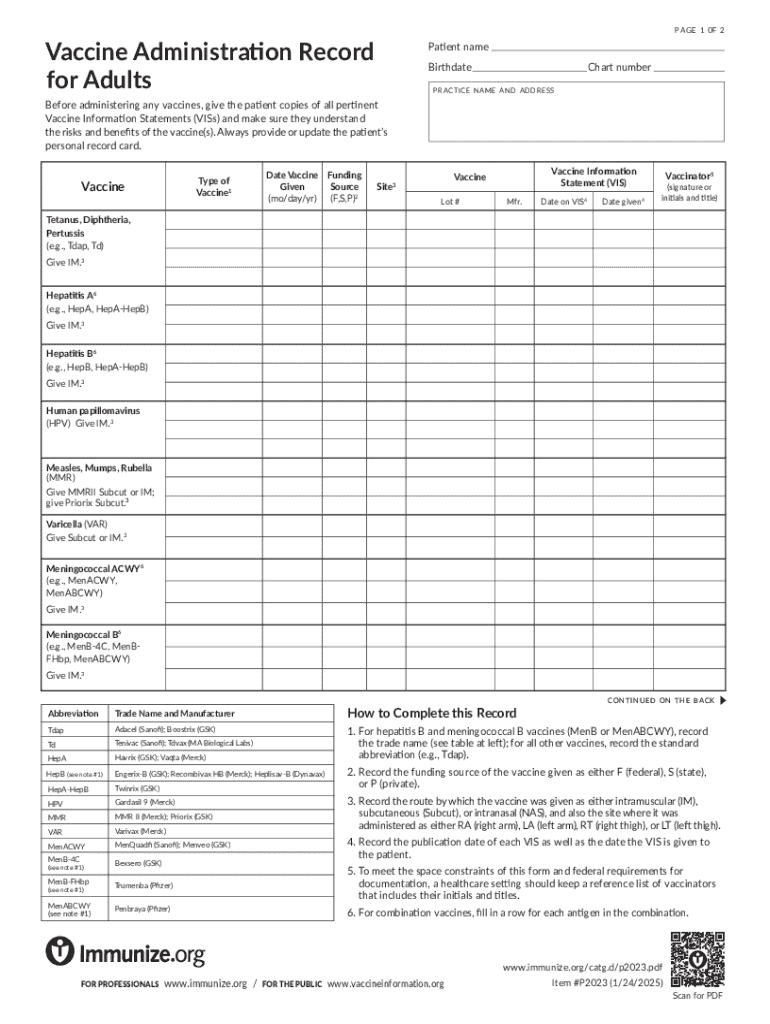







Definition and Meaning of the Vaccine Administration Record for Adults
The Vaccine Administration Record for Adults is a critical document used in the healthcare sector. It serves as a formal record-keeping tool that documents all pertinent information related to vaccines administered to adult patients. This record captures various details such as patient information, specifics of the vaccine, the date of administration, vaccine manufacturer, and funding sources. The primary purpose of this record is to ensure an accurate, comprehensive, and organized documentation of immunizations, which helps in tracking patient vaccination history and managing vaccine inventory efficiently.
Importance of Accurate Documentation
Accurate documentation in the Vaccine Administration Record for Adults is crucial for several reasons:
- Patient Safety: Provides a comprehensive history to avoid unnecessary repeat vaccinations.
- Effective Monitoring: Assists healthcare providers in monitoring vaccine coverage and efficacy.
- Public Health: Facilitates the tracking of immunization trends and potential outbreaks.
Detailed Sections of the Record
The Vaccine Administration Record consists of clearly defined sections, each serving a unique role:
- Patient Information: Includes name, age, and contact details.
- Vaccine Details: Lists the type, dosage, and batch number of the vaccine.
- Administration Data: Date and location of vaccine administration.
- Manufacturer Details: Information about the vaccine producer.
- Funding Sources: Identifies the financial backing for the vaccine provision.
How to Use the Vaccine Administration Record for Adults
Using the Vaccine Administration Record for Adults effectively requires a systematic approach. Healthcare providers must ensure that every section of the record is accurately completed at the time of vaccine administration.
Step-by-Step Completion Process
- Patient Identification: Start by filling in the patient's personal details to ensure correct identification.
- Vaccine Selection: Indicate the exact vaccine type and dosage to be administered.
- Administration Logging: Record the date and location where the vaccine was given.
- Manufacturer Information: Note the vaccine manufacturer's name and any relevant lot numbers.
- Educational Follow-up: Ensure that the patient receives the Vaccine Information Statement (VIS) and understands the benefits and potential risks.
Key Considerations for Use
- Accuracy: Double-check each entry for accuracy to maintain the integrity of the patient’s record.
- Timeliness: Complete records immediately after vaccine administration to avoid errors due to memory recall.
- Confidentiality: Ensure that patient information is kept secure, adhering to privacy regulations.
Key Elements of the Vaccine Administration Record for Adults
Understanding the key elements of the Vaccine Administration Record for Adults is vital for its effective implementation in healthcare settings.
Major Components
- Personal Data: Basic details for uniquely identifying the patient.
- Historical Data: Information about past vaccinations, aiding in determining future vaccine needs.
- Administrative Details: Includes the healthcare professional's name and signature, affirming the administration of the vaccine.
Importance of Each Element
- Patient Information: Ensures the right patient receives the correct vaccine.
- Vaccine Details: Helps track vaccine-related adverse events and effectiveness.
- Administration Signature: Provides legal confirmation of the vaccine given by a qualified individual.
Legal Use of the Vaccine Administration Record for Adults
The Vaccine Administration Record for Adults also serves a legal function, documenting that the healthcare provider has informed the patient about the vaccine's benefits and risks.
Legal Significance
- Compliance with Regulations: Complies with federal and state public health guidelines.
- Evidence of Informed Consent: Demonstrates that the patient was adequately informed via the VIS.
- Proof of Vaccination: Acts as an official medical document, which may be required for employment, travel, or education.
Considerations for Legal Compliance
- Retention Period: Retain records for a specified period as mandated by local laws.
- Accessibility: Ensure records are readily accessible for audit or verification purposes without breaching patient confidentiality.
Examples of Using the Vaccine Administration Record for Adults
The Vaccine Administration Record for Adults can be applied in various scenarios, showcasing its versatility and utility.
Practical Applications
- Healthcare Clinics: Centralized record of all vaccines administered in a clinical setting.
- Workplace Health Programs: Documenting vaccinations as part of employee health initiatives.
- Travel Clinics: Recording vaccines administered for travel health requirements.
Case Studies
- Occupational Safety: A large corporation uses the record to manage employee vaccine compliance for diseases like influenza.
- Community Health Projects: A public health initiative employs this record to track vaccination campaigns in local communities, ensuring no demographic is underserved.
By thoroughly exploring these aspects, stakeholders can effectively utilize the Vaccine Administration Record for Adults, ensuring both compliance and optimal patient care.




