01. Edit your form online
Type text, add images, blackout confidential details, add comments, highlights and more.

Type text, add images, blackout confidential details, add comments, highlights and more.

Draw your signature, type it, upload its image, or use your mobile device as a signature pad.

Send it via email, link, or fax. You can also download it, export it or print it out.
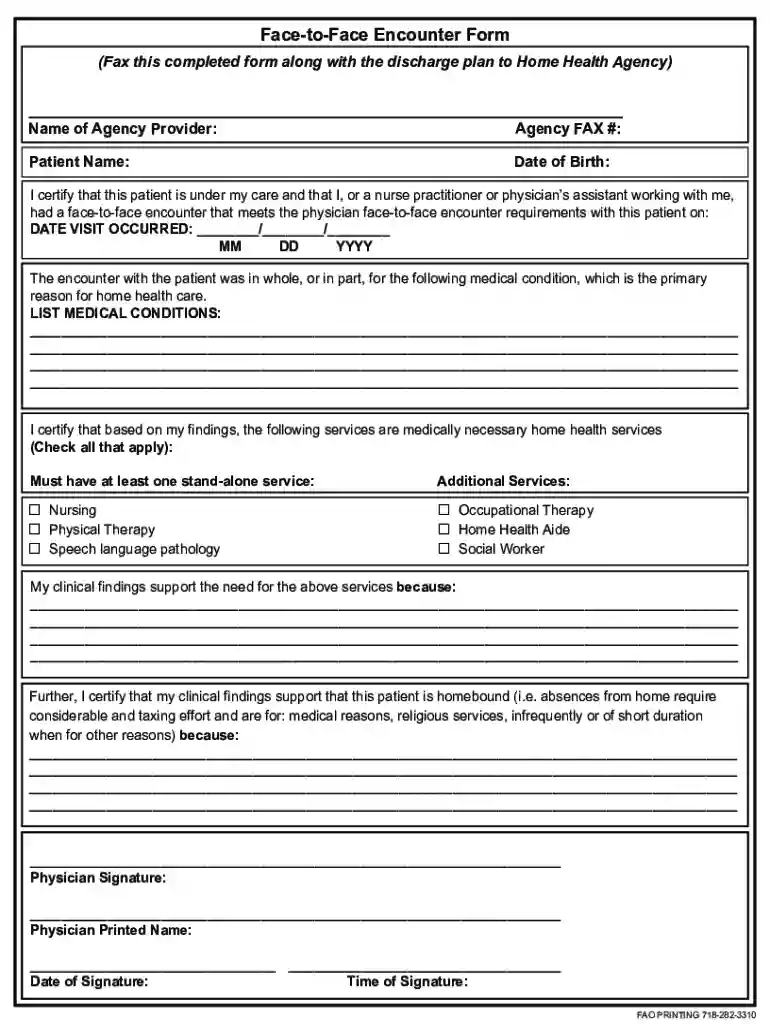
The "elitehc 02Home-Health-Care-Face-to-FaceFace-to-Face Encounter Form" from Elite Healthcare Consultants is a critical document designed for healthcare providers. Its primary function is to verify and document that a medical professional has had a direct encounter with a patient. This form is essential to substantiate the medical necessity of home health services for individuals unable to travel for outpatient treatment due to health conditions. It includes comprehensive sections that capture the patient's personal information, the date of the encounter, specific medical conditions, and the type of care required, such as nursing or therapy. Physicians must include a signature to validate the visit and articulate the rationale for the patient's homebound status.
To effectively utilize this form, healthcare providers must ensure that it is filled accurately and completely. The process involves:
Attention to detail in this process ensures compliance with healthcare regulations and facilitates the timely provision of necessary services.
Completing the form requires a thorough and systematic approach. The following step-by-step guide can aid in ensuring all necessary information is appropriately captured:
Using the Face-to-Face Encounter Form carries significant legal responsibilities. This document is central in meeting Medicare requirements, where accuracy and honesty are paramount. Medicare mandates face-to-face documentation to ensure that only truly homebound patients receive in-home care. Providers are legally bound to maintain precise records within this form, ensuring that all the information corresponds with the patient's medical chart and is compliant with federal health insurance stipulations. This adherence protects against legal repercussions and ensures continued eligibility for service reimbursements.
The form encompasses several crucial elements that healthcare providers must address:
Each part plays a vital role in ensuring that the patient's treatment plan is well-supported and justifiable.
This form is predominantly utilized by:
These users must meticulously document each aspect of the form to ensure patient care continuity and regulatory compliance.


While the core elements of the form remain consistent across the United States, certain states may have additional requirements or specifications. Healthcare providers should be mindful of:
Understanding and adhering to these state-specific adjustments ensures legal compliance and uninterrupted service provision.
The form is available in both digital and paper formats, each with its pros and cons:
Digital Format:
Paper Format:
Choosing the right format depends on institutional capabilities and provider preferences, but both must comply with security standards.
At DocHub, your data security is our priority. We follow HIPAA, SOC2, GDPR, and other standards, so you can work on your documents with confidence.