




01. Edit your form online
Type text, add images, blackout confidential details, add comments, highlights and more.

Type text, add images, blackout confidential details, add comments, highlights and more.

Draw your signature, type it, upload its image, or use your mobile device as a signature pad.

Send it via email, link, or fax. You can also download it, export it or print it out.
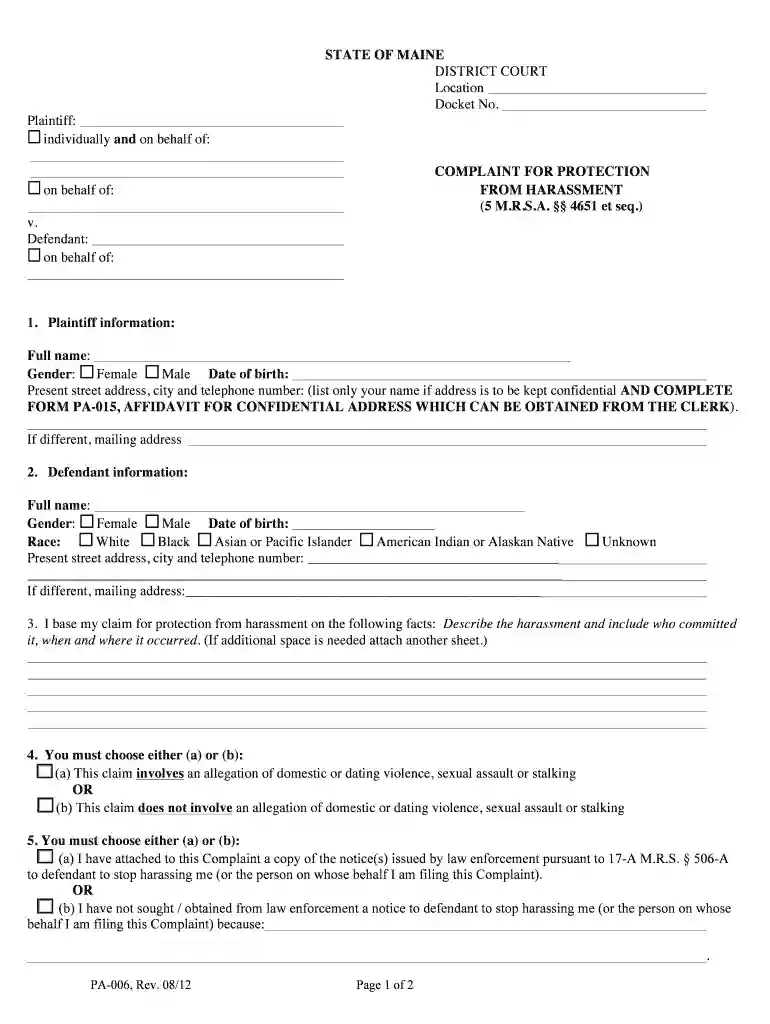
In the legal context, the term "STATE OF MAINE DISTRICT COURT Location Docket No Plaintiff" refers to a specific type of legal document associated with district court proceedings in the state of Maine. This document serves as a formal record within the court's docket, pertaining to a particular case involving a plaintiff who has filed a legal complaint or request for judicial intervention. The docket number uniquely identifies the case, allowing for organized tracking and management of court documents and proceedings. Understanding the precise utility of this document is crucial for plaintiffs hoping to engage with the Maine district court system efficiently.
Utilizing the "STATE OF MAINE DISTRICT COURT Location Docket No Plaintiff" form involves several key steps to ensure compliance with legal standards:
Filing a Complaint: Plaintiffs must draft a legal complaint outlining the nature of their case, the parties involved, and the specific relief or outcome sought from the court.
Submission to Court: The completed form, along with any supporting documents, should be submitted to the appropriate district court location. This can often be done online, by mail, or in person, depending on court facilities.
Docket Number Assignment: Once submitted, the court assigns a docket number. This number becomes the case's unique identifier, crucial for all future court references and communications.
Tracking Progress: Plaintiffs should use the docket number to keep track of their case status, including scheduled hearings, required filings, and judgments.
Response and Communication: It's important for plaintiffs to respond promptly to any court notices or requests for additional information, ensuring continuous engagement with the legal process.
Completing this form involves understanding its sections and providing accurate information at each step:
Identify the Court Location: Specify the district court's geographical location where the proceedings will take place to ensure accurate jurisdiction.
Case and Docket Number Assignment: If applicable, include a previously assigned docket number for ongoing cases. This number is essential for case tracking.
Plaintiff Information: Fill in the plaintiff's details comprehensively, including full name, address, and contact information, to avoid any discrepancies or communication issues.
Nature of Complaint: Clearly articulate the reasons for filing, supported by facts and evidence relevant to the case.
Relief Sought: Outline the specific resolution or judicial relief requested from the court, such as injunctions or restraining orders, if relevant.
File Documentation: Ensure all requisite documents accompany the form, providing a comprehensive view of the case details.
Submission and Fees: Submit to the designated court location and ensure any applicable filing fees are paid to prevent processing delays.
This document contains several vital components essential for its validity and functionality:
This form serves several legal purposes within the Maine district court's administrative and procedural functions:
Understanding the terminology associated with this form is crucial for effectively navigating the legal system:
Several scenarios demonstrate the practical application of this form:
Maine has unique state-specific guidelines governing the usage of this form:
Maine's district court system provides versatile submission options:
This detailed exploration of the "STATE OF MAINE DISTRICT COURT Location Docket No Plaintiff" form provides comprehensive insight into its use, procedural steps, and implications within the legal landscape.
We've got more versions of the STATE OF MAINE DISTRICT COURT Location Docket No Plaintiff form. Select the right STATE OF MAINE DISTRICT COURT Location Docket No Plaintiff version from the list and start editing it straight away!
At DocHub, your data security is our priority. We follow HIPAA, SOC2, GDPR, and other standards, so you can work on your documents with confidence.



Click on a Docket # for more detailed information on that case. Click on a plaintiff or defendant to see other cases they were involved. Docket# Plaintiff
Parties can access most of their electronic case records cases remotely (without having to go to the courthouse) in courts where eFiling is available.Read more
The case was dismissed by the district court in 2005 and then reversed by the Second Circuit court in 2009. In 2010, the Obama Administration submitted a briefRead more


