




01. Edit your form online
Type text, add images, blackout confidential details, add comments, highlights and more.

Type text, add images, blackout confidential details, add comments, highlights and more.

Draw your signature, type it, upload its image, or use your mobile device as a signature pad.

Send it via email, link, or fax. You can also download it, export it or print it out.
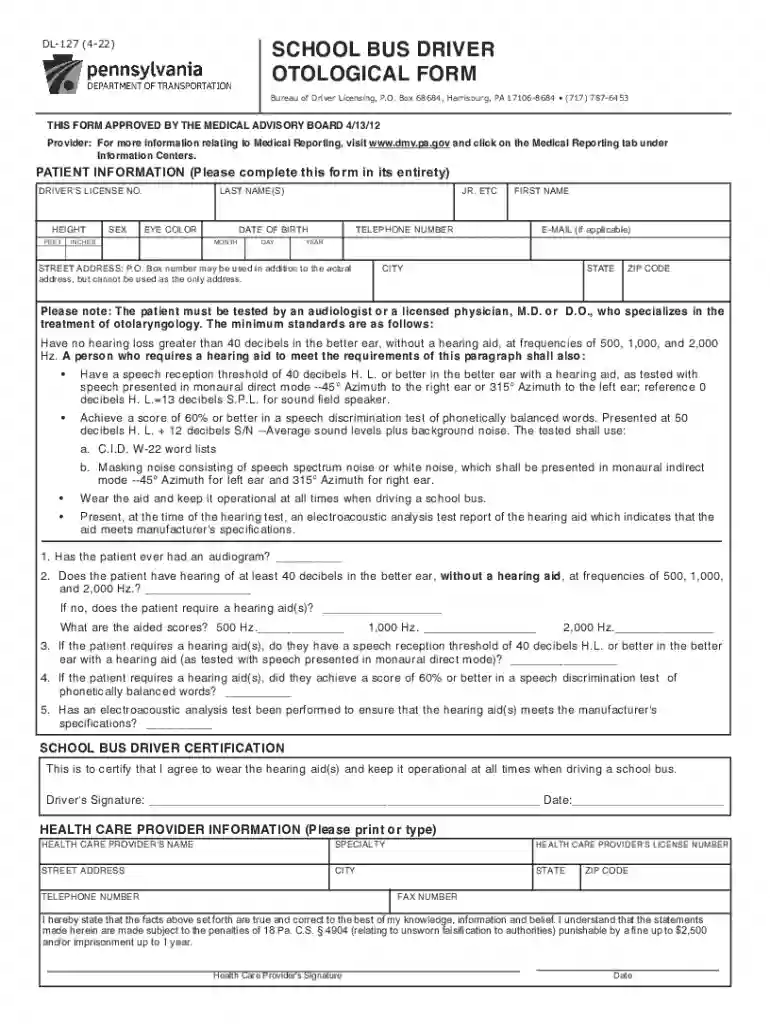
The School Bus Driver Otological Form is a specialized document used to capture essential hearing information for school bus drivers. This form is integral in ensuring compliance with state and federal audiological standards. It accumulates detailed patient information and hearing test results to ascertain a driver's ability to operate a school bus safely. This includes evaluations and certifications required for drivers who utilize hearing aids, focusing on drivers' operational hearing capabilities while driving.
Gather Personal Information: Collect all necessary personal details, including full name, contact details, and any official identification numbers required by the form.
Obtain Audiological Evaluations: Schedule a hearing assessment with a certified audiologist. The results of this test, which include audiograms and other hearing measurements, form the core of this documentation process.
Document Hearing Aid Details: If the driver uses hearing aids, record specific information about these devices, such as model and functional status.
Certification and Attestation: Have the audiologist certify the hearing test results by signing the designated section on the form, verifying that the evaluation meets all regulatory standards.
Review and Submission: Students and school districts should review the form to ensure completeness before submission. Follow the outlined submission methods, which may include options for online, mail, or in-person submission.
Utilizing this form ensures that school bus drivers meet the necessary hearing standards required for safe vehicle operation. The form’s rigorous documentation process minimizes risks associated with hearing impairments while driving. It also provides a thorough framework for documenting a driver's compliance with legal hearing requirements, thus protecting both the driver and the school district from potential liabilities.
This form is primarily used by:


Personal Information Section: Captures the name, address, and contact information of the school bus driver.
Audiological Evaluation Results: Contains data from hearing tests including audiograms, specifying frequencies, thresholds, and examiner comments.
Hearing Aid Certification: Details the functioning and specifications of any hearing aids used by the driver.
Professional Attestation: Requires signatures from certified professionals who conducted the hearing test and verified the form.
The form is used to demonstrate compliance with federal and state hearing regulations required for school bus drivers. It provides a legal record confirming that a driver has undergone necessary assessments and meets operational hearing criteria. Proper use of the form can protect drivers from legal liabilities and ensure continuation of their employment under compliance law.
Different states may have specific criteria and additional forms related to the School Bus Driver Otological Form. For instance, some states might require periodic submissions while others might have distinct protocols for handling and confirming certifications. Verification of state-specific rules is essential to ensure proper compliance.
Valid Identification: Includes any state-issued driver’s license or identification card needed for the documentation.
Audiological Reports: Comprehensive audiogram results and hearing test reports from licensed audiologists.
Proof of Hearing Aid Usage: If applicable, include documentation on hearing aid usage, maintenance, and operational status.
Validating the accurately filled document with all required attachments is critical to ensure the processing of the otological form without unnecessary delays.
We've got more versions of the School Bus Driver Otological Form form. Select the right School Bus Driver Otological Form version from the list and start editing it straight away!
At DocHub, your data security is our priority. We follow HIPAA, SOC2, GDPR, and other standards, so you can work on your documents with confidence.


Individuals, upon hire to drive a school bus, shall manage their diabetes by complying with the following requirements: Self-monitoring blood glucose 1 hourRead more
bus busbies busboy busboys busby bused buses bush bushed bushel busheled busheler


