




01. Edit your form online
Type text, add images, blackout confidential details, add comments, highlights and more.

Type text, add images, blackout confidential details, add comments, highlights and more.

Draw your signature, type it, upload its image, or use your mobile device as a signature pad.

Send it via email, link, or fax. You can also download it, export it or print it out.
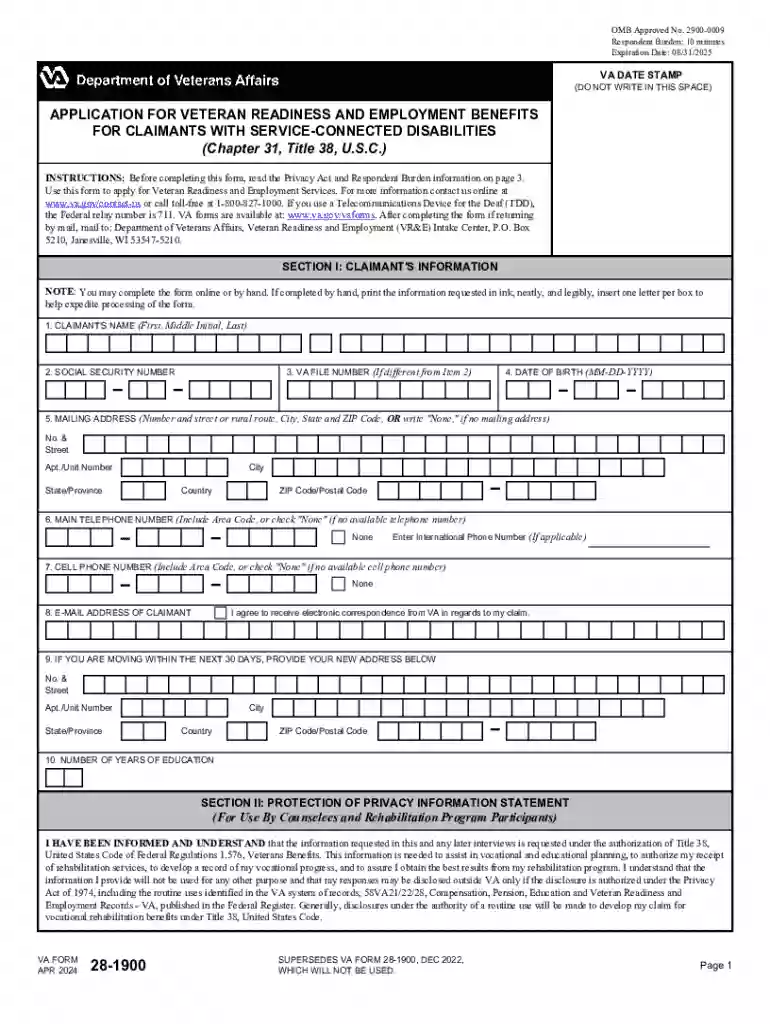
Chapter 31, Title 38 of the United States Code is focused on Veteran Readiness and Employment (VR&E) benefits provided by the Department of Veterans Affairs (VA). This legal provision offers support to veterans with service-connected disabilities to help them prepare for, find, and maintain suitable employment. It also facilitates independent living for those who are severely disabled. Understanding the nuances of Chapter 31, Title 38 is crucial for veterans seeking vocational rehabilitation and employment assistance, as it outlines the eligibility criteria, benefits, and the application process for these vital services.
The VA Form 28-1900 is the application form used for obtaining VR&E benefits under Chapter 31, Title 38, U.S.C. Veterans should carefully fill out the form by providing detailed personal information, including their service history and the nature of their disability. When completing the form, it is important to be thorough in detailing how the disability affects one’s ability to obtain or retain employment. This information helps the VA assess eligibility for the program and design a personalized rehabilitation plan.
Eligibility for Chapter 31 benefits hinges on having a service-connected disability which impairs a veteran’s ability to prepare for, obtain, or maintain employment. The veteran must also have been discharged or released under conditions other than dishonorable. Specific disabilities, such as those above a certain percentage, may increase eligibility prospects. Importantly, meeting with a Vocational Rehabilitation Counselor is part of the process to confirm eligibility and to develop a tailored rehabilitation plan.


VA Form 28-1900 is legally utilized to process applications for Veteran Readiness and Employment benefits. This form serves as the formal request for these specific benefits and facilitates the VA’s ability to review and determine eligibility. Any information provided in the form is protected under privacy laws, ensuring that applicants' data is used solely for processing their benefits. Accurate and truthful information is mandatory, as discrepancies can lead to delays or denial of benefits.
The application process begins with the submission of VA Form 28-1900. Following submission, veterans attend a meeting with a Vocational Rehabilitation Counselor who will assess eligibility. The approval time can vary, typically depending on the completeness of the application and the availability of necessary documentation. Once determined eligible, a detailed individualized rehabilitation plan is developed, outlining the benefits and services the veteran will receive.
Veterans can submit the VA Form 28-1900 through various channels:
This comprehensive guide covers the essential aspects of completing and submitting VA Form 28-1900 for veterans seeking benefits under Chapter 31, Title 38. Understanding these procedures and requirements is critical to successfully navigating the application process and receiving the support needed for vocational rehabilitation and employment.
We've got more versions of the er 31, Title 38, U S C ) form. Select the right er 31, Title 38, U S C ) version from the list and start editing it straight away!
At DocHub, your data security is our priority. We follow HIPAA, SOC2, GDPR, and other standards, so you can work on your documents with confidence.


Title 38 VETERANS BENEFITS is a continuation and restatement of the Servicemens Readjustment Act of 1944,
Before a service-disabled veteran may receive training and rehabilitation services under Chapter 31, Title 38 U.S.C., three basic requirements must be met:
To provide protections for certain sports medicine professionals, to reauthorize Fed- eral aviation programs, to improve aircraft safety certification


