




01. Edit your form online
Type text, add images, blackout confidential details, add comments, highlights and more.

Type text, add images, blackout confidential details, add comments, highlights and more.

Draw your signature, type it, upload its image, or use your mobile device as a signature pad.

Send it via email, link, or fax. You can also download it, export it or print it out.
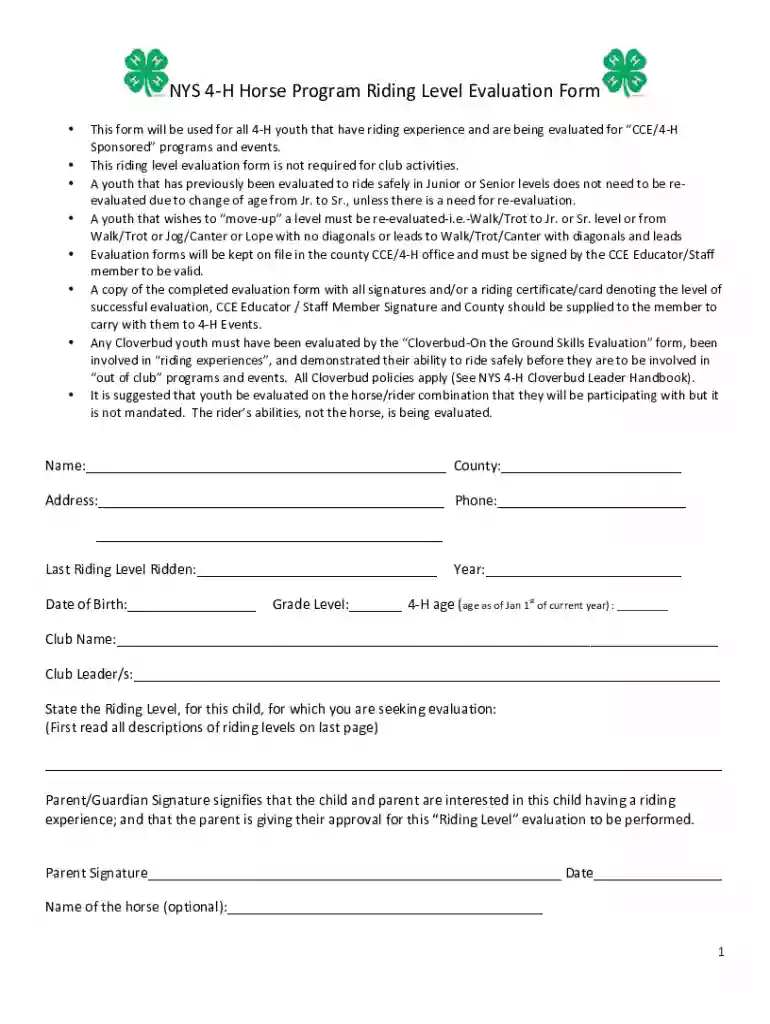
The "Riding Evaluation-2 docx" refers to a specific document used in evaluating the riding skills and competencies of individuals participating in certain equestrian programs, likely under a structured setting such as the NYS 4-H Horse Program. This evaluation form serves as an essential tool to assess the proficiency level of participants, including their handling skills and overall rider safety adherence. The document typically outlines criteria that must be met to pass or advance to higher riding levels, ensuring consistency and fairness in evaluation.
To use the "Riding Evaluation-2 docx," the evaluator first needs to download or access the document, ensuring they have the latest version to reflect any recent updates. Following this, the evaluator can begin the assessment by observing the participant’s performance according to the criteria set forth in the form. It is crucial to fill out each section thoroughly, documenting both strengths and areas for improvement. This form might include a checklist of skills, allowing clear and structured feedback for both participants and program organizers, ultimately helping in the identification of training needs and progress tracking.
This document is often utilized by riding instructors, horse trainers, and program coordinators involved in educational or recreational equestrian activities. It serves not only as a tool for assessment but also as a mechanism to ensure riders are progressing safely and effectively through their respective programs. Participants themselves can also use this form as a record of their achievements and areas needing further effort, particularly when transitioning between different riding levels.


The form is used within the legal framework of the program offering the riding evaluation. It may be subject to state-specific guidelines, particularly in educational or youth-focused programs like those sponsored by 4-H. As such, compliance with local laws regarding youth safety, education, and animal welfare is essential. The form provides a record that can serve as evidence of conducted evaluations and training sessions, protecting both program organizers and participants in legal matters.
In practice, the "Riding Evaluation-2 docx" might be used in a scenario where a 4-H youth participant is being assessed during a regional horse show. The evaluator will document the participant's ability to control the horse, the rider’s posture and balance, and how effectively they follow directives. Feedback from this form can guide future training sessions, ensuring that the participant is prepared for more advanced competitions or riding challenges. Another example could be in a summer camp setting, where the document serves to evaluate a large number of new riders, offering structured insights into each rider's aptitude and progress.
We've got more versions of the Riding Evaluation-2 docx form. Select the right Riding Evaluation-2 docx version from the list and start editing it straight away!
At DocHub, your data security is our priority. We follow HIPAA, SOC2, GDPR, and other standards, so you can work on your documents with confidence.




Basic Rider Course 2 (BRC2) has 8 exercises followed by the Rider Skills Evaluation. A RiderCoach will give you the name and objective of each exercise;
2. An assessment of the potential severity and probability of unintended outcomes occurring. 3. Mitigation measures to reduce potential risk. 4. OtherRead more


