01. Edit your form online
Type text, add images, blackout confidential details, add comments, highlights and more.

Type text, add images, blackout confidential details, add comments, highlights and more.

Draw your signature, type it, upload its image, or use your mobile device as a signature pad.

Send it via email, link, or fax. You can also download it, export it or print it out.
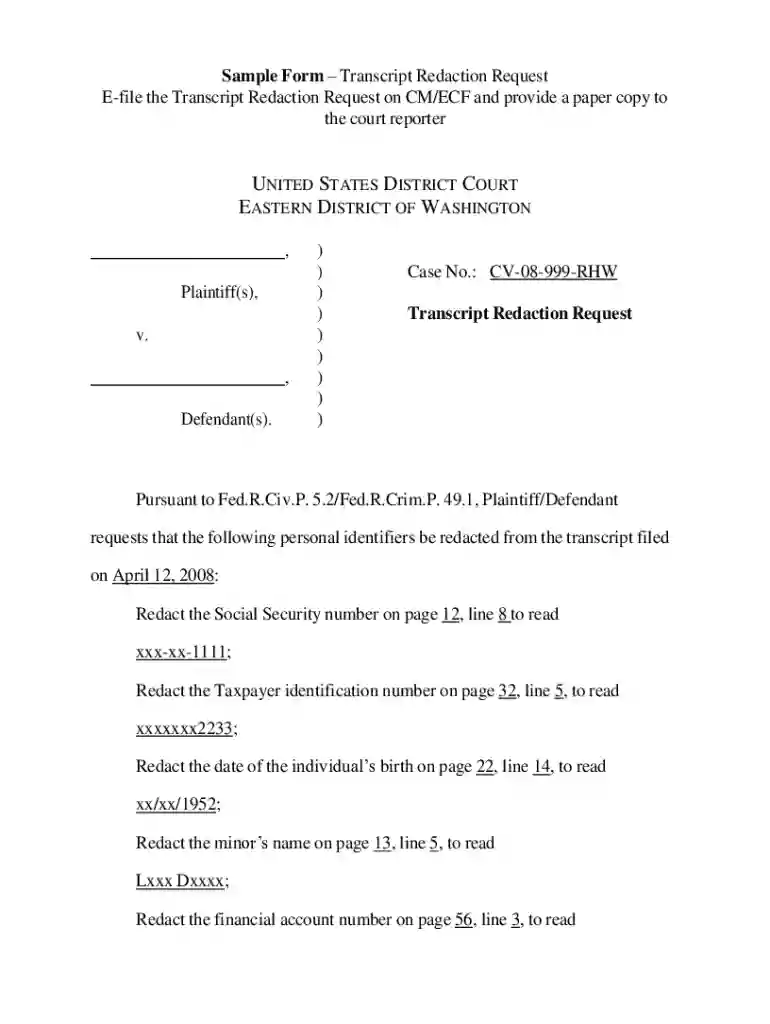
The Transcript Redaction Request form is a legal document used within the United States District Court system, particularly in the Eastern District of Washington. This form allows individuals to request the redaction of personal identifiers, such as Social Security numbers, taxpayer identification numbers, birth dates, names of minors, financial account numbers, and home addresses, from court transcripts. The primary aim of this document is to protect sensitive information, thereby upholding individuals' privacy and conforming to federal privacy standards.
To use the Transcript Redaction Request form, you must fill out all relevant sections, ensuring that each personal identifier you wish to have redacted is clearly specified. Sign and submit the completed form to the appropriate court clerk. Ensure that your request is comprehensive by including an attorney’s information and a certification of service. The form is essential for protecting sensitive information, and incomplete submissions could delay processing.
The Transcript Redaction Request form is legally binding and must be completed in accordance with the requirements set by the respective court jurisdiction. This ensures that the request aligns with privacy laws and federal guidelines regarding personal information in public records. The form helps protect individuals from identity theft and unauthorized use of personal data.
Completing the form involves several steps, which must be carefully followed to ensure accuracy and compliance. This procedure can vary slightly depending on specific court requirements; however, the general process remains consistent.
The Transcript Redaction Request form is commonly used by attorneys, parties involved in court cases, and court-appointed representatives. Any individual or entity involved in a case, who wishes to maintain the confidentiality of personal information within a transcript, can also submit this request.


Several key elements within the form must be addressed to ensure an effective redaction process. These elements are crucial for the court to accurately process and adhere to privacy requests.
Understanding the terminology associated with the Transcript Redaction Request is vital for effectively completing and submitting the form. Below are key terms to be familiar with:
It is essential to note the specific deadlines associated with the redaction request to ensure timely and effective processing by the court. Deadlines can impact the form’s acceptance and the ability to maintain the confidentiality of sensitive information.
By addressing these crucial aspects of the Transcript Redaction Request form, individuals and attorneys can ensure that personal information is adequately protected within the public domain, complying with both court and federal privacy requirements.
We've got more versions of the id uscourts ContentFetcherindexSample FormRedaction Request - Transcript UNITED STATES form. Select the right id uscourts ContentFetcherindexSample FormRedaction Request - Transcript UNITED STATES version from the list and start editing it straight away!
| Versions | Form popularity | Fillable & printable |
|---|---|---|
| 2018 | 4.8 Satisfied (47 Votes) |
At DocHub, your data security is our priority. We follow HIPAA, SOC2, GDPR, and other standards, so you can work on your documents with confidence.