




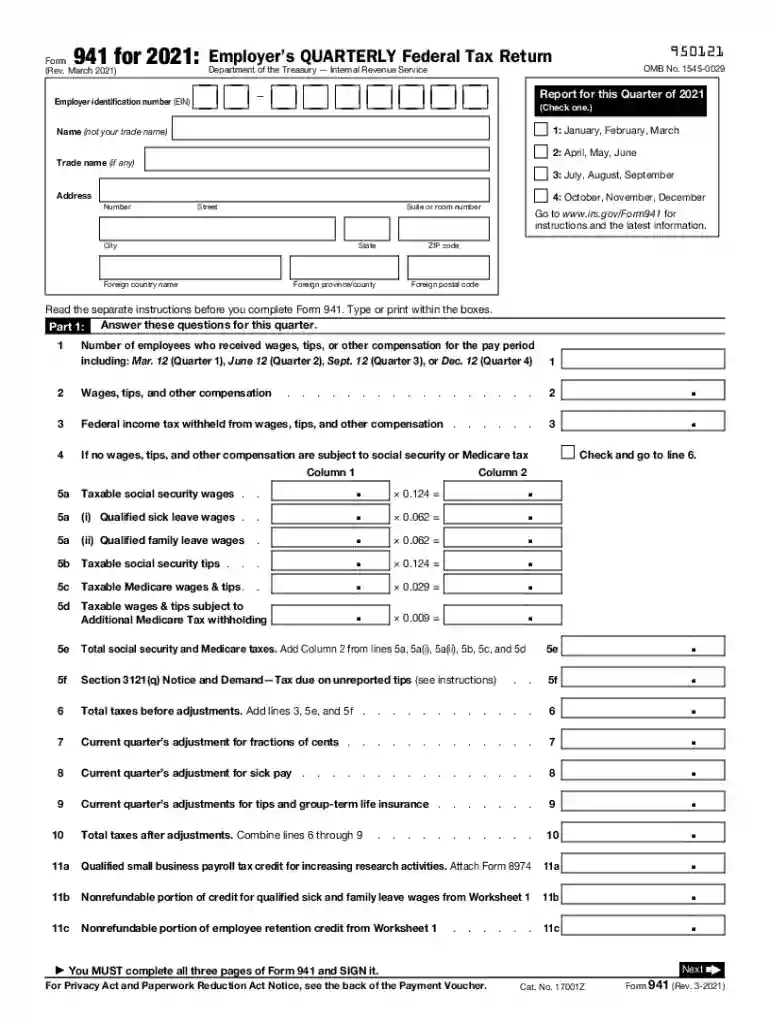
01. Edit your form 941 for 2021 online
Type text, add images, blackout confidential details, add comments, highlights and more.

Type text, add images, blackout confidential details, add comments, highlights and more.

Draw your signature, type it, upload its image, or use your mobile device as a signature pad.

Send 941 form 2021 via email, link, or fax. You can also download it, export it or print it out.
The Form 941, known formally as the Employer's Quarterly Federal Tax Return, is a crucial document for employers in the United States. It reports wages paid to employees, federal income tax withheld, and Social Security and Medicare taxes. Employers must file this form every quarter to comply with the IRS requirements.
To effectively use Form 941, employers should ensure they accurately calculate all wages, tips, and other compensations paid within the quarter. This includes reporting any federal income tax withheld from employees' paychecks. Employers should also include information on Social Security and Medicare taxes, ensuring all figures align with payroll records.
Wages and Taxes: Begin by calculating the total wages paid and the federal income tax withheld.
Social Security and Medicare: Determine the Social Security and Medicare taxes that apply to the wages.
Adjustments and Credits: Include any necessary adjustments or credits, such as for sick leave or family leave credits.
Final Review: Verify all figures for accuracy against payroll records before submission.
Employers can obtain Form 941 directly from the IRS website. It's also available at local IRS offices and can be delivered by postal service upon request. Many employers find it convenient to download the form electronically for immediate use.
Filling out Form 941 requires a systematic approach. Employers need to gather precise payroll and tax information to ensure correctness.
Business Information: Enter the business name, address, and employer identification number.
Quarter Selection: Indicate the quarter for which the form is being filed.
Employee Counts: Report the number of employees who received wages during the quarter.
Taxable Wages: Fill in the total amount of wages, tips, and other compensations.
Tax Calculations: Calculate and report the federal income taxes withheld, and Social Security and Medicare taxes.
Adjustments: Make any necessary adjustments or claim credits.
Signature: An authorized person must sign and date the form before submission.
The IRS provides comprehensive guidelines that employers must follow. These guidelines ensure that employers correctly report their tax liabilities every quarter. Adhering to these standards helps in avoiding common errors that could lead to audits or penalties.
Timely filing of Form 941 is critical. The deadlines are typically the last day of the month following the end of the quarter.
Failing to file Form 941 on time or providing inaccurate information can result in penalties imposed by the IRS. These penalties can accumulate quickly if not addressed promptly.
Employers have several options for submitting Form 941. It can be filed electronically or via mail, each with its benefits.
Various business types are required or find it advantageous to use Form 941 for tax reporting. This includes corporations, partnerships, and sole proprietorships that have employees.
Through careful adherence to these guidelines, employers can ensure compliance with federal tax laws, minimize errors, and avoid unnecessary penalties.
We've got more versions of the form 941 for 2021 form. Select the right form 941 for 2021 version from the list and start editing it straight away!
| Versions | Form popularity | Fillable & printable |
|---|---|---|
| 2024 | 4.8 Satisfied (58 Votes) | |
| 2023 | 4.2 Satisfied (60 Votes) | |
| 2022 | 4.8 Satisfied (92 Votes) | |
| 2022 | 4.4 Satisfied (44 Votes) | |
| 2021 | 4.3 Satisfied (182 Votes) | |
| 2021 | 4.3 Satisfied (151 Votes) | |
| 2020 | 4.4 Satisfied (186 Votes) | |
| 2020 | 4.3 Satisfied (183 Votes) | |
| 2020 | 4.1 Satisfied (43 Votes) | |
| 2019 | 4.1 Satisfied (40 Votes) | |
| 2018 | 4.4 Satisfied (178 Votes) | |
| 2017 | 4.1 Satisfied (60 Votes) | |
| 2016 | 4.4 Satisfied (389 Votes) | |
| 2015 | 4.3 Satisfied (39 Votes) | |
| 2014 | 4.3 Satisfied (28 Votes) |
At DocHub, your data security is our priority. We follow HIPAA, SOC2, GDPR, and other standards, so you can work on your documents with confidence.



Be sure to enter your. EIN, Form 941, and the tax period (1st Quarter 2025,. 2nd Quarter 2025, 3rd Quarter 2025, or 4th Quarter. 2025) on your checkRead more
Oct 6, 2017 Taxes on wages paid to nonfarm workers are reported on. Form 941/941-SS, Employers QUARTERLY Federal Tax Return, or Form 943-A to your FormRead more
The 941 Worksheet for A Quarter is used to collect the pay period wage and tax information that is necessary to complete the Form 941 at the end of the quarter.Read more


