




01. Edit your free fillable form 941 online
Type text, add images, blackout confidential details, add comments, highlights and more.

Type text, add images, blackout confidential details, add comments, highlights and more.

Draw your signature, type it, upload its image, or use your mobile device as a signature pad.

Send fillable form 941 via email, link, or fax. You can also download it, export it or print it out.
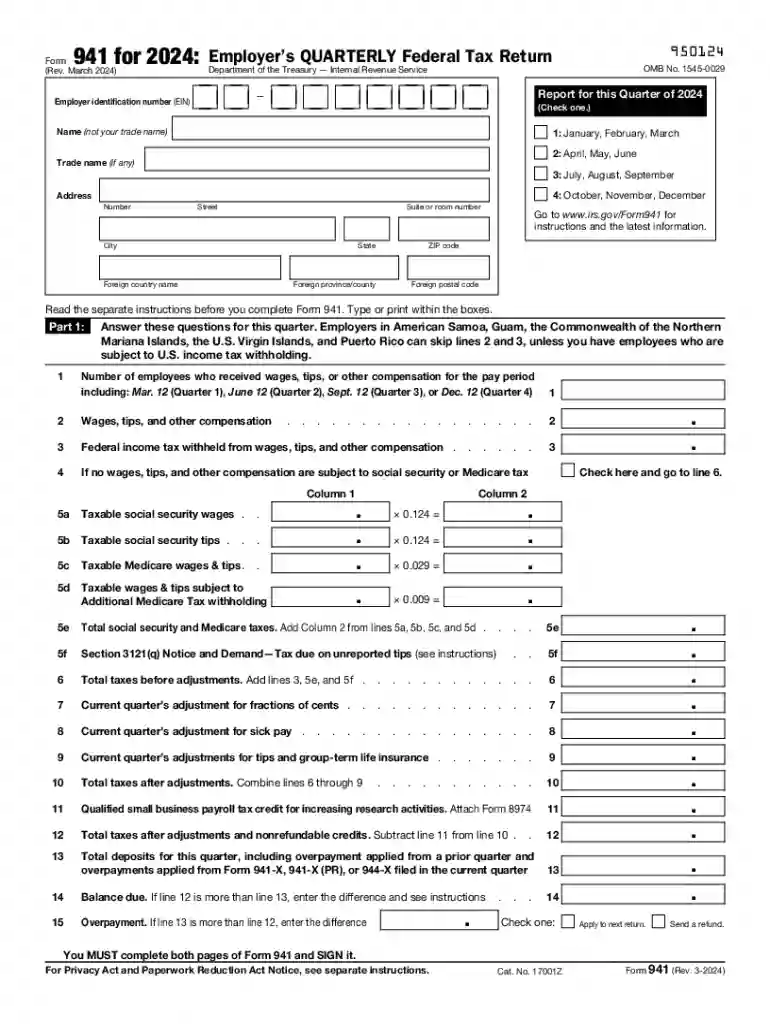
Form 941 (Rev March 2024), or the Employer's Quarterly Federal Tax Return, is a critical document used by businesses within the United States to report essential employment tax information. Primarily, it details wages paid to employees, as well as the federal income taxes withheld. Businesses are required to submit this form quarterly, ensuring that all necessary employer tax contributions, such as Social Security and Medicare taxes, are reported accurately. This form is instrumental in maintaining compliance with federal tax laws and ensuring that employers pay the appropriate employment taxes.
Employers utilize Form 941 to detail wages, tips, and other compensation paid out to employees throughout the quarter. The process begins by calculating the total taxable wages and tips, followed by reporting withheld federal income taxes. Additionally, the form requires employers to declare both the employer and employee portions of Social Security and Medicare taxes. Employers must also take note of any adjustments or overpayments from previous quarters and make the necessary corrections on the form. Finally, if applicable, employers must use Form 941-V as a payment voucher when submitting any owed taxes.
Employers are required to file Form 941 quarterly with the IRS. The due dates for submission are as follows:
To avoid penalties, businesses should file on time and ensure any taxes owed are paid by these deadlines. If the due date falls on a legal holiday or a weekend, the deadline extends to the next business day.
Failure to file Form 941 on time can result in significant penalties. The IRS generally assesses a penalty of five percent of the unpaid tax per month, up to a maximum of 25 percent. Additionally, penalties may be applied for errors or inaccuracies found on the form. Employers who fail to deposit taxes in a timely manner may also face penalties and interest on the unpaid amount. To mitigate these risks, businesses should ensure accurate and timely filings.
Employers have the option to file Form 941 either electronically or via paper submission. Filing electronically through authorized e-file providers offers several benefits, including faster processing times and reduced risk of errors. Electronic submissions also provide automatic confirmation of receipt by the IRS. On the other hand, filing a paper version may be suitable for businesses with simpler tax situations or those who prefer handling their submissions manually.
Form 941 is used predominantly by U.S.-based businesses that employ workers and are responsible for withholding federal taxes from employee wages. This includes a wide range of entities, such as:
These employers must file the form to report their federal tax liability accurately, contribute to Social Security and Medicare systems, and ensure compliance with withholding requirements.


We've got more versions of the free fillable form 941 form. Select the right free fillable form 941 version from the list and start editing it straight away!
| Versions | Form popularity | Fillable & printable |
|---|---|---|
| 2024 | 4.8 Satisfied (58 Votes) | |
| 2023 | 4.2 Satisfied (60 Votes) | |
| 2022 | 4.8 Satisfied (92 Votes) | |
| 2022 | 4.4 Satisfied (44 Votes) | |
| 2021 | 4.3 Satisfied (182 Votes) | |
| 2021 | 4.3 Satisfied (151 Votes) | |
| 2020 | 4.4 Satisfied (186 Votes) | |
| 2020 | 4.3 Satisfied (183 Votes) | |
| 2020 | 4.1 Satisfied (43 Votes) | |
| 2019 | 4.1 Satisfied (40 Votes) | |
| 2018 | 4.4 Satisfied (178 Votes) | |
| 2017 | 4.1 Satisfied (60 Votes) | |
| 2016 | 4.4 Satisfied (389 Votes) | |
| 2015 | 4.3 Satisfied (39 Votes) | |
| 2014 | 4.3 Satisfied (28 Votes) |
At DocHub, your data security is our priority. We follow HIPAA, SOC2, GDPR, and other standards, so you can work on your documents with confidence.


