




01. Edit your fillable 2023 form 941 online
Type text, add images, blackout confidential details, add comments, highlights and more.

Type text, add images, blackout confidential details, add comments, highlights and more.

Draw your signature, type it, upload its image, or use your mobile device as a signature pad.

Send 941 form 2023 via email, link, or fax. You can also download it, export it or print it out.
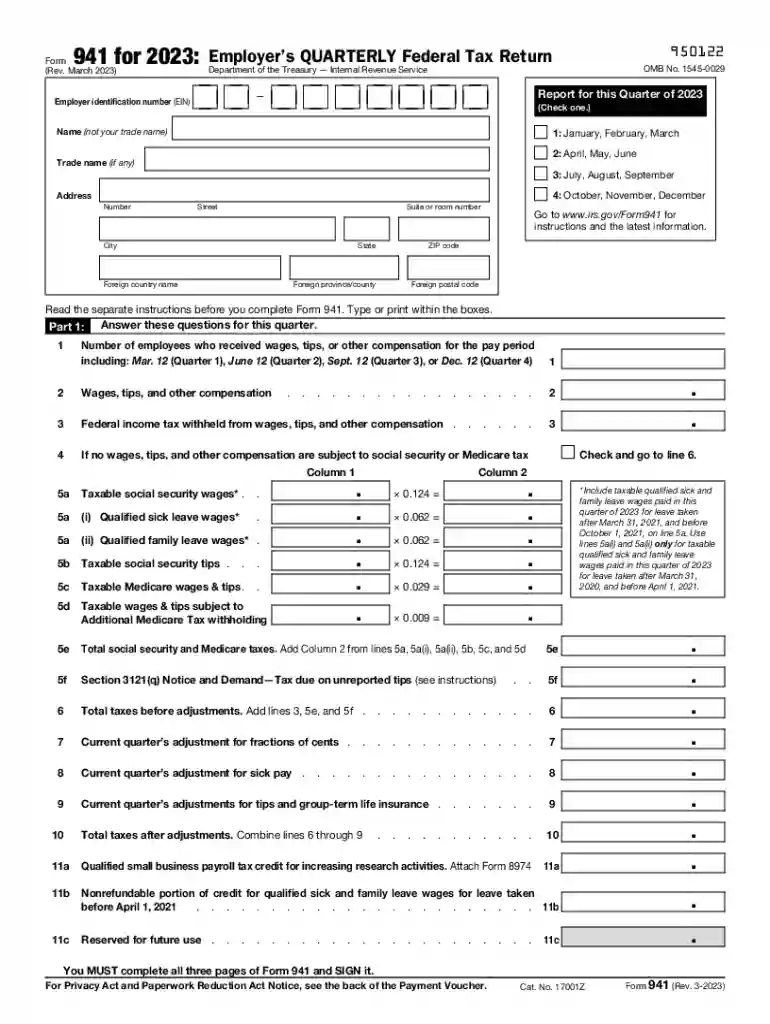
Form 941, known officially as the Employer's Quarterly Federal Tax Return, is a critical document used by employers to report various federal employment taxes. It is designed to report wages, tips, and other compensation paid to employees during the quarter, along with federal income tax withheld and Social Security and Medicare taxes. The form also includes sections for reporting employee counts, taxable wages, adjustments, credits, and detailed payment information for each quarter of the year. Employers must ensure the accuracy of all entries to maintain compliance with IRS regulations. Failing to appropriately file this form could result in penalties and interest.
Gather Required Information: Before filling out Form 941, collect all necessary payroll records, including total wages paid, tips reported, tax withholdings, and adjustments. Verify the employee social security numbers and employment status.
Fill Out Employer Information: Enter the employer's name, address, and Employer Identification Number (EIN) at the top of the form. Ensure accuracy, as the IRS uses this information to match filing records.
Calculate Taxes and Enter Details: Work through each section of the form by reporting the number of employees, total wages, and tips paid, along with the federal income tax withheld. In the appropriate sections, enter the amounts for Social Security and Medicare taxes.
Adjustments and Credits: If applicable, complete the adjustments for fractions of cents, sick pay, life insurance, and other relevant credits. This ensures the correct tax liability.
Final Payable Amount: Calculate the total taxes due after considering deposit amounts, credits, and overpayments. Make sure the final amount is correct before proceeding.
Signature and Submission: Review the form thoroughly before signing. A signature by the business owner or authorized representative is mandatory for validation.
Submit Form: Choose the preferred submission method—electronically through the IRS e-file system, or by mailing it to the designated IRS location.
Understanding these deadlines is essential to avoid late submission penalties. Early filing ensures any corrections can be made in time.
Employers have multiple options to submit Form 941, each with its benefits:
Failure to file Form 941 on time, or errors resulting in underpayment, can lead to penalties and interest:
To avoid penalties, ensure all information is accurate, and submit timely.
Adhering to IRS guidelines is crucial for precise and compliant Form 941 submission:
Understanding and following IRS guidelines ensure compliance and minimize potential issues during audits or reviews.
We've got more versions of the fillable 2023 form 941 form. Select the right fillable 2023 form 941 version from the list and start editing it straight away!
| Versions | Form popularity | Fillable & printable |
|---|---|---|
| 2024 | 4.8 Satisfied (58 Votes) | |
| 2023 | 4.2 Satisfied (60 Votes) | |
| 2022 | 4.8 Satisfied (92 Votes) | |
| 2022 | 4.4 Satisfied (44 Votes) | |
| 2021 | 4.3 Satisfied (182 Votes) | |
| 2021 | 4.3 Satisfied (151 Votes) | |
| 2020 | 4.4 Satisfied (186 Votes) | |
| 2020 | 4.3 Satisfied (183 Votes) | |
| 2020 | 4.1 Satisfied (43 Votes) | |
| 2019 | 4.1 Satisfied (40 Votes) | |
| 2018 | 4.4 Satisfied (178 Votes) | |
| 2017 | 4.1 Satisfied (60 Votes) | |
| 2016 | 4.4 Satisfied (389 Votes) | |
| 2015 | 4.3 Satisfied (39 Votes) | |
| 2014 | 4.3 Satisfied (28 Votes) |
At DocHub, your data security is our priority. We follow HIPAA, SOC2, GDPR, and other standards, so you can work on your documents with confidence.
Form 941 Employers Quarterly Federal Tax Return [e.g., 3-31-2023]. Form 940 Employers Annual Federal Unemployment (FUTA) Tax Return - Year(s) [e.g., 12-31-Read more
*Include taxable qualified sick and family leave wages paid in this quarter of 2023 for leave taken after March 31, 2021, and before.Read more
Apr 15, 1976 Form Number and Title. W-2. Employers QUARTERLY Federal Tax Return. 941. Sch J. Income Averaging for Farmers and Fishermen. Form Number andRead more


