
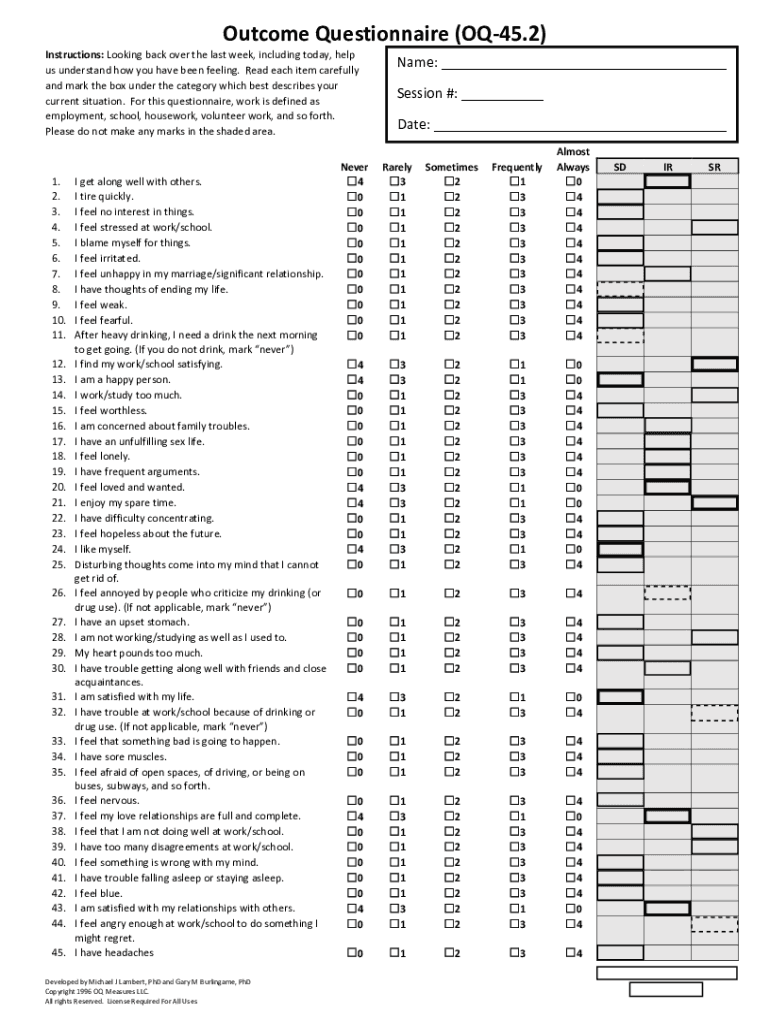







Definition and Meaning
The Outcome Questionnaire (OQ-45.2) is a robust tool used to assess an individual's psychological and emotional well-being over the preceding week. It aims to provide insights into personal experiences related to feelings, relationships, work or school satisfaction, and symptoms of mental health issues. The OQ-45.2 helps in identifying areas requiring attention or support by offering a structured way to measure changes in an individual's state over time.
How to Use the Outcome Questionnaire (OQ-45.2)
To effectively utilize the OQ-45.2, understanding the structure and scoring system is essential.
- Respondents assess a series of statements based on their experiences in the last week, using a scale typically ranging from "never" to "almost always."
- Each response contributes to an overall score that can highlight levels of distress, providing clues for therapeutic focus areas.
Examples of Statements
- "I feel no interest in things."
- "I feel lonely."
- "I am satisfied with my life." These statements assist clients in articulating their mental state and facilitating discussions with mental health professionals.
Steps to Complete the Outcome Questionnaire (OQ-45.2)
- Preparation: Familiarize the respondent with the instructions and objective of the questionnaire.
- Response Selection: Encourage honest and reflective answers based on personal experience, as the OQ-45.2 relies on self-reporting.
- Review: Upon completion, go through the responses to ensure no sections are missed.
- Scoring: Calculate the responses to produce a composite score that reflects the respondent's current psychological well-being.
Key Elements of the Outcome Questionnaire (OQ-45.2)
- Symptom Distress (SD): Measures symptoms like anxiety and depression.
- Interpersonal Relations (IR): Evaluates relationship satisfaction and dynamics.
- Social Role Performance (SRP): Assesses the satisfaction with work, school, or daily roles.
Subsections within Elements
The questionnaire breaks down these elements into specific areas, allowing for a deep dive into each facet of mental health and social interaction.
Who Typically Uses the Outcome Questionnaire (OQ-45.2)
The OQ-45.2 is widely used by:
- Mental health professionals to track progress in therapy.
- Psychologists as a diagnostic aid.
- Researchers seeking to evaluate the effectiveness of mental health interventions.


Legal Use of the Outcome Questionnaire (OQ-45.2)
While the questionnaire provides critical insights into mental health, it must be used in compliance with privacy laws such as the Health Insurance Portability and Accountability Act (HIPAA).
- Ensure patient consent is obtained for the collection and analysis of their data.
- Maintain confidentiality across all stages of administration and reporting.
Examples of Using the Outcome Questionnaire (OQ-45.2)
Case Study: Therapy Progression
A therapist administers the OQ-45.2 at the start of a treatment plan and again after six months. The scoring indicates significant reductions in symptom distress and improvements in interpersonal relationships, guiding further therapy approaches.
Why Use the Outcome Questionnaire (OQ-45.2)
The primary utility of the OQ-45.2 lies in its ability to provide:
- Baseline data for establishing initial mental health conditions.
- Ongoing measurements for the evaluation of intervention effectiveness.
- A structured framework that facilitates objective communication between patients and healthcare providers.
It ensures that both positive developments and areas needing improvement are systematically identified and addressed.




