L:USERSA_MGMT SharedConnieFormsRepossession Form 2 ... 2026

Get Form
louisiana repo affidavit Preview on Page 1

Here's how it works

01. Edit your louisiana repo affidavit online
Type text, add images, blackout confidential details, add comments, highlights and more.

02. Sign it in a few clicks
Draw your signature, type it, upload its image, or use your mobile device as a signature pad.

03. Share your form with others
Send louisiana affidavit of repossession form via email, link, or fax. You can also download it, export it or print it out.

Definition & Meaning of the L:USERSA_MGMT SharedConnieFormsRepossession Form 2

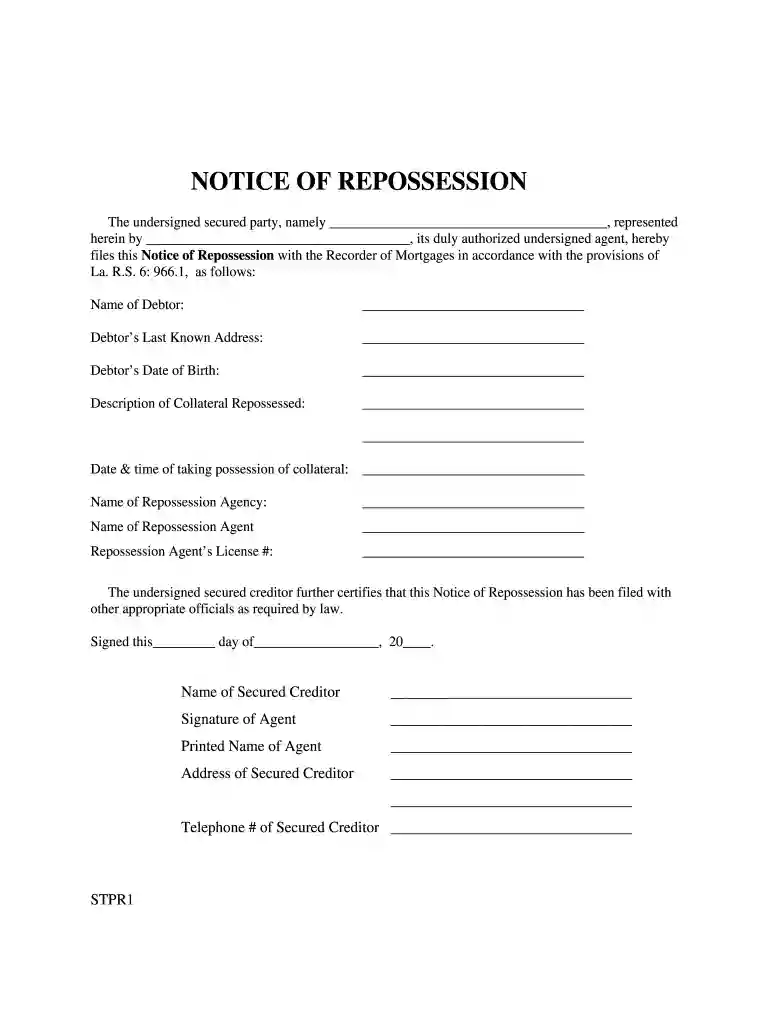
The L:USERSA_MGMT SharedConnieFormsRepossession Form 2 is a formal document utilized in the repossession process, serving as a crucial tool for secured parties to notify debtors about the repossession of collateral. This form must include essential information such as the debtor's name, address, and date of birth, as well as a detailed description of the collateral being repossessed. Furthermore, it should outline specific details pertaining to the repossession agency involved and the agent responsible for executing the repossession. The completion and filing of this form demonstrate compliance with the legal requirements laid out for repossession actions in the United States, ensuring the secured party can legally reclaim the collateral.

The purpose of this form extends beyond mere notification; it serves to protect the rights of both the creditor and the debtor. By formally documenting the repossession process, this form reduces the risk of misunderstandings and can act as evidence in legal disputes that may arise regarding the repossession. Understanding the nuances and requirements of the L:USERSA_MGMT SharedConnieFormsRepossession Form 2 is vital for any stakeholder involved in the repossession process, ensuring all actions are conducted legally and ethically.

Steps to Complete the L:USERSA_MGMT SharedConnieFormsRepossession Form 2

Completing the L:USERSA_MGMT SharedConnieFormsRepossession Form 2 involves several critical steps. Each section of the form must be filled out accurately to ensure compliance and avoid potential legal issues.

  1. Gather Necessary Information:

    • Collect the debtor's full legal name, address, and date of birth. In addition, ensure you have the detail of the collateral to be repossessed, including any identifying features such as VIN numbers for vehicles or serial numbers for equipment.
  2. Provide Collateral Description:

    • Clearly describe the collateral being repossessed, including make, model, and condition. This detail is essential to confirm the specifics of what is being reclaimed.
  3. Complete the Repossession Agency Information:

    • Enter the name and contact details of the repossession agency handling the process. This may include the agency's physical address, phone number, and a designated contact person.
  4. Include Agent Details:

    • Fill in the name and relevant qualifications of the agent executing the repossession. This ensures the debtor knows who is responsible for the action, enhancing transparency.
  5. Review and Sign the Form:

    • Once all sections are completed, review the form for accuracy. A signature from the secured party is usually required, affirming that the information provided is complete and truthful.
  6. File the Form:

    • Finally, submit the completed form according to state laws and regulations. This could involve sending it to the debtor, filing it with local authorities, or both, depending on legal requirements.

Following these steps meticulously will aid in ensuring the repossession process adheres to legal standards and protects the rights of involved parties.

Important Terms Related to the L:USERSA_MGMT SharedConnieFormsRepossession Form 2

Understanding the terminology associated with the L:USERSA_MGMT SharedConnieFormsRepossession Form 2 is crucial for stakeholders engaged in the repossession process. Key terms include:

  • Secured Party: The individual or entity holding a security interest in the collateral, entitled to reclaim it upon default.
  • Debtor: The individual or entity that owes a debt and whose property is subject to repossession.
  • Collateral: Property pledged as security for a loan, which can be reclaimed by the secured party if the debtor defaults on their obligations.
  • Repossession Agency: A business authorized by the secured party to recover the collateral on their behalf, typically equipped to handle the logistics of repossession.
  • Agent: A representative employed by the repossession agency, responsible for executing the repossession, adhering to legal guidelines, and communicating with the debtor.
  • Default: The failure of the debtor to meet the terms of the agreement, such as missed payments, triggering the right of the secured party to reclaim the collateral.

Having a clear understanding of these terms can help all parties navigate the repossession process with clarity and compliance.

Legal Use of the L:USERSA_MGMT SharedConnieFormsRepossession Form 2

The L:USERSA_MGMT SharedConnieFormsRepossession Form 2 plays a significant role in ensuring the legal use of repossession actions. Compliance with state and federal regulations is critical when utilizing this form.

  • Compliance with State Regulations:

    • Different states have specific laws governing repossession, including how notices must be delivered and requirements for providing the debtor with information. The form must be completed in accordance with these laws to avoid legal repercussions.
  • Notice Requirements:

    • In many jurisdictions, state laws mandate that debtors are notified before a repossession can occur. The completion and delivery of the Notice of Repossession through this form serve as that notification, providing written evidence that the debtor was informed of the intention to reclaim the collateral.
  • Legal Protections:

    • Utilizing the form appropriately establishes a legal framework protecting both the secured party's rights to their collateral and the debtor's rights during repossession. This balance helps mitigate potential conflicts and leads to smoother resolutions.
  • Documentation and Record-Keeping:

    • Filing the form correctly not only fulfills legal obligations but also creates an official record of the repossession which can be crucial in case of disputes or legal action. Proper documentation can substantiate claims and provide clarity for both parties involved.

Understanding the legal implications and requirements surrounding the use of the L:USERSA_MGMT SharedConnieFormsRepossession Form 2 is essential for anyone in the repossession field, ensuring all actions align with established laws.

State-Specific Rules for the L:USERSA_MGMT SharedConnieFormsRepossession Form 2

The repossession process is governed by state-specific rules, which significantly influence the way the L:USERSA_MGMT SharedConnieFormsRepossession Form 2 must be completed and filed. These variations can impact timelines, notification requirements, and necessary documentation.

  • Notification Periods:

    • States may require different waiting periods before a repossession can be executed after a default has occurred. For instance, some states mandate a notice period prior to repossession, while others may not.
  • Requirements for Delivery of Notice:

    • Variations in the method of delivering the notice also exist. Some states permit electronic notification, whereas others may require physical mail or in-person delivery to the debtor.
  • Local Legal Codes:

    • It's imperative to refer to local statutes for specifics on language and content that must be included in the repossession notice. Certain states have standardized wording or specific inclusions that must be addressed to fulfill compliance.
  • Public Notice Requirements:

    • Certain jurisdictions may necessitate that repossession actions be reported publicly, especially when dealing with high-value collateral, further emphasizing transparency in the process.
  • Recovery Procedures:

    • States may define standardized procedures for the physical act of repossessing collateral, affecting how agents conduct repossessions. This could involve restrictions on the timing or method of recovery to protect consumer rights.

Navigating these state-specific rules is crucial for any secured party or repossession agency, ensuring that all actions are legal and uphold the protections offered to debtors while facilitating the rights of creditors.

be ready to get more

Complete this form in 5 minutes or less

Get form

Got questions?

We have answers to the most popular questions from our customers. If you can't find an answer to your question, please contact us.
Contact us

Yes, a typed name is recognized as a legitimate electronic signature when you create it on your form utilizing a compliant solution like DocHub. Simply import your louisiana notice of repossession form to our editor, click Sign in the top tool pane → Create your signature → Type your name in the proper tab, and decide how it will appear on your document.

If you store your paperwork in Google Drive, there is no need to download your L:USERSA_MGMT SharedConnieFormsRepossession Form 2 ... on your computer and upload it back to our editor. A significantly simpler way is to set up a browser extension developed by DocHub to streamline this flow. The extension allows editing PDFs in your web browser. Alternatively, you can integrate your DocHub and Gmail accounts for more efficient modifying.

Security and compliance

At DocHub, your data security is our priority. We follow HIPAA, SOC2, GDPR, and other standards, so you can work on your documents with confidence.

Learn more
ccpa2
pci-dss
gdpr-compliance
hipaa
soc-compliance
be ready to get more

Complete this form in 5 minutes or less

Get form