




01. Edit your 72 passenger school bus seating chart online
Type text, add images, blackout confidential details, add comments, highlights and more.

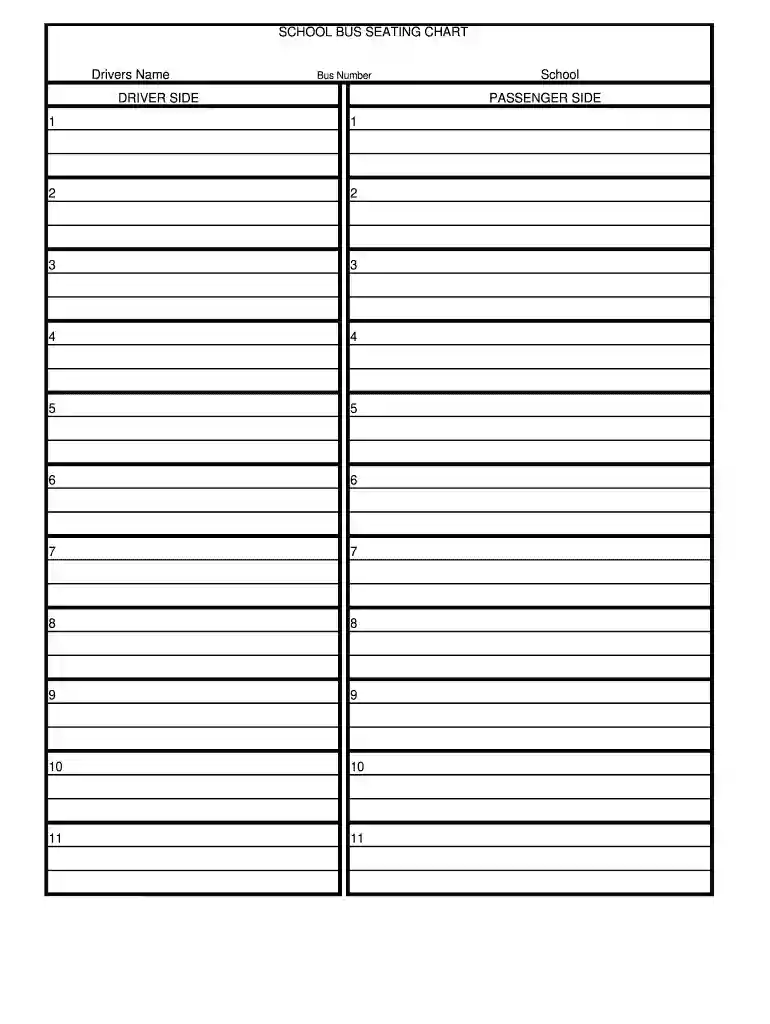
Type text, add images, blackout confidential details, add comments, highlights and more.

Draw your signature, type it, upload its image, or use your mobile device as a signature pad.

Send bus seating chart template via email, link, or fax. You can also download it, export it or print it out.
A bus seating chart is a detailed diagram outlining the seating arrangement within a bus, including the positioning of passengers, the driver, and the bus number. It serves multiple purposes, such as ensuring safety, optimizing seating based on various needs, and aiding in the efficient management of passenger allocation. The chart typically includes both the driver and passenger sides, complete with fields for the driver's name and pertinent revision and retention data.
The layout not only facilitates organization but also aids in compliance with safety protocols and regulations. By providing a clear map of where each individual is seated, the chart helps in emergency planning and passenger accountability. Each seat assignment can accommodate specific needs, accommodating requests for accessibility, company policies, or school rules, where applicable.
To effectively use a bus seating chart, one must first comprehend its layout. It generally includes rows and columns representing seats, grouped by sections such as the driver area and passenger rows. Some charts may also feature annotations for specific seating orders like front, middle, or rear sections.
For educators, ensuring that students adhere to the outlined seating arrangement is vital for maintaining order and tracking individuals. The chart can also be adjusted to accommodate special requirements, such as seating students with behavioral considerations near supervisors.
These steps ensure that the chart is both comprehensive and functional, aiding in any necessary changes or audits.
The significance of the bus seating chart lies in its ability to maintain order, security, and compliance. By providing a visual map of seating, it reduces confusion during boarding, allows for quick identification of seats, and facilitates efficient passenger management. Additionally, the chart can be critical during emergency evacuations, as it helps to identify and account for all passengers swiftly.
In educational settings, the chart further aids teachers in learning student names and faces quickly, reducing instances of misbehavior by assigning chaperones strategically.
By maintaining these elements, the seating chart fulfills its primary functions of organization and safety effectively.
The chart is primarily used by bus operators, school administrators, and event organizers who need to manage groups of people efficiently. Educators find it particularly useful for supervising student transit, ensuring that seating arrangements adhere to school policies and safety standards.
Organizers of events and tour operators also benefit from bus seating charts to allocate seats strategically, allowing them to manage group dynamics and ensure a pleasant passenger experience.


While bus seating charts are largely standardized, specific states may have additional requirements affecting their use. In the United States, different jurisdictions may impose regulations concerning school bus assignments, such as mandates for specific seating arrangements to promote student engagement or inclusion.
For instance, some states may require that younger children sit at the front, while others necessitate that bus seating plans are submitted as part of compliance documentation. Understanding these state-specific rules is crucial for those responsible for chart creation and implementation to ensure full regulatory compliance.
Bus seating charts are applied in several practical scenarios, such as:
These examples illustrate how the bus seating chart can be adapted to fit varied situations, providing significant context and utility tailored to specific needs.
We've got more versions of the 72 passenger school bus seating chart form. Select the right 72 passenger school bus seating chart version from the list and start editing it straight away!
| Versions | Form popularity | Fillable & printable |
|---|---|---|
| 2002 | 4 Satisfied (47 Votes) |
With DocHub, you can rapidly sign your school bus seating chart pdf or any other paperwork on iOS, even without setting up extra programs. You can access your DocHub account from any web-connected browser and complete and sign your document in any way you like with just a couple of clicks.
Apart from a comprehensive toolset for editing PDFs on mobile phones, DocHub allows you to sign your bus seating chart printable along the way. Open our editor in your web browser, make changes using DocHub’s toolset, and complete your editing by eSigning the completed form.
At DocHub, your data security is our priority. We follow HIPAA, SOC2, GDPR, and other standards, so you can work on your documents with confidence.



Oct 20, 2025 With the Classroom Seating Chart Tool, faculty can track student participation and attendance and generate names for cold calling with an easy-to-use,Read more
School Bus Seating Chart. Bus#. Driver: Seat#. 2. 1. 4. 3. 6. 5. 8. 7. 10. 9. 12. 11. 14. 13. 16. 15. 18. 17. 20. 19. 22. 21. 24. 23. 26. 25.Read more


