
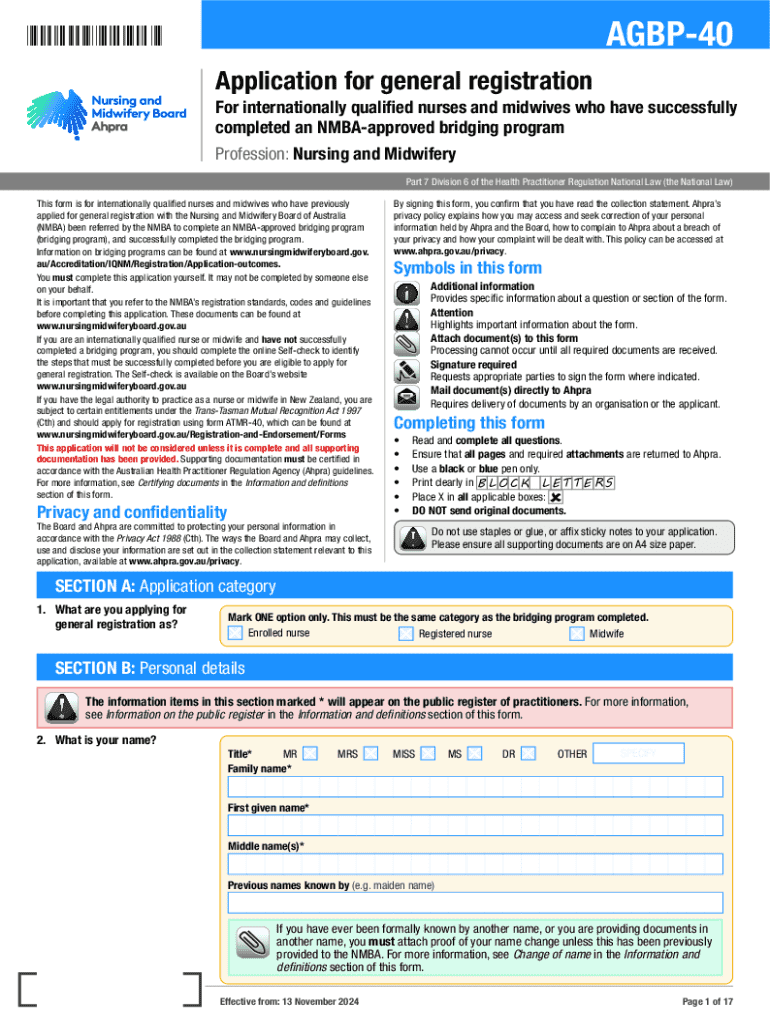







Definition and Purpose of the Application for General Registration as an Enrolled Nurse
The "Application for General Registration as an Enrolled Nurse" is a formal document primarily used by internationally qualified nurses and midwives seeking registration with the Nursing and Midwifery Board of Australia (NMBA). The application serves to verify that candidates meet specific regulatory standards necessary for practice within the healthcare industry. It encompasses detailed sections including personal information, qualifications, and legal declarations, ensuring that each applicant fulfills all criteria for enrollment as an enrolled nurse.
Eligibility Criteria


General Requirements
- Education: Candidates must complete an NMBA-approved bridging program or hold equivalent credentials.
- Language Proficiency: Evidence of English language competency is mandatory for all applicants, typically demonstrated through standardized exams like IELTS or OET.
Professional Experience
- Work History: A comprehensive record of prior nursing roles and responsibilities must be included, detailing experience in healthcare settings similar to Australian standards.
Verification
- Criminal History Check: Applicants must provide documentation of a cleared background check conducted by a recognized authority, ensuring that there are no disqualifying legal issues.
How to Obtain the Form
Online Availability
The application form can be accessed directly from the official website of the Nursing and Midwifery Board of Australia. Users are encouraged to download the latest version to ensure compliance with current standards.
Alternative Access Points
- Educational Institutions: Many recognized nursing schools provide the form as part of the registration package for participants of their bridging programs.
- Professional Associations: Various nursing associations may also facilitate access to the application as part of their support services for members.
Steps to Complete the Application
-
Gather Required Documents: Prepare all necessary documents, including proof of identity, qualifications, and language proficiency.
-
Fill Out Personal Details: Complete sections related to your personal information with accuracy and precision.
-
Detail Professional Qualifications: Record your relevant educational background and any certifications obtained.
-
Submit Work History: Provide a comprehensive list of prior nursing positions held, including the duration and responsibilities.
-
Attach Supporting Documentation: Include verified copies of all required documents, ensuring they are certified as per NMBA guidelines.
-
Review and Submit: Thoroughly review the application for any errors or omissions before submitting through the chosen method.
Key Elements of the Form
- Identification Information: Includes name, date of birth, and contact details.
- Educational History: Requires details about completed nursing or midwifery programs.
- Language Skills: Specific section for demonstrating English language competency.
- Professional Experience: Areas dedicated to outlining past work experience.
- Legal Declarations: Applicants must sign and declare that all information provided is true and correct.
Legal Use and Compliance
Using the "Application for General Registration as an Enrolled Nurse" signifies understanding and agreement with terms set by NMBA for practice within Australia. It ensures compliance with professional and legal standards, safeguarding the public by maintaining a competent nursing workforce.
Important Terms Related to the Application
- NMBA: Nursing and Midwifery Board of Australia, the regulatory body for nursing practice standards.
- Bridging Program: A course designed to assist internationally qualified nurses in meeting Australian standards.
- ESIGN Act: Relevant for understanding the equivalence of paper and electronic signatures in legal contexts.
Required Documents
Essential Documents
- Identity Proof: Passport or national ID card.
- Educational Certificates: Diplomas and transcripts of all relevant qualifications.
- Background Check: Recent criminal history clearance.
Additional Documentation
- Professional Indemnity Insurance: Proof of current insurance coverage is typically requested.
Form Submission Methods
The form can be submitted through various channels, providing flexibility for applicants:
Digital Submission
- Email: Preferred for its speed and efficiency.
Traditional Methods
- Mail or In-Person: Some applicants may prefer or require these methods for document inclusion or verification.
Form Variants and Alternatives
In some cases, applicants might be presented with alternative forms dependent on their unique circumstances, such as country-specific versions or those tailored for specific educational pathways.
- AGBP-40: Often used by those completing certain bridging programs.
- Updated Versions: Ensure access to the most current form to avoid potential issues during processing.




