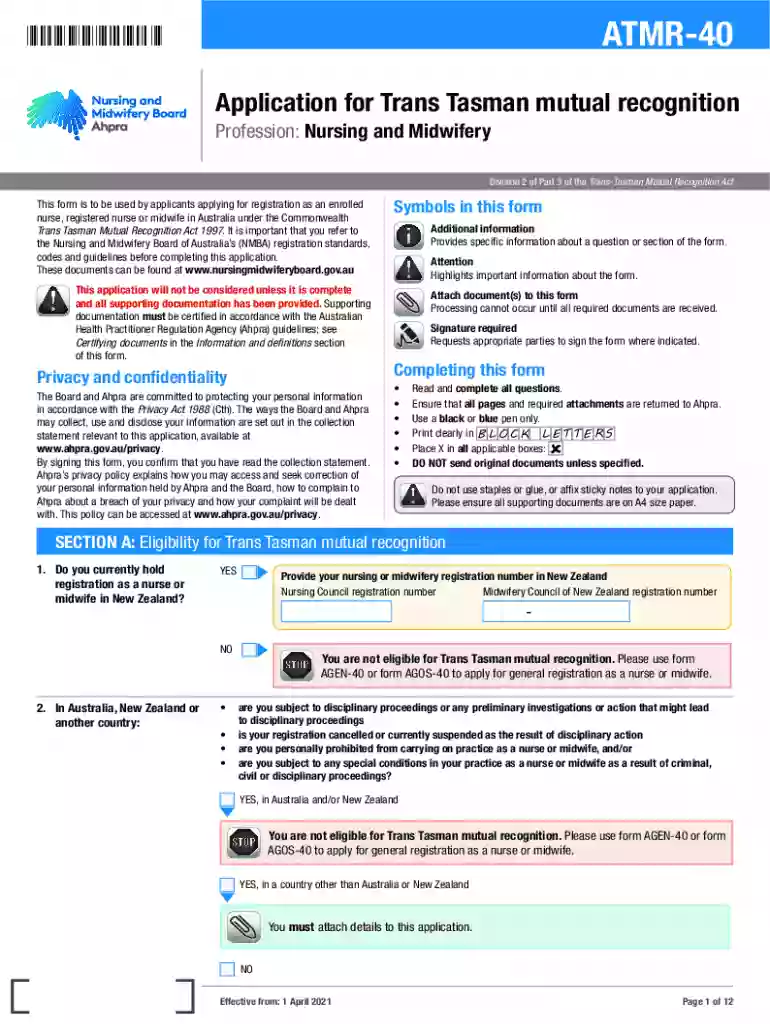
Application for Trans Tasman mutual recognition as an enrolled nurse, registered nurse or midwife - 2026

Get Form
application trans tasman mutual recognition Preview on Page 1

Here's how it works

01. Edit your application trans tasman mutual recognition online
Type text, add images, blackout confidential details, add comments, highlights and more.

02. Sign it in a few clicks
Draw your signature, type it, upload its image, or use your mobile device as a signature pad.

03. Share your form with others
Send application trans tasman mutual recognition nursing via email, link, or fax. You can also download it, export it or print it out.

Definition & Meaning

The "Application for Trans Tasman Mutual Recognition as an Enrolled Nurse, Registered Nurse, or Midwife" is a formal request used by nursing and midwifery professionals seeking registration in Australia as per the Commonwealth Trans Tasman Mutual Recognition Act 1997. This application facilitates the recognition of New Zealand nursing and midwifery credentials in Australia, permitting professionals to work across borders without requalification. It outlines necessary documentation, eligibility criteria, and legal obligations under the Nursing and Midwifery Board of Australia (NMBA).

Eligibility Criteria

To be eligible for the Trans Tasman mutual recognition, applicants must hold an active nursing or midwifery registration in New Zealand. The applicant must meet specific criteria, including displaying good character, not being subject to disciplinary proceedings, and maintaining professional indemnity insurance. The form mandates proof of identity and qualification documentation, all certified according to outlined standards.


decoration image ratings of Dochub

Additional Requirements

  • Evidence of current New Zealand registration.
  • Certified copies of professional qualifications.
  • Completed proof of identity documents.
  • Declaration of professional indemnity insurance coverage.

Steps to Complete the Application

Filling out the application requires adherence to precise steps to ensure accuracy and compliance:

  1. Gather Required Documents: Assemble all necessary documents, ensuring they are fully certified.
  2. Complete Personal Details Section: Fill out personal and contact information accurately.
  3. Provide Qualifications: List academic and professional qualifications, supplying certified documents.
  4. Professional Indemnity Insurance: Include details of insurance coverage pertinent to your professional practice.
  5. Attach Supporting Documents: Ensure all relevant supporting documents are attached.
  6. Review and Submit: Double-check all information and submit the form to the appropriate authority.

Key Elements of the Application

The form consists of various sections vital for the assessment of the applicant's eligibility:

  • Personal Details: This section captures the applicant's identity and contact information.
  • Proof of Identity: Includes passports and other government-issued IDs.
  • Qualifications and Experience: Lists all relevant education and professional practice history.
  • Consent and Declaration: Applicants must consent to terms and affirm the truthfulness of supplied information.

Required Documents

Critical to the application process is the submission of specific documents:

  • Current New Zealand registration certificate.
  • Certified academic credentials.
  • Professional indemnity insurance certificate.
  • Passport or equivalent ID for proof of identity.

Legal Use of the Application

The application serves legal purposes by authenticating the individual's right to practice in Australia. It ensures compliance with the Trans Tasman Mutual Recognition Act 1997, allowing professionals to bypass additional qualifications or registration processes which would otherwise be mandatory.

Who Typically Uses this Application

Primarily, the form is used by New Zealand enrolled nurses, registered nurses, and midwives who wish to extend their practice across the Tasman Sea. This is particularly beneficial for professionals seeking temporary or permanent relocation to Australia for work purposes.

Application Process & Approval Time

The process involves submitting the completed form with requisite documents to the designated authority, with approval times varying based on the completeness of the submission and verification requirement. Typically, processing can take several weeks, and immediate action post-submission is not guaranteed.

Potential Delays

  • Incomplete documentation can slow down the process.
  • Delays in inter-agency communication can extend approval time.

Form Submission Methods

Applicants have the option to submit their forms through several avenues, contributing to convenience and accessibility:

  • Online Submission: Digital forms with electronic copies of documents can be sent via the official portal.
  • Mail Submission: Postal services allow for physical delivery of the form and attachments.
  • In-Person: Applicants may also submit documents directly at administrative offices, providing real-time confirmation of submission.

Versions or Alternatives to the Form

While this particular application is the standard for the intended recognition, alternative forms or supplementary documents may exist for related processes, ensuring comprehensive coverage of diverse professional needs. Applicants should verify if any additional paperwork is necessary for specific circumstances.

Software Compatibility

The application process is facilitated by websites like DocHub that support the creation, editing, and digital submission of complex forms. DocHub ensures that documents are handled securely and efficiently, accommodating formats such as PDF, which align with software used in professional document management.

Important Terms Related to the Application

Understanding key terms is critical for applicants:

  • "Trans Tasman Recognition": Refers to the mutual acknowledgment of professional credentials between Australia and New Zealand.
  • "Certified Copies": Official confirmation that replicated documents are true copies of the original.
  • "Professional Indemnity Insurance": Insurance protecting against claims of malpractice or professional negligence.

State-Specific Rules

While the primary application form remains consistent across states, internal state regulations may influence the specifics of professional practice, especially concerning healthcare practices and regional healthcare policies. It is advisable for applicants to review state-specific requirements post-recognition.

be ready to get more

Complete this form in 5 minutes or less

Get form

Got questions?

We have answers to the most popular questions from our customers. If you can't find an answer to your question, please contact us.
Contact us
All nurses are required to provide documents proving their: identity. current registration/s held in the last 10 years. nursing qualification equivalent to NZ qualifications. evidence of English language proficiency. 1,800 hours post-registration nursing experience.
An EN can become a registered nurse (RN) with the completion of a Bachelor of Nursing. Many universities offer a Bachelor of Nursing to ENs, recognising previous learning and experience.
To become a registered nurse, you will need to complete an accredited course at a recognised university. Two-year fast track programs are now available. Upon successful completion, you can apply for Nursing and Midwifery Board of Australia registration.
A new employment pathway that allows nursing and midwifery students to work in frontline settings during their studies has been introduced in the Tasmanian health system with the aim of strengthening nursing and midwifery workforce development opportunities and enhancing delivery of services.
Similarly, the subclass 190 visa for nurses is also an option that is available for the enrolled nurse occupation, as is a subclass 482 visa sponsorship for nurses in Australia.

Security and compliance

At DocHub, your data security is our priority. We follow HIPAA, SOC2, GDPR, and other standards, so you can work on your documents with confidence.
Learn more
ccpa2
pci-dss
gdpr-compliance
hipaa
soc-compliance

People also ask

The average annual salary for Registered Nurse jobs in Tasmania ranges from $90,000 to $100,000.
Tasmanias nursing and midwifery workforce is the largest health professional workforce. It has been growing, while average hours have been falling. The proportion of hours worked between the public and the private sectors has remained steady. docHub supply variations exist by region and area of practice.
The easiest nursing degree to obtain is typically an Associate Degree in Nursing (ADN). It usually takes about two years to complete and offers a more accessible pathway into the nursing profession compared to a Bachelor of Science in Nursing (BSN).

Related links