01. Edit your form online
Type text, add images, blackout confidential details, add comments, highlights and more.

Type text, add images, blackout confidential details, add comments, highlights and more.

Draw your signature, type it, upload its image, or use your mobile device as a signature pad.

Send it via email, link, or fax. You can also download it, export it or print it out.
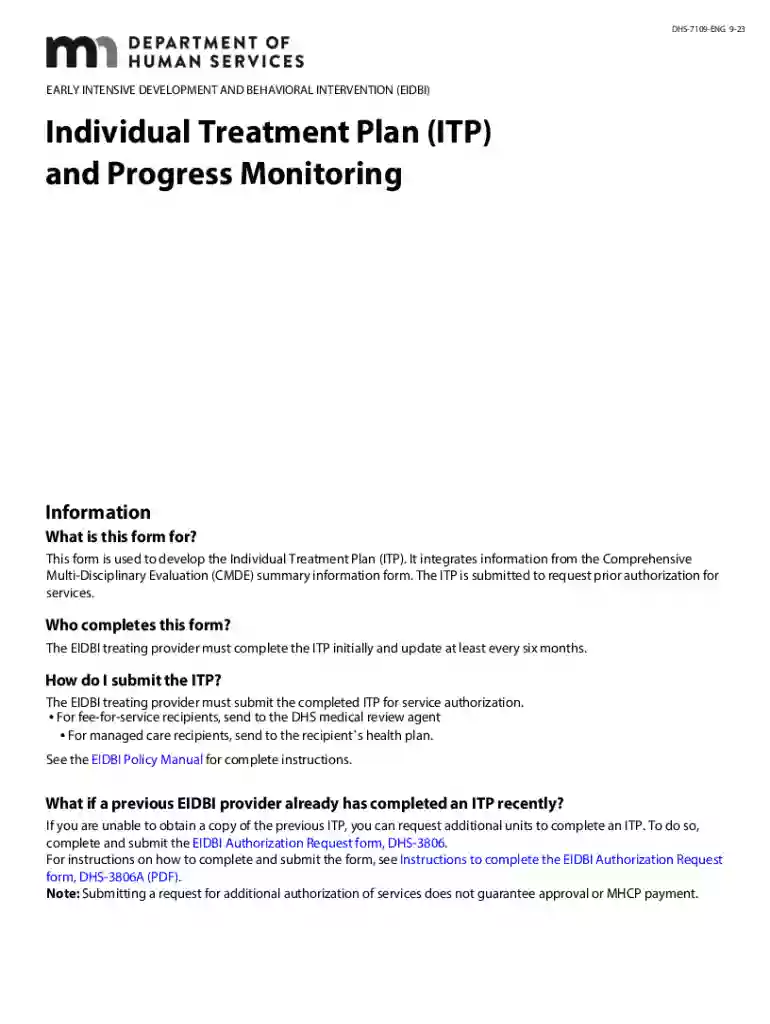
The DHS-7109-ENG, also known as the Individual Treatment Plan (ITP) and Progress Monitoring - form-1, is a structured document designed to outline a comprehensive treatment plan for individuals under medical or psychological care. This form assists healthcare providers in organizing and implementing a tailored care strategy that addresses the specific needs of a patient. The form also serves as a tool for monitoring progress and adjusting treatment plans as necessary. It ensures that all care aspects are systematically considered, tracked, and adjusted based on the patient's evolving condition.
The form includes several critical components that work together to create a detailed and dynamic Individual Treatment Plan:
Patient Information: Collects basic details such as name, date of birth, and identification number.
Diagnosis and Assessment: Documents the patient's medical diagnosis and the initial assessment that informs the treatment plan.
Treatment Objectives: Outlines specific, measurable goals that the treatment aims to achieve.
Intervention Strategies: Lists the specific treatment methods and therapeutic techniques to be employed.
Progress Monitoring: Provides sections to record the patient's progress over time, including any changes or adjustments to the treatment plan.
Review Dates: Sets scheduled times for reviewing and updating the plan to ensure it remains relevant to the patient’s condition.
Utilizing the DHS-7109-ENG effectively involves understanding the process of filling out and applying the form in clinical settings:
Initial Assessment: Healthcare providers begin by conducting a thorough assessment of the patient, which informs the diagnosis and proposed objectives.
Completion of the Form: The form is meticulously filled out with all necessary information, including patient specifics, treatment objectives, and planned interventions.
Regular Updates: As treatment progresses, the form needs periodic updates to reflect any changes in the patient's condition or the treatment being provided.
Collaboration: The form is often filled out in collaboration with other healthcare team members to ensure a holistic approach to treatment.
The process of completing the DHS-7109-ENG is straightforward when broken down into the following steps:
Gather Patient Information: Start with the basic identification details.
Document Diagnosis: Record current medical or psychological conditions based on the most recent assessment.
Set Treatment Goals: Define clear and attainable goals that the patient should work towards.
Detail Intervention Plans: Provide a comprehensive list of the therapies and interventions to be used.
Establish Review Dates: Specify when the treatment plan should be re-evaluated.
Monitor and Record Progress: Continually track the patient’s progress and modify the plan as necessary.
This form is primarily used by healthcare professionals, including:
Psychologists and Psychiatrists: For mental health treatment plans.
Physicians: For general or specialized medical treatment strategies.
Social Workers: In case management and liaising with other service providers.
Therapists: For tracking interventions in speech, occupational, or physical therapy.


In a legal context, the DHS-7109-ENG serves as an official document that can be used to justify the care provided to a patient. It outlines all planned interventions and records changes, fulfilling both compliance and accountability requirements. It demonstrates that care decisions are data-driven and consistent with recognized standards of practice, protecting both the patient and the provider in the event of audits or reviews.
Understanding key terminology is crucial for accurately completing and interpreting the form:
Objective: A specific outcome or milestone aimed for in the treatment.
Intervention: A specific treatment or therapy applied to achieve an objective.
Progress Monitoring: The process of reviewing and recording the patient’s response to treatment.
Review Date: A scheduled time to evaluate and potentially update the treatment plan.
While the form itself is versatile, different states may have specific requirements or guidelines influencing its use:
Additional Documentation: Some states require supplementary forms or methods of documentation.
Review Frequency: Depending on state regulations, treatment plans might need more frequent reviews.
Licensure Requirements: The legal authority to complete or revise the form may be restricted to licensed professionals only.
Understanding these state-specific differences is vital for compliance and effective plan implementation.
We've got more versions of the DHS-7109-ENG (Individual Treatment Plan (ITP) and Progress Monitoring) - form-1 form. Select the right DHS-7109-ENG (Individual Treatment Plan (ITP) and Progress Monitoring) - form-1 version from the list and start editing it straight away!
At DocHub, your data security is our priority. We follow HIPAA, SOC2, GDPR, and other standards, so you can work on your documents with confidence.