
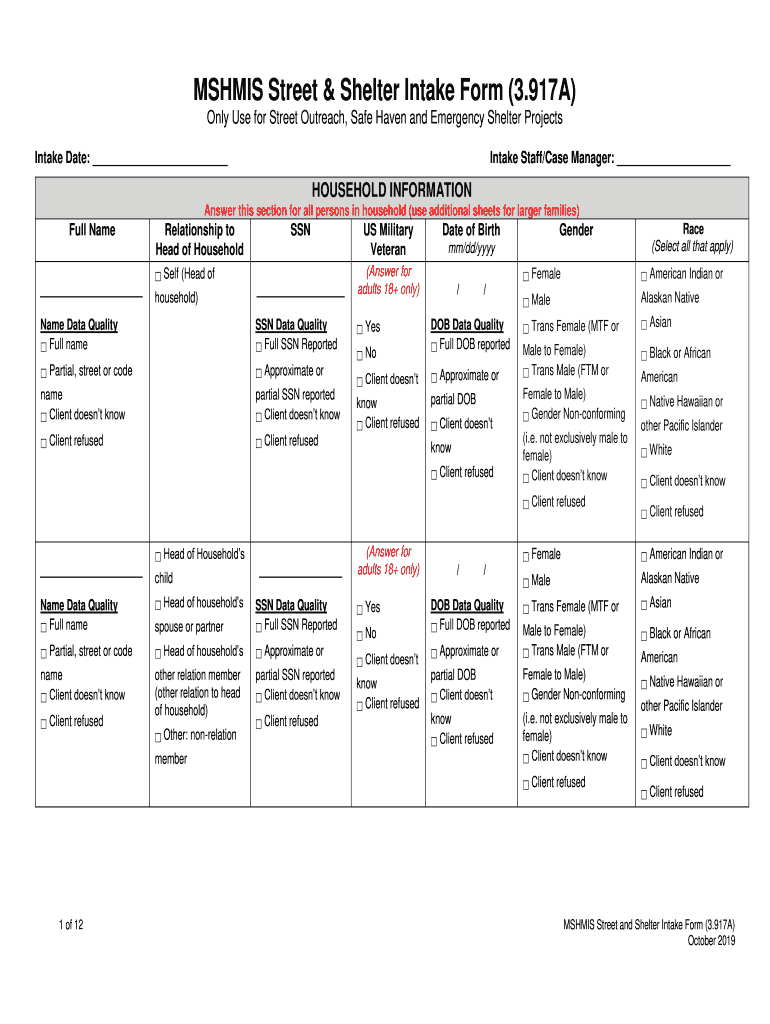







Definition & Purpose of the MSHMIS Street & Shelter Intake Form
The MSHMIS Street & Shelter Intake Form (3.917A) is a comprehensive tool primarily used in street outreach, safe haven, and emergency shelter projects across the United States. It serves as a means to collect essential information regarding individuals experiencing homelessness, facilitating tailored support services. The form records detailed information about household composition, demographic data, disability status, income sources, and current living situations, providing a foundation for assessing a client’s needs.
Key Elements of the MSHMIS Intake Form
Several critical elements characterize the MSHMIS Street & Shelter Intake Form, each serving a specific purpose in gathering comprehensive client information:
-
Personal and Demographic Information: This section captures basic details such as name, age, gender, and ethnicity, which are vital for identifying the individual and understanding demographic trends amongst those experiencing homelessness.
-
Disability Status: This part of the form collects information about any physical or mental disabilities the individual may have, guiding the provision of appropriate support services.
-
Income Sources and Employment: Details about current income sources and employment status are recorded to evaluate financial needs and potential eligibility for economic assistance programs.
-
Housing and Living Situation: This section documents the individual's current and recent living situations, aiding in determining their level of homelessness and eligibility for housing support services.
How to Use the MSHMIS Street & Shelter Intake Form
Professionals working in outreach or shelter environments are the typical users of the MSHMIS form. Here's a step-by-step guide to effectively utilizing it:
-
Gather Initial Information: Begin with the personal and demographic sections to establish a foundational understanding of the individual's background.
-
Assess Needs through Detailed Sections: Use the disability status and income sources sections to formulate an assessment of the client's immediate needs.
-
Determine Service Eligibility: Utilize the housing and living situation information to determine eligibility for various services and programs.
-
Collaborative Completion: It is often beneficial to complete the form with the input of the individual to ensure accuracy and encouragement of transparency.
Steps to Complete the MSHMIS Street & Shelter Intake Form
Completing the MSHMIS form involves several structured steps:
-
Start with Identification: Verify and input accurate identification details to avoid any errors that may complicate service provision.
-
Record Demographics and Personal Data: Carefully fill out the demographic information as required by service guidelines.
-
Evaluate and Note Disabilities: Assess any disabilities that might require specific accommodations or interventions.
-
Input Financial Details: Accurate financial reporting is crucial for eligibility assessment for financial aid and support programs.
-
Detail Living Situations: This helps stakeholders understand the urgency and nature of support required.
-
Review and Finalize: Ensure all sections are complete and accurate before submitting the form for processing.
Who Typically Uses the MSHMIS Street & Shelter Intake Form
The form is extensively used by professionals within the social service sector, including:
- Social Workers: Engage with individuals to gather and fill out accurate data.
- Shelter Staff: Utilize the form for intake and ongoing assessment of residents' needs.
- Case Managers: Use the data collected to develop tailored intervention strategies for each client.
- Policy Makers and Researchers: Aggregate data to understand trends and inform resource allocation.


Legal Use and Compliance
The legal use of the MSHMIS form aligns with several compliance standards:
- Confidentiality Protocols: Adhere to strict confidentiality guidelines to protect client data.
- Data Sharing Regulations: Follow appropriate protocols for sharing information between agencies.
- Record Keeping Requirements: Maintain thorough and accurate records for auditing and accountability purposes.
Examples of Using the MSHMIS Intake Form in Practice
Real-world scenarios illustrate the utility of the MSHMIS form:
- Emergency Shelter Intake: Quickly assess an individual's status and needs upon seeking shelter to prioritize assistance.
- Street Outreach Program: Use the form in the field to capture immediate data from individuals encountered on the streets.
- Data Collection for Research: Aggregate demographic and housing information for studies on homelessness.
State-Specific Rules and Variations
Different states might have adaptations or additional criteria regarding how the MSHMIS form should be completed and processed. It's crucial for practitioners to understand and comply with state-specific guidelines to ensure the accurate capture and use of data.
Digital vs. Paper Version
The form is available in both digital and paper formats, offering flexibility:
- Digital Version: Allows quick updates and easy submissions while reducing paper waste.
- Paper Version: May be necessary in areas with limited digital access or during outreach where technology is not available.
Choosing between these versions typically depends on the resources available and the setting in which data is collected.




