01. Edit your form online
Type text, add images, blackout confidential details, add comments, highlights and more.

Type text, add images, blackout confidential details, add comments, highlights and more.

Draw your signature, type it, upload its image, or use your mobile device as a signature pad.

Send it via email, link, or fax. You can also download it, export it or print it out.
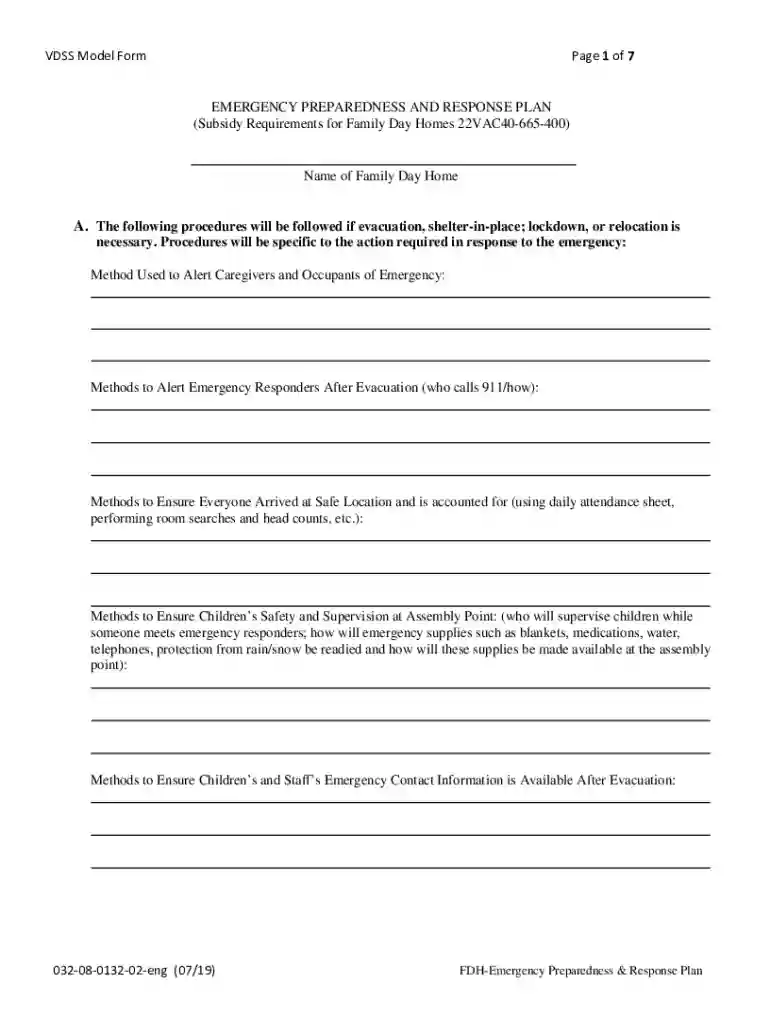
The "VDSS Model Form Page 1 of 7 EMERGENCY PREPAREDNESS" serves as a critical guide for family day homes, providing detailed procedures for various emergency situations. It outlines essential steps for evacuation, shelter-in-place, lockdown, and relocation, ensuring the safety of children and staff. This form is crucial in maintaining a structured plan that covers communication protocols, safety measures, and emergency drills. Its primary purpose is to create a standardized response to emergencies, minimizing risks and ensuring efficient coordination during critical events.
Review Emergency Protocols
Collect Required Information
Customize the Form
Assign Responsibilities
Regular Updates and Training
The VDSS Model Form is primarily used by family day homes and childcare providers in the United States. These institutions rely on the form to create a structured and reliable emergency response plan, ensuring the safety and well-being of children in their care. Additionally, caregivers, staff members, and administrative personnel are key users of the form. It becomes an indispensable tool for daycare operators, helping them comply with legal requirements and industry standards for emergency preparedness.


Adhering to the VDSS Model Form is often a legal requirement for childcare providers and family day homes. Compliance with the form ensures that these institutions meet state-mandated regulations for emergency preparedness and response. Failure to implement an effective emergency plan as outlined in the form can result in legal repercussions, including fines and potential loss of operating licenses. Therefore, it is critical that family day homes incorporate the form into their operational procedures and regularly update their plans to align with any regulatory changes.
Fire Drill Implementation: The form allows daycare centers to simulate fire drills by following the evacuation procedures documented within it, ensuring children and staff know the routes to exit safely.
Severe Weather Preparedness: During a tornado warning, the form's shelter-in-place guidelines provide instructions for securing all occupants in a safe and designated area of the facility.
Lockdown Scenario: If there is a security threat, such as an unauthorized individual on the premises, the lockdown procedures in the form direct staff on how to secure the building and protect children.
Different states may have unique requirements for the implementation and customization of the VDSS Model Form. These variances can include specific compliance criteria, frequency of drills, and detailed reporting obligations. Providers should consult their state’s regulatory body to understand localized mandates and incorporate any state-specific procedures into their emergency plans. This ensures that the form not only serves as a practical guide but also meets all regional legal requirements effectively.
The VDSS Model Form can be both completed online or via paper submission, depending on the provider's preference. Online submission offers advantages such as ease of updates, instant accessibility, and electronic sharing with stakeholders. Traditional paper forms still remain an option for those who prefer physical documentation, although they may involve more manual efforts in updating and disseminating information. The choice between online and paper forms typically depends on the provider's capacity to manage digital documentation and their specific operational needs.
We've got more versions of the VDSS Model Form Page 1 of 7 EMERGENCY PREPAREDNESS form. Select the right VDSS Model Form Page 1 of 7 EMERGENCY PREPAREDNESS version from the list and start editing it straight away!
| Versions | Form popularity | Fillable & printable |
|---|---|---|
| 2019 | 4.2 Satisfied (25 Votes) |
At DocHub, your data security is our priority. We follow HIPAA, SOC2, GDPR, and other standards, so you can work on your documents with confidence.