




01. Edit your form online
Type text, add images, blackout confidential details, add comments, highlights and more.

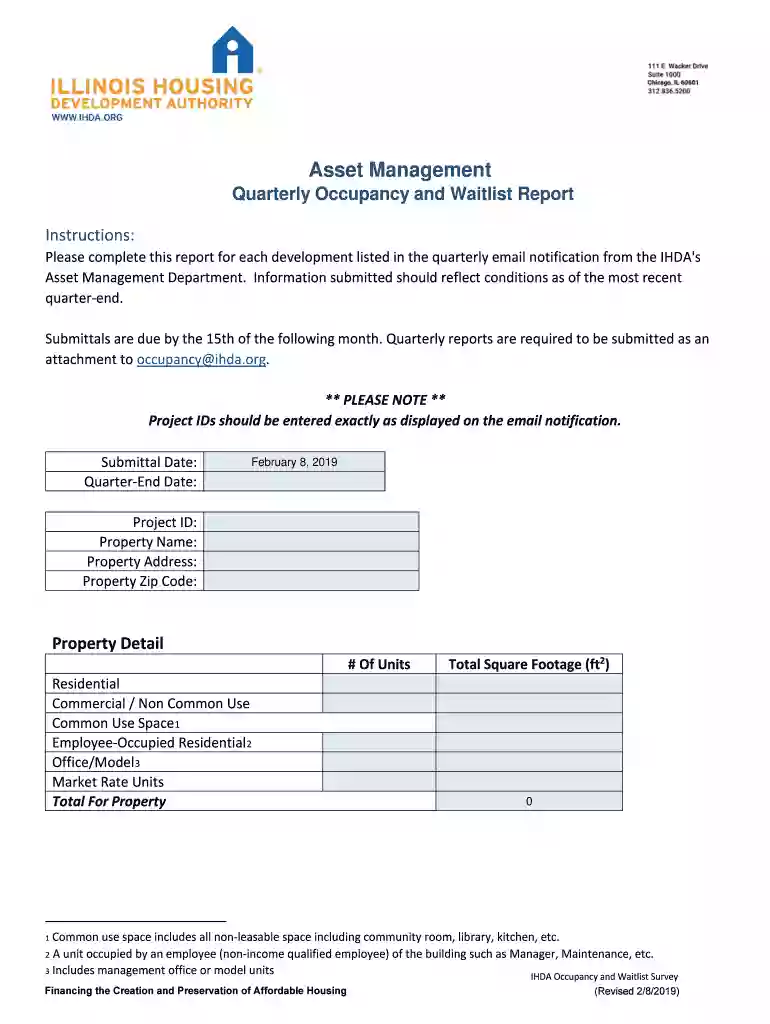
Type text, add images, blackout confidential details, add comments, highlights and more.

Draw your signature, type it, upload its image, or use your mobile device as a signature pad.

Send it via email, link, or fax. You can also download it, export it or print it out.
The "Quarterly Occupancy and Waitlist Report" is a form designed to gather detailed information about property occupancy, waitlist status, and compliance with the Americans with Disabilities Act (ADA). It is typically required by housing authorities, such as the Illinois Housing Development Authority (IHDA), to monitor asset management and ensure that properties maintain compliance with regulatory requirements. This report plays a crucial role in understanding the availability and demand for housing within specific developments, providing insight into potential availability for prospective tenants.
The report consists of several sections, each focusing on different aspects of property management:
Property managers or authorized users typically receive the Quarterly Occupancy and Waitlist Report through official channels, such as email notifications from organizations like IHDA. It may also be accessed through a secure portal provided by the housing authority. In some cases, a physical copy might be mailed directly to the property management office for records.
The primary users of this report include property managers, real estate developers, and housing authority representatives. Property managers use it to report compliance and operational status to their governing bodies, while housing authorities analyze the data to ensure housing needs are met and compliance is maintained across developments.


The report is a vital tool for assessing housing availability and accessibility, providing a roadmap for future development and resource allocation. It enables authorities to identify trends in housing demand and supply, making informed decisions regarding new projects and financial investments. It also ensures accountability and transparency within the property management sector.
Submissions for the report are generally required by the 15th of the month following each quarter. Timeliness is crucial to uphold organizational standards and comply with regulatory requirements. Missing deadlines could lead to penalties or affect the standing of properties under management.
The submission process for this report can be done through various methods, including online portals provided by housing authorities, email submissions, or postal mail. Each method has its specific guidelines, and it is important to follow the prescribed procedure to ensure that the report is received and processed without issues.
Using this report helps ensure compliance with legal and regulatory requirements associated with property management. It serves as an official document certifying properties' adherence to occupancy standards and ADA regulations. Failure to submit or inaccurate reporting can result in legal repercussions and impact property accreditation.
Consider a property management company overseeing several hundred units. Using the report, they can determine which properties are consistently occupied and which have waitlists. If a particular building always has a waiting list, it might justify new developments or expansions.
In another scenario, a housing authority might analyze multiple reports to identify areas where ADA compliance needs improvement, prompting further inspections or enhancement projects. These examples illustrate how crucial the report is for strategic planning and operational excellence in property management.
We've got more versions of the Quarterly Occupancy and Waitlist Report form. Select the right Quarterly Occupancy and Waitlist Report version from the list and start editing it straight away!
At DocHub, your data security is our priority. We follow HIPAA, SOC2, GDPR, and other standards, so you can work on your documents with confidence.
Quarterly, Vol. 29, No. 1 (February 1994), pp. 2229; and. Sheryl E. Kimes and Breffni M. Noone, Perceived Fairness of. Yield Management: An Update, Cornell
Quarterly reports are only required for Hosts with a Tier 3 or Tier 4 license. Hosts with a Tier 1 or Tier 2 license are not required to submit quarterly


